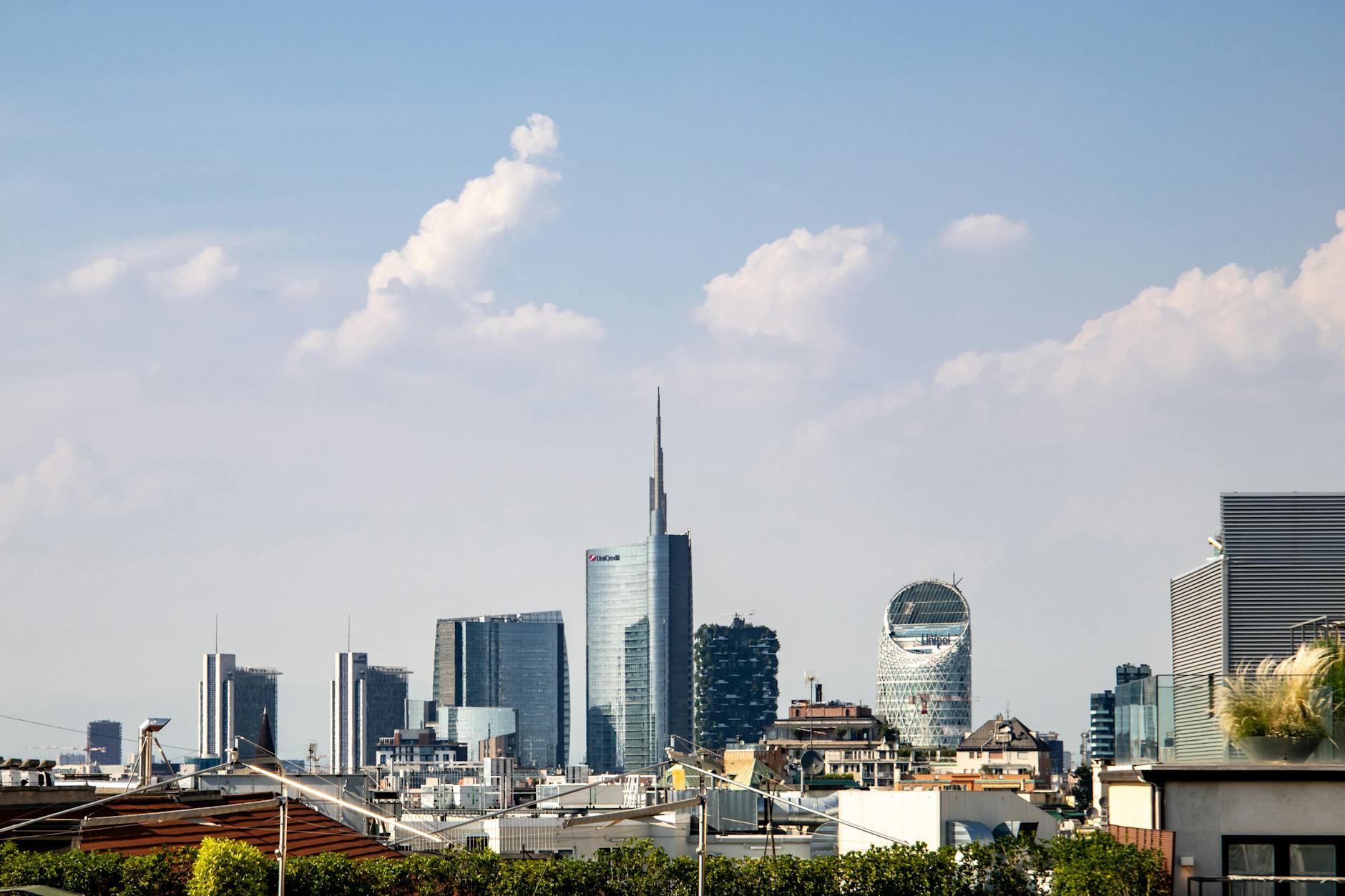
Porta Nuova Milan is the only district in the city where I tell first-time visitors to ignore the guidebook and just walk. You exit the M2 at Porta Garibaldi, climb the escalator past the commuter crowd, and the first thing you see is the Unicredit Tower spire — 231 meters of glass and steel reflecting whatever light Lombardy decided to provide that morning. To the left, the green columns of Bosco Verticale. Behind you, the long curved roof of Stazione Garibaldi. It is the most disorienting two minutes in Milan, and it is free.
This is where most of Milan’s international offices ended up, which is why it turns up first in our Milan business travel guide alongside the rest of the city’s working geography.
I have walked the Porta Nuova area maybe forty times in the last three years. I take every visiting friend here, usually around 6pm, because the light hits the curtain-wall glass and the whole district turns gold for about twenty minutes. This is my actual route, the spots I send people to, and the small practical things — like where you can sit down without paying €18 for a spritz — that the marketing pages skip.
 Bosco Verticale Milan Porta Nuova” class=”wp-image-548″ srcset=”https://www.milantourism.org/wp-content/uploads/2026/05/porta-nuova-milan-1-bosco-verticale-milan-porta-nuova.jpg 1880w, https://www.milantourism.org/wp-content/uploads/2026/05/porta-nuova-milan-1-bosco-verticale-milan-porta-nuova-300×200.jpg 300w, https://www.milantourism.org/wp-content/uploads/2026/05/porta-nuova-milan-1-bosco-verticale-milan-porta-nuova-1024×682.jpg 1024w, https://www.milantourism.org/wp-content/uploads/2026/05/porta-nuova-milan-1-bosco-verticale-milan-porta-nuova-768×512.jpg 768w, https://www.milantourism.org/wp-content/uploads/2026/05/porta-nuova-milan-1-bosco-verticale-milan-porta-nuova-1536×1024.jpg 1536w” sizes=”auto, (max-width: 1880px) 100vw, 1880px” />
Why Porta Nuova is worth seeing (even if you don’t care about architecture)
Most people approach Milan’s modern district as an architecture pilgrimage. Bosco Verticale check, Unicredit Tower check, photo of the fountain check, back on the metro. That misses the point. Porta Nuova is the only neighborhood in Milan where you can stand in a public square at street level and feel the city the way Milanesi who work here feel it on a Tuesday lunch break.
The whole district was built between 2009 and 2015 on a derelict railway yard. Before that it was a no-go zone of warehouses and chain-link fences. Now it is the headquarters of Unicredit, Google Italy, BNP Paribas, Amazon, and roughly thirty other companies that pumped about €2 billion into the project. The result is the closest thing Italy has to a planned modern urban district, and unlike most planned modern urban districts, it actually works.
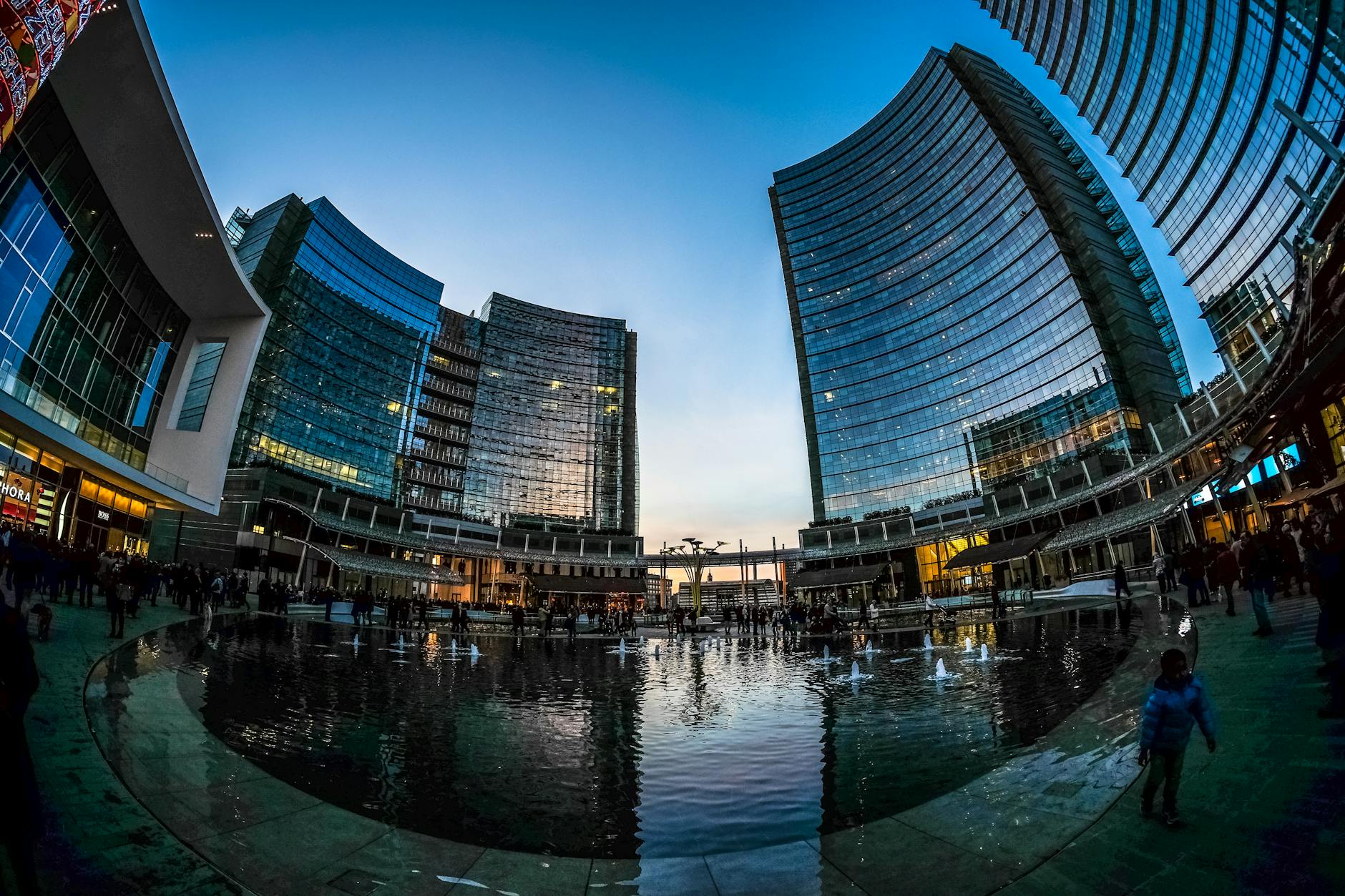
Three reasons it is worth your afternoon. First, the scale is human. Piazza Gae Aulenti is raised six meters above street level, which sounds odd until you stand there and realize the elevated plaza buffers you from traffic noise — it is quieter than Brera at the same hour. Second, the photo angles are genuinely unique in Italy; there is nowhere else in the country where a 1,000-tree residential tower frames a 231-meter skyscraper across a circular fountain. Third, it is one of the few central Milan districts where you can comfortably bring kids, a stroller, or a wheelchair — every transition is ramped, the pavement is flat, and the BAM park has actual grass.
If you are deciding whether to skip it for another Duomo visit: don’t. Porta Nuova is the counterweight that makes the rest of Milan make sense. The city is not just Renaissance courtyards and tram-lined boulevards. It is also this.
How to get to Porta Nuova
The easiest entrance is M2 (green) or M5 (lilac) Garibaldi FS. Both lines stop at the same interchange under the train station, and you want exit “Piazza Gae Aulenti” — it dumps you onto the elevated plaza via escalator. From the Duomo, M3 yellow to Centrale, then change to M2 green for two stops. Total time about 12 minutes, €2.20 on a single ticket.
From Brera, walk. It is fifteen minutes north up Via Solferino, and the route takes you past three good bookshops and the Fondazione Corriere della Sera. I prefer this approach because you pop out at the south edge of Corso Como rather than the elevated plaza, which gives you the proper “old Milan ends, new Milan begins” moment. The Milan transport guide has more detail on which day passes make sense if you are planning multiple neighborhood hops.
From Navigli, take tram 2 from Porta Genova to Bastioni di Porta Nuova, then walk five minutes north. From Malpensa, the Malpensa Express terminates at Cadorna; switch to M2 there and ride seven stops to Garibaldi. From Linate, the M4 blue line connects to M2 at San Babila in about twenty minutes.
One quiet tip: if you are coming from Isola, do not take the metro one stop. Walk across the De Castillia footbridge that crosses the railway tracks. You get the best frontal photo of Bosco Verticale from the middle of that bridge, and almost no tourist knows it exists.
A 2-hour Porta Nuova walking route
This is the route I do with friends. It covers roughly 3 kilometers, ends at a bar, and assumes you start at the Garibaldi metro exit.
- 0:00 — Piazza Gae Aulenti. Walk to the central fountain, then to the eastern railing. From here you get the full vertical sweep: Unicredit Tower above, Bosco Verticale to the right, the curved Diamond Tower in the distance.
- 0:20 — Down the eastern stairs to BAM (Biblioteca degli Alberi). The park is a 95,000-square-meter botanical garden with about 500 trees and 90,000 plants, all free, open dawn to midnight. Walk diagonally across it.
- 0:45 — Base of Bosco Verticale. Stand directly under the smaller tower (76m) and look straight up. Most people shoot from across the street and miss this angle.
- 1:00 — Via Confalonieri toward Isola. Cross under the elevated metro, into the old neighborhood. Coffee stop at Frida or Deus Cafe.
- 1:30 — Back via De Castillia footbridge. Best skyline shot of the trip.
- 1:45 — Corso Como. Pedestrian, cobbled, full of overpriced boutiques and one genuinely interesting concept store.
- 2:00 — Drink at Radio Rooftop or Princi. Pick based on your budget.
What to see in Porta Nuova
- Piazza Gae Aulenti. The circular elevated plaza, opened December 2012, named after the architect who renovated the Musée d’Orsay. Free, 24/7, with three fountains synchronized to a light sequence at night. Come back after 9pm to see the LED grid on the Unicredit Tower run its colored animation — it loops every 15 minutes and is genuinely worth waiting for.
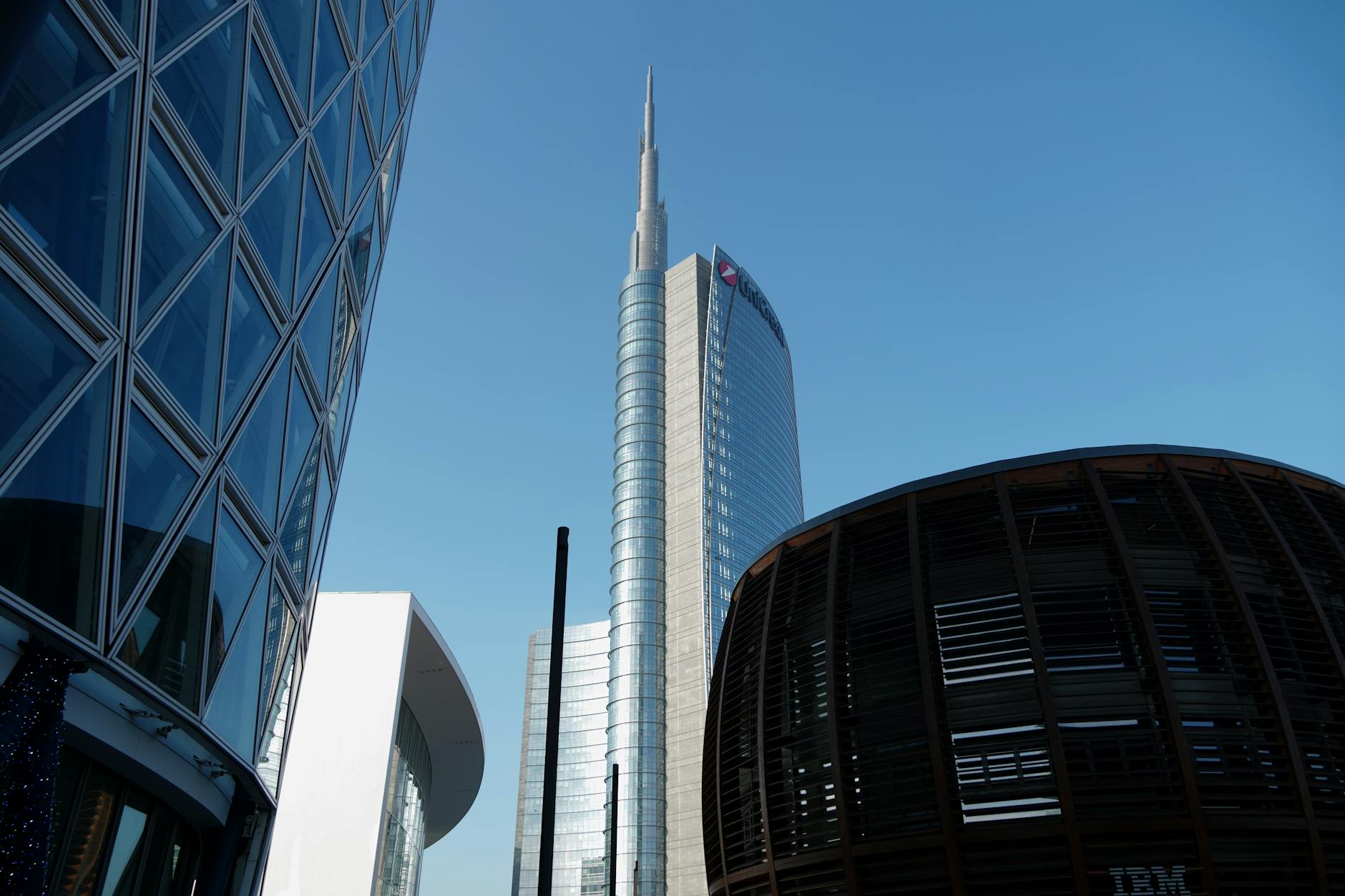
- Unicredit Tower. 231 meters to the roof, 238 meters with the spire — the tallest building in Italy. Designed by César Pelli (also Petronas Towers, KL). There is no observation deck open to the public, which surprises everyone. For panoramic views you want the 39th floor of Palazzo Lombardia, about 600 meters east, which opens to the public on Sundays 10am-6pm and is free. I cover this in the Milan attractions guide.
- Bosco Verticale. Stefano Boeri’s twin residential towers (111m and 76m), completed 2014, planted with about 800 trees, 4,500 shrubs, and 15,000 perennials. You cannot go inside — it is a private apartment building, and the residents are firm about that. You can stand at the base, walk through the courtyard between the towers, and photograph from BAM park or De Castillia footbridge. The trees change color seasonally; October is the best month for autumn foliage shots.
- BAM (Biblioteca degli Alberi). “Library of Trees” — a 95,000 sqm public park designed by Dutch firm Inside Outside. Free, open 24 hours. Hosts free yoga classes Saturday mornings at 10am from April through October. Good place to sit with a book or a takeaway lunch from Eataly.
- Diamond Tower (Torre Diamante). The faceted 140-meter tower on the eastern side of the district. Headquarters of BNP Paribas. Office building only, no public access, but it is one of the most photogenic skyscrapers in the city because of the way the glass facets reflect the sky in fragments.
- Corso Como. Pedestrian cobbled street linking Porta Nuova to Brera. About 250 meters long, lined with boutiques, gelaterias, and the famous concept store at number 10.
- Stazione Garibaldi. Worth a 10-minute walk through. The 1963 modernist station was renovated in 2013, and the curved canopy roof is itself an architectural piece. The platforms also serve regional trains to Como, Bergamo, and Lecco if you want a day trip.
- Casa della Memoria. A small 2015 brick building on Via Federico Confalonieri, dedicated to the victims of Italian terrorism, the Resistance, and the Holocaust. Free, often empty, and a quiet counterweight to the corporate gloss around it.
- UniCredit Pavilion. The curved wooden building on the edge of Piazza Gae Aulenti hosts rotating exhibitions, often free. Worth checking the schedule.
Where to eat and drink in Porta Nuova
Porta Nuova is expensive. There is no way around it — this is a corporate district, and lunch options are priced for expense accounts. But there are five spots I genuinely recommend, ranging from a €4 coffee to a €25 plate.
Princi (Piazza XXV Aprile, southern edge of the district). The Milanese bakery chain that Starbucks copied. Coffee €1.50 standing at the counter, focaccia slices around €4, sit-down breakfast around €8. Open 7am to 8pm. The southern branch on Piazza XXV Aprile is the largest and has outdoor seating that catches the morning sun. This is my default coffee stop before walking the district.
Berberè (Via Sebenico 21, technically in Isola, 5 minutes from Bosco Verticale). Wood-fired Neapolitan-style pizza with sourdough crust, pizzas €10-14, perfect lunch spot if you want to escape the corporate canteens. Book ahead for dinner, especially Friday and Saturday. The things to do in Milan guide lists more nearby food stops.
Eataly Smeraldo (Piazza XXV Aprile 10). The flagship Eataly in a converted theater, three floors of food halls plus a fish counter, a butcher, a pasta bar, and a rooftop trattoria. Lunch counter pasta €9-12, sit-down meals €15-25. Open 8:30am to midnight. Buy ingredients for a BAM picnic from the ground floor — a hunk of focaccia, mortadella, and an apple comes to about €8.
10 Corso Como Café (Corso Como 10). The café inside the famous concept store, set in a vine-covered interior courtyard that the street outside hides completely. Coffee €4, cocktails €15-18, lunch around €25. Worth it for the courtyard alone — sit there with an espresso for half an hour and you will see why this place has lasted since 1990. The store, gallery, and bookshop are free to browse even if you do not buy anything.
Radio Rooftop (ME Milan Il Duca, Piazza della Repubblica 13). Rooftop bar on the 14th floor with a 270-degree view that includes Unicredit Tower and Bosco Verticale. Cocktails €18-22. Go at 7pm in summer to catch sunset on the skyline. Reservations required Thursday through Saturday. This is the rooftop I send people to when they want one drink with a view rather than a full dinner.
For coffee under €2, the standing counter at any local bar on Via Galvani or Corso Como will do it. The €4 coffee is a Porta Nuova thing, not a Milan thing.
Practical tips
A few things I wish someone had told me the first time.
Best photo time: golden hour, which in Milan means roughly 7:30pm in June and 4:30pm in December. The Unicredit Tower’s east-facing glass catches the sunset reflection and the entire piazza turns amber for about 15 minutes. Shoot from the western railing of Piazza Gae Aulenti looking back toward the tower, or from the De Castillia footbridge looking at Bosco Verticale.
Free vs paid views: the district itself is entirely free to walk through. Piazza Gae Aulenti, BAM park, the area around Bosco Verticale — all free, all 24/7. The only paid experience is a paid architecture tour, which runs about €25-35 through GetYourGuide or Viator and is worth it only if you want the historical context. For a free elevated view, take the escalator from street level up to Piazza Gae Aulenti and walk to the eastern railing — that is a 6-meter elevated platform with the best free angle in the district. Milan’s photography spots guide lists the other free skyline points.
Toilets: there are public toilets at the base of Unicredit Tower (free, surprisingly clean), inside Eataly Smeraldo (free, basement level), and at Stazione Garibaldi (€1, turnstile). Most cafés will let you use the bathroom only if you order something.
Crowds: the Porta Nuova area does not get tourist crowds in the way the Duomo or Chinatown do, but it gets office-worker crowds on weekday lunches (12:30-2pm). Avoid that window if you want photos without suits in the foreground.
Weather: the elevated plaza is exposed and windy. In January and February the wind tunnel between the Unicredit Tower and Diamond Tower is brutal. Bring a coat heavier than you think you need.
Pickpockets: rare here compared to Duomo or Centrale, but not zero. Standard precautions.
Best time to visit Porta Nuova
Late afternoon on a weekday is the right answer. Specifically, I would aim for a Wednesday or Thursday, arriving around 4pm, lingering through golden hour, and staying for the light show on the Unicredit Tower at 9pm.
Weekday mornings are dead — the office workers are inside, and the piazza feels strangely empty. Weekday lunches are the opposite, packed with suits queuing at the food trucks behind the tower. Weekend afternoons are the busiest tourist window, with the crowd peaking around 3pm Saturday.
By season: April through June is the best window, when BAM is in full bloom and the Bosco Verticale leaves are fresh green. October is the second-best for autumn color. July and August are uncomfortably hot — the elevated plaza has no shade and the glass reflects heat in every direction. December is cold but the Christmas lights on Corso Como are worth a 30-minute detour, and the temporary ice rink on Piazza Gae Aulenti usually runs from mid-November through early January.
Avoid the Salone del Mobile week in mid-April. The district turns into a corporate event zone, everything is booked, and prices double.
Where to stay near Porta Nuova
The Porta Nuova district proper is mostly office buildings and luxury apartments, so the hotel options are limited and expensive. The realistic move is to stay in the surrounding districts and walk in.
For luxury (€400+/night): the ME Milan Il Duca on Piazza della Repubblica is the closest, with the Radio Rooftop bar mentioned above. The Hotel Principe di Savoia, also on Repubblica, is the grande dame option.
For mid-range (€180-300/night): stay in Isola. The B&B Hotel Milano Cenisio Garibaldi and the NYX Hotel are both 10 minutes’ walk from Bosco Verticale and significantly cheaper than anything inside Porta Nuova. Bonus: Isola has the better dinner scene anyway.
For budget (€90-160/night): look at Porta Venezia or Porta Romana, both 15 minutes by metro. Both have proper neighborhood character, better food, and rooms at half the Porta Nuova price. The full where to stay in Milan guide compares all the districts side by side.
One area I would skip for accommodation: the immediate Stazione Garibaldi blocks. The station-adjacent hotels are noisy, often dated, and you are paying a station premium for a location that is not actually convenient to anything except the train.
Porta Nuova FAQ
Is Porta Nuova worth visiting?
Yes, especially if you have already seen the Duomo and want to understand modern Milan. Two to three hours is the right amount of time. Half a day if you fold in dinner in Isola.
Can you go inside Bosco Verticale?
No. The towers are private residences and the lobby is closed to non-residents. You can walk through the public courtyard between the two towers and photograph from BAM park or De Castillia footbridge. Some architecture tours include a lobby visit but this is rare and depends on the residents’ association.
Is there an observation deck at the Unicredit Tower?
No. The tower is private office space. For the highest public view in Milan, go to the 39th floor of Palazzo Lombardia, open Sundays 10am-6pm, free. Other options include the Duomo terraces and Torre Branca in Parco Sempione.
How long do you need in Porta Nuova?
Two hours covers the main loop — Piazza Gae Aulenti, BAM, Bosco Verticale, Corso Como — at an unhurried pace with photo stops. Add an hour for a sit-down meal, or two if you continue into Isola for dinner.
Is Porta Nuova safe at night?
Yes. It is one of the safest districts in central Milan after dark, partly because of constant security at the office buildings and partly because the elevated plaza is well-lit and pedestrianized. The light show on the Unicredit Tower at night is worth staying for.
What is the difference between Porta Nuova and Isola?
Porta Nuova is the corporate, glassy, planned new district built 2009-2015. Isola is the older bohemian neighborhood immediately north, separated only by a railway. Porta Nuova is for architecture and skyline; Isola is for dinner, drinks, and vintage shops. Most people who enjoy one will want to spend time in both — they are a 5-minute walk apart. The Milan neighborhoods guide goes deeper on how the districts fit together, including how Porta Nuova compares to Città Studi on the east side.
Final thoughts
Porta Nuova is the district that changes how you think about Milan. You arrive expecting another Italian city of Renaissance courtyards and Gothic spires, and instead you stand on an elevated plaza surrounded by Italy’s tallest buildings, with a 1,000-tree apartment building reflecting in a fountain, and the whole thing somehow does not feel like a corporate showpiece. It feels like a working district where people live, work, drink coffee, and walk their dogs.
That is the part the photos miss. The Bosco Verticale shots online look like a render. In person, you can hear birds in the trees on the 18th-floor balconies, and you can watch a resident on the 22nd floor watering basil in a planter. The Unicredit Tower at night does the LED show and a kid points at it. The fountain runs and someone’s dog tries to drink from it.
Come at 4pm on a Wednesday. Walk the route above. Stop at Princi for coffee, eat a slice of focaccia in BAM, cross the footbridge for the skyline shot, end at Radio Rooftop with a spritz at sunset. Two hours that justify the rest of the day spent elsewhere in Milan. That is what Porta Nuova is for.
Related Milan guides
Keep planning with our other Milan neighborhoods guide resources: