You can walk through it in ninety seconds, or you can stand under its glass dome and lose an hour. Most people do the first by accident on their way from the cathedral to the opera house, and then wish they had done the second.
The Galleria Vittorio Emanuele II is Milan’s grand nineteenth-century shopping arcade, a soaring glass-and-iron cathedral of commerce linking Piazza del Duomo to Piazza della Scala. Opened in the 1870s, it is free to walk through, open day and night, and home to luxury flagships, historic cafés and a famous good-luck ritual involving a mosaic bull.
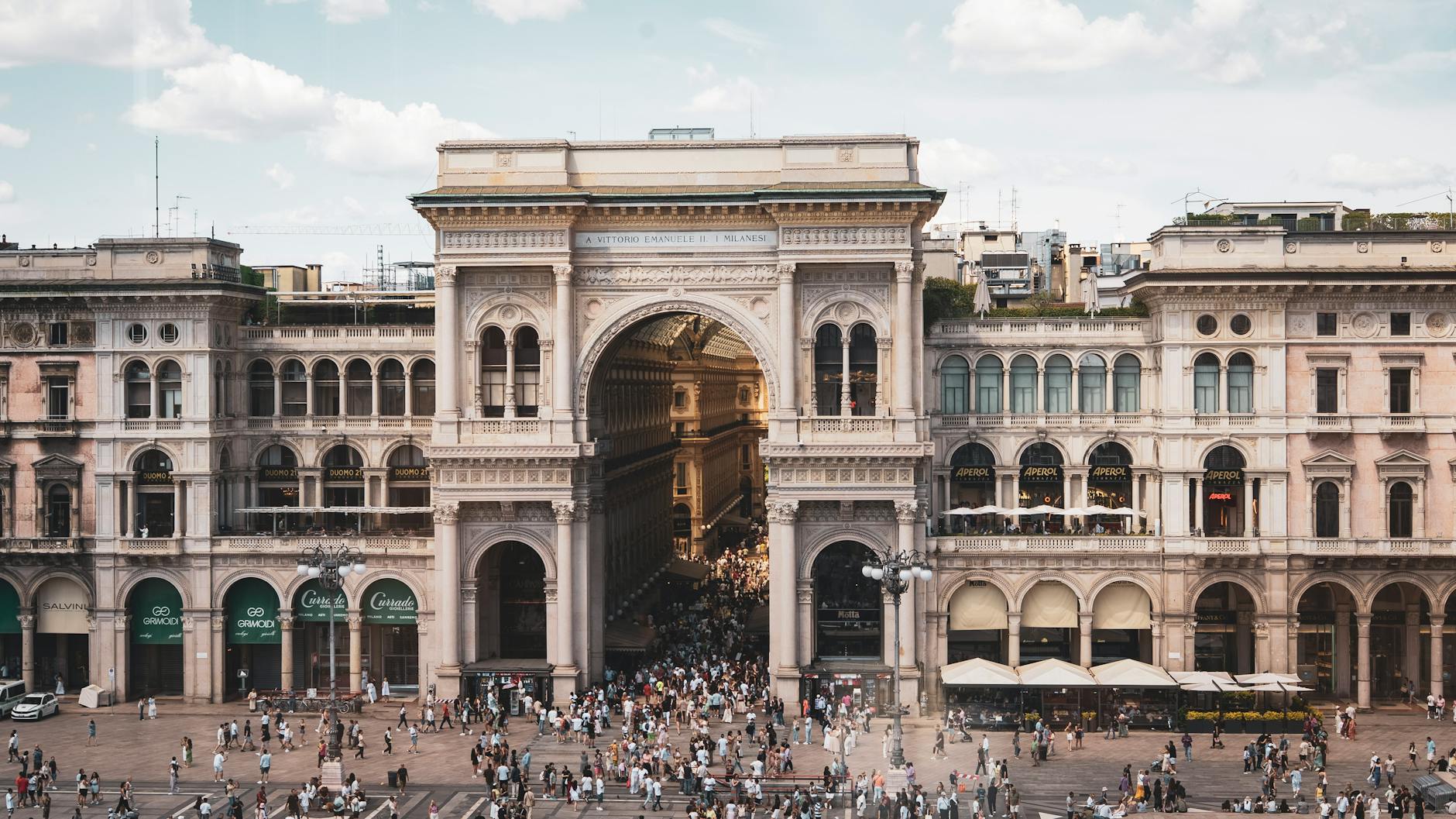
Milanese call it “il salotto di Milano” — the city’s drawing room — and the name fits. This is where the city has come to see and be seen for a century and a half, and it remains, for my money, the single most beautiful interior you can enter in Milan without paying a cent. Here is everything worth knowing before you go, from the architecture overhead to the bull beneath your heel.
What the Galleria Vittorio Emanuele II actually is
Built between 1865 and 1877 and named for Vittorio Emanuele II, the first king of a newly unified Italy, the Galleria was designed by the architect Giuseppe Mengoni as a covered street — a then-radical idea borrowing from the glass-roofed arcades of Paris and London but built on a far grander scale. Two glass-vaulted passages cross in the middle beneath an enormous glass-and-iron dome, an engineering showpiece of its age.
The story Milanese love to tell is a dark one. Mengoni fell to his death from the scaffolding in 1877, just days before the official inauguration. Whether it was an accident or something sadder has never been settled, and the tale clings to the building like the city’s own ghost story. Look up at the dome and it is easy to feel the weight of the ambition that went into it.
Today the Galleria sits at the very centre of the city’s sightseeing, a covered shortcut between the two landmarks every visitor wants — the Duomo and the Teatro alla Scala. If you are building a tight day in the city, our Milan in one day itinerary routes you straight through here, and the wider Milan attractions guide places it among the must-sees.
Look up: the architecture and the dome
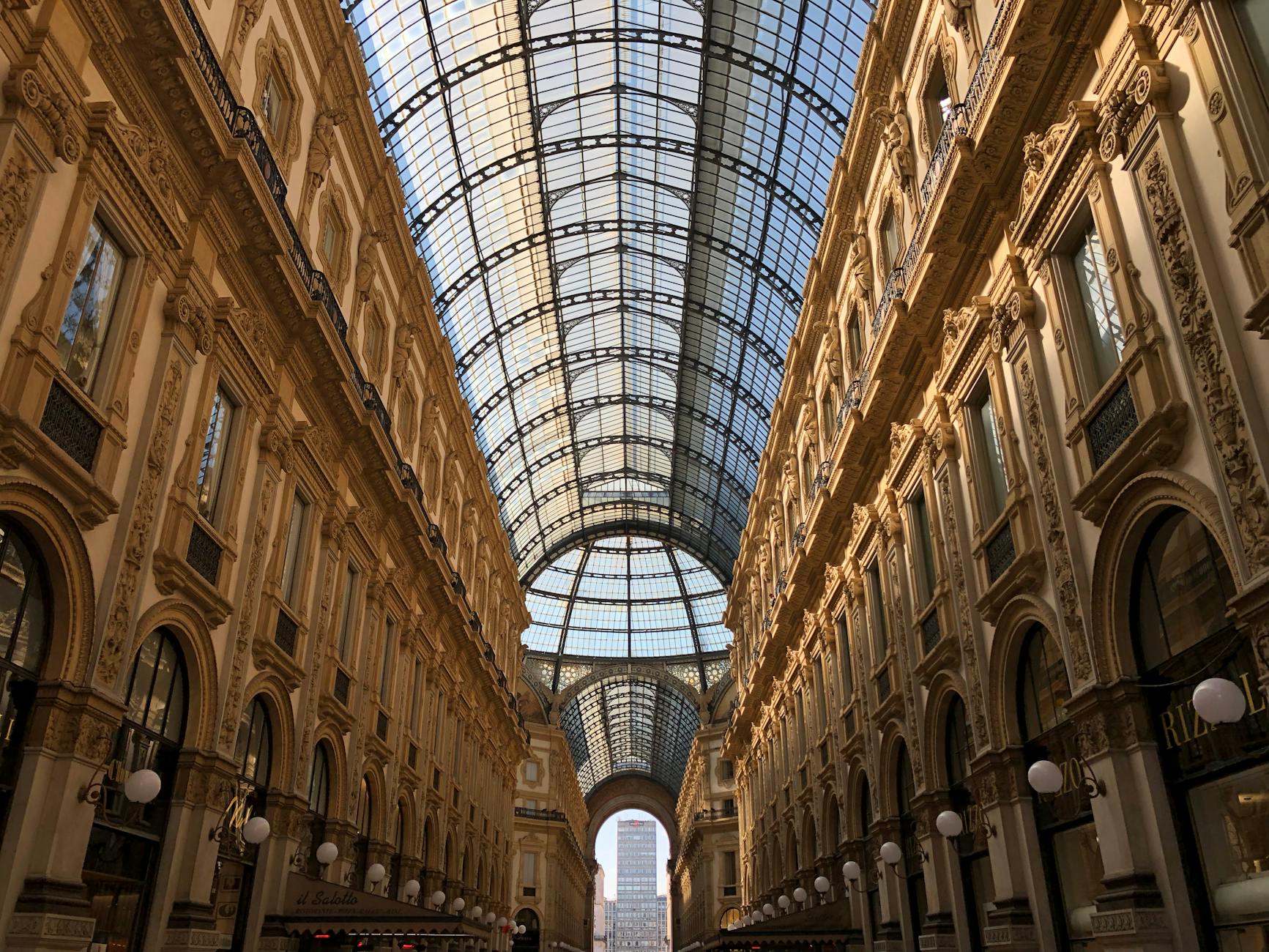
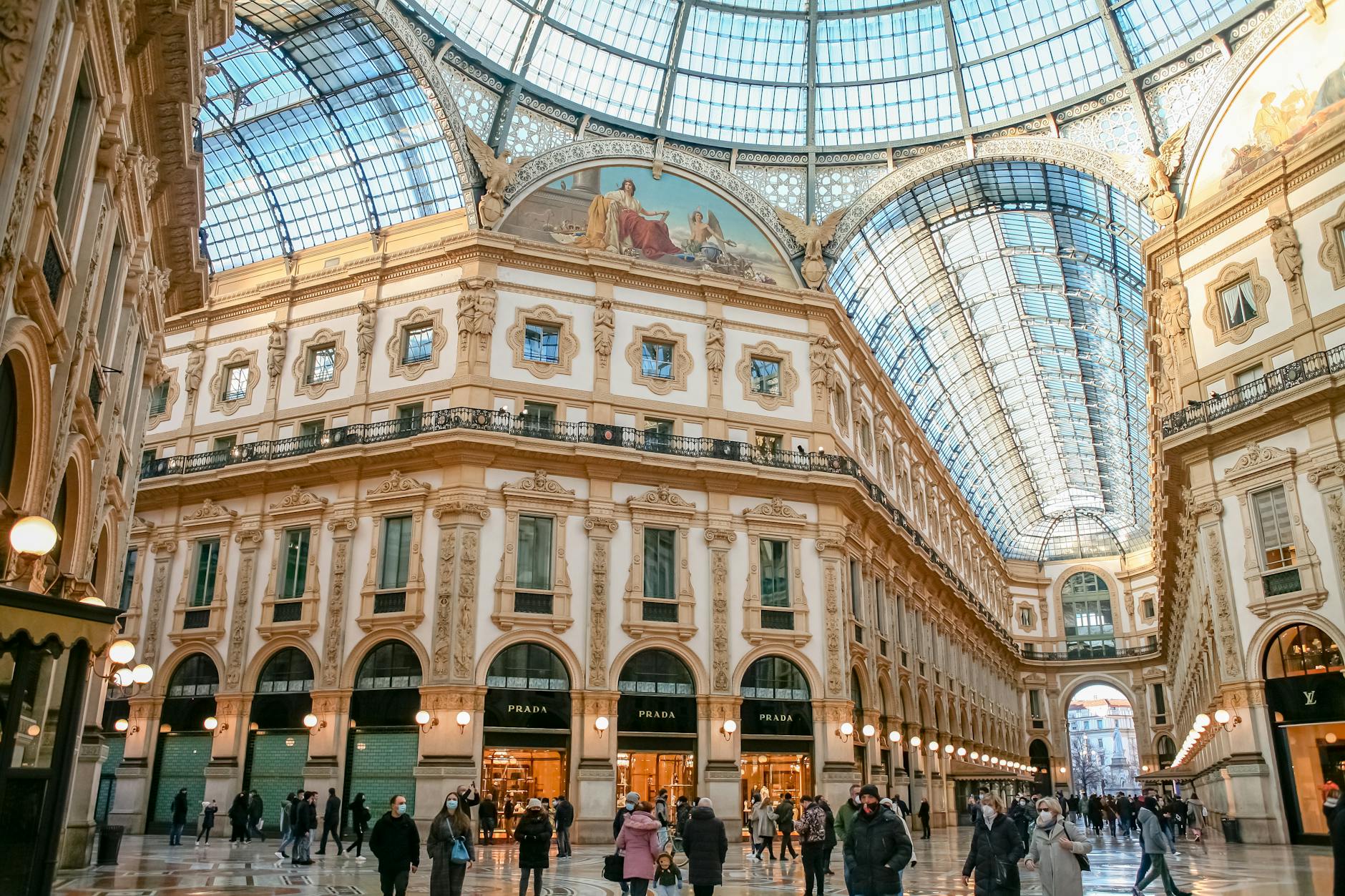
The first thing to do is stop walking and look up. The central octagon is the showstopper: four arched glass passages meeting under a 47-metre dome, the iron ribs painted to read almost like stone, the glass catching whatever light Milan’s sky is offering that day. On a bright morning it glows; on a grey one it has a moody, cinematic quality I love just as much.
Around the upper level run lunettes and frescoes representing the continents — Europe, Asia, Africa and America — and personifications of art, science, agriculture and industry, the proud themes of a confident young nation. It is one of the best photography spots in Milan, though you will be sharing the frame with a few hundred other people; come early if you want a clean shot.
The mosaic floor and the lucky bull
Now look down. The floor is a carpet of mosaic, with the coats of arms of the three other capitals of the Kingdom of Italy set into the octagon: the white cross of Turin’s bull, the she-wolf of Rome, the lily of Florence. Find the Turin bull and you will notice a small crater worn into the tiles right where its, ahem, most delicate anatomy should be.
The tradition goes that if you place your heel on the bull and spin around three times, you will have good luck — or, depending on who is telling it, you will return to Milan one day. Locals are gently amused by the queue of tourists doing the spin, but everyone does it anyway, and the floor is repaired every few years because so many heels have worn it through. It is a daft little ritual and you should absolutely take part.
Shopping in the Galleria
The Galleria has been a luxury address since it opened, and it still is. The original Prada store has occupied a corner here since 1913 — the brand was born in Milan and this is its ancestral home — and it sits alongside flagships for Louis Vuitton, Versace, Gucci and other heavyweights. Even if your budget says window-shopping only, the storefronts are part of the spectacle, all polished brass and theatrical display.
This is high-end territory, so go in with eyes open. If you are a non-EU visitor planning a serious purchase, read our guide to tax-free shopping in Milan first, because the VAT refund on a luxury bag is worth claiming properly. For ideas on what actually makes a good buy here versus elsewhere, our overview of what to buy in Milan is honest about where the value is. And the Galleria is really the ceremonial gateway to the wider Quadrilatero della Moda, the luxury grid a few streets north, which our full Milan shopping guide covers end to end.
The historic cafés and restaurants
For me, the Galleria is best enjoyed with a drink in hand. Camparino in Galleria, on the Duomo-facing corner, opened in 1915 and is the spiritual home of the Campari aperitivo — order a Campari soda or a Negroni, stand at the historic bar or pay for a table, and watch the arcade flow past. It is touristy and the table service is not cheap, but the setting is unrepeatable. Our Milan aperitivo guide explains the ritual and where else to drink one.
Upstairs, the historic Savini restaurant has been serving since 1867, a grande-dame address for risotto alla milanese and old-school ceremony. For something simpler, the Galleria’s cafés will pour you an espresso at a standing bar for a couple of euros — far better value than a seated drink, and very Milanese. Our Milan coffee guide has the etiquette down if you want to do it like a local.
Walking on the roof: the Highline Galleria
Here is the part most visitors miss entirely. You can go up onto the roof of the Galleria via the Highline Galleria, a panoramic walkway along the iron-and-glass roofline that gives you the Duomo’s spires at eye level and a view down into the arcade. It is a paid ticket and hours vary by season, so check before you go, but as one of the city’s quieter hidden gems it is well worth the climb.
Practical tips for visiting
The Galleria is free and, as a public passage, effectively always open — the shops keep their own hours, but you can walk through and photograph it late at night when the crowds have thinned and the lights make it magical. The nearest metro is Duomo, served by lines M1 and M3, and you will pass through almost inevitably if you are visiting the cathedral. It pairs naturally with the museums and the La Scala opera house at its northern end.
Because it costs nothing, it earns a place on our list of free things to do in Milan and on any sensible plan for things to do in Milan. The best times to visit are early morning, when the light is soft and the floor is nearly empty, or late evening for that lit-up, after-hours atmosphere. Avoid the midday crush if you can; our notes on the best time to visit Milan apply here in miniature. If you want to stay within strolling distance, the hotels near the Duomo put the Galleria on your doorstep, and the artsy lanes of Brera are a short walk beyond La Scala for an unhurried afternoon.
Frequently asked questions
Is the Galleria Vittorio Emanuele II free to visit?
Yes. Walking through the arcade and admiring the dome, frescoes and mosaic floor costs nothing, and as a public passageway it is accessible day and night. You only pay if you shop, sit down for table service at one of the cafés, or buy a ticket for the Highline Galleria rooftop walkway. It is one of the best free experiences in central Milan.
What is the bull tradition in the Galleria?
Set into the mosaic floor is the coat of arms of Turin, featuring a bull. Tradition says that if you place your heel on the bull and spin around three times, you earn good luck and a return to Milan. So many people do it that the tiles wear through and are periodically repaired. It is a fun, harmless ritual — join the queue and give it a spin.
How long should I spend at the Galleria?
Passing through takes a couple of minutes, but to do it justice give it twenty to thirty: time to look up at the dome, find the mosaic bull, peer into the flagship windows and perhaps stand at a bar for an espresso or an aperitivo. Add an hour if you book the Highline rooftop walkway or sit down for a proper drink.
Where is the Galleria and how do I get there?
The Galleria opens directly off Piazza del Duomo on one side and Piazza della Scala on the other, in the dead centre of Milan. The nearest metro station is Duomo on lines M1 (red) and M3 (yellow), and countless trams and buses stop nearby. If you are visiting the cathedral, you will almost certainly walk through it without trying.
Final thoughts
The Galleria is the rare landmark that delivers whether you have two minutes or two hours. Rush through it and you will still catch your breath under that dome; linger, and you will find a Campari, a lucky bull, a rooftop view and a slice of the city’s nineteenth-century swagger that still feels alive. It is free, it is central, and it is unmistakably Milan — start here, then let our Milan shopping guide lead you out into the rest of the Quadrilatero.