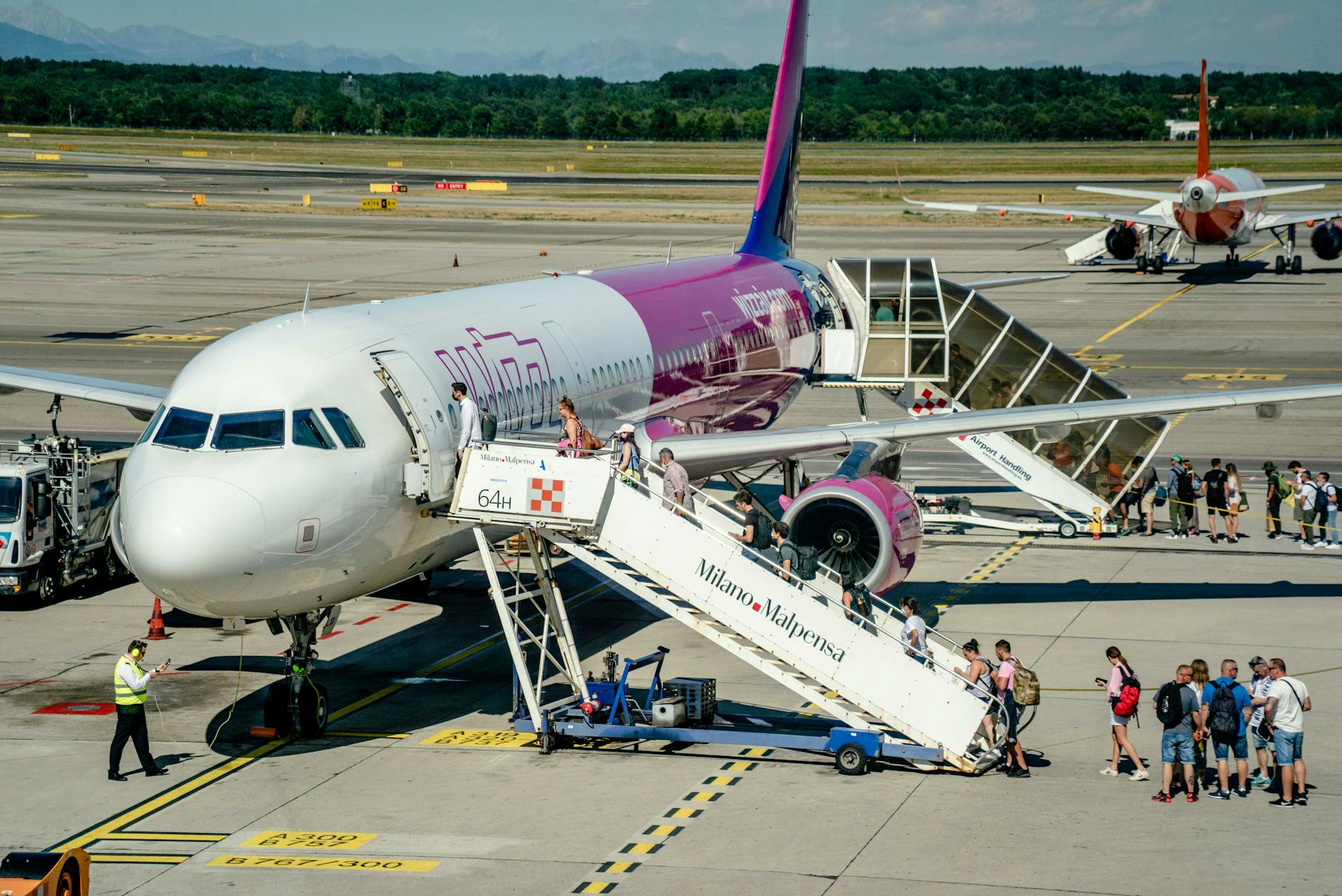
The Malpensa Express stops running at about 00:20 and does not start again until roughly 05:30. That five-hour hole is the single most expensive fact in Milanese air travel, and the people who fall into it are almost always the ones who booked the cheap late flight without checking what happens at the other end.
It is a solvable problem. It is just not solvable at 00:45 in an arrivals hall with a dying phone battery, which is when most people start trying.
Malpensa at night still works: the airport stays open, coaches cover part of the overnight window, and the fixed €114 taxi to the city centre runs 24 hours regardless. Linate is the easiest of the three because the M4 metro runs to about 00:30, but it has a night curfew, so a badly delayed flight can be diverted to Malpensa instead. Bergamo is the hardest, with coaches timed around scheduled arrivals rather than delayed ones. Once you reach the city, night buses NM1 to NM4 replace the closed metro lines from around 00:30 to 05:30, every thirty minutes, on ordinary tickets. And the taxi meter switches to a night rate from 21:00.
Malpensa after midnight
Malpensa has no night curfew, so flights do land here at unsociable hours and the terminal is set up for it. Terminal 1 stays open, there is lighting, seating, security presence and at least some food. It is not a hostile place to spend a few hours.
Your options, in the order I would try them:
- The last train. If you land before about 23:30 and travel light, you can usually still make the final Malpensa Express at around 00:20. Check the actual last departure on the platform board, not on a blog — and if your bags are in the hold, be realistic about the forty minutes reclaim can take.
- The overnight coach. Coaches run later than the train and restart earlier, with departures broadly timed around the arrivals bank. They do not run continuously all night. Check the operator’s timetable before you fly.
- The official taxi. The €114 flat rate to central Milan is fixed by the city and applies at any hour. It is the reliable answer, it is expensive, and for two or more people it stops being outrageous.
- A pre-booked transfer. Similar money, with a driver holding a sign. Worth it if you are arriving with children or on a flight you already know is delayed.
- Wait for the first train. At around 05:30, perfectly viable if you land at 03:00 and have somewhere to sit. Less viable at 00:45, when you are looking at five hours.
The genuinely useful trick, if your inbound flight is one of the notorious late arrivals, is to book a hotel by the airport in advance rather than deciding on the night. A room ten minutes away often costs less than the taxi and buys you a bed — our guide to hotels near Malpensa airport covers which ones run shuttles at that hour, which is the only question that matters at 01:00.
Linate after midnight — and the curfew problem
Linate is the easiest late arrival in Milan, right up until it is the worst.
The easy part: the M4 metro runs until around 00:30, and its late finish was deliberately designed to catch the last flights of the evening. Land at 23:40, clear a small border hall, walk downstairs, and you are at San Babila for €2.20 twelve minutes later. There is no other airport in Italy where a near-midnight arrival is that painless.
The hard part: Linate sits inside the urban area and operates under a night curfew. It cannot take flights through the small hours. A significantly delayed evening arrival does not simply land late — it can be diverted to Malpensa, which turns a twelve-minute metro ride into a fifty-kilometre transfer in the middle of the night, usually on a coach the airline arranges with limited enthusiasm.
If you are booking the last flight of the day into Linate, that is the risk you are taking. It is not common, but it is the failure mode, and it is worth knowing before you choose that flight over an earlier one. The rest of the airport is covered in our Linate airport guide.
After the M4 stops, Linate falls back on night buses and taxis. A metered taxi to the centre runs €25 to €35 by day and more at the night rate — still far less than the Malpensa equivalent, because you are seven kilometres out rather than forty-eight.

Bergamo after midnight — the hardest of the three
Bergamo is where late arrivals genuinely hurt, because there is no train at all: a dedicated airport railway has been under construction for years and is not open at the time of writing, so everything depends on the road.
Coaches to Milano Centrale are timed around the scheduled arrivals bank rather than around delays. If your flight lands on time at 23:50, there is usually a bus. If it lands at 01:15 because of a delay in Stansted, there may not be, and the next one may be hours away. The operators — Orioshuttle, Terravision, Flibco, Autostradale — publish their timetables, and checking the last departure before you board your outbound flight takes two minutes.
The fallbacks are a metered taxi to Milan at roughly €110 to €130, or a hotel in Bergamo itself. The second is genuinely worth considering: Bergamo is a proper city fifteen minutes from the airport by local bus, hotel rates are lower than Milan’s, and you get to see the Città Alta in the morning. The routes are in our guide to getting from Bergamo airport to Milan.
Getting around Milan once you are in the city
The metro closes earlier than visitors expect. Last departures from the terminus stations are around 00:30 on the M1, M2, M3 and M4, and around midnight on the M5.
What replaces it is genuinely good and almost nobody knows about it. From roughly 00:30 to 05:30, night buses NM1, NM2, NM3 and NM4 run along the same routes as the corresponding metro lines, every thirty minutes. They stop at or near the metro stations, so if you know your metro stop, you know your bus stop.
The important detail: no special ticket is required. Ordinary ATM tickets and passes are valid, including a standard €2.20 single within its 90-minute window and any 24- or 72-hour pass. Our Milan metro guide covers the ticket types.
Thirty-minute headways are a long wait with luggage at 02:00 in February, so this is a better solution for a night out than for an airport arrival. But it exists, it is cheap and it is safe, and it beats standing at a taxi rank in the rain.
Taxi fares after dark
Milan taxis switch to a night tariff between 21:00 and 06:00, and the difference is not trivial: the starting fare rises from around €4.10 on a weekday daytime to roughly €7.90 at night, with holidays at about €6.60. Surcharges for luggage and for calls out to certain areas sit on top.
Three rules that matter more at night than by day. Use the official white taxis at marked ranks or book through an app. Do not accept a lift from anyone who approaches you inside a terminal or station — they are not licensed and the price is whatever they decide it is. And note that the fixed €114 Malpensa rate is exactly that: fixed, at any hour, so a night arrival does not make it more expensive. Our guide to taxis and ride-sharing in Milan covers which apps work here.
Is it safe to arrive in Milan at night?
Broadly, yes. Milan is a safe European city and the airports are secure, well-lit and staffed around the clock. The realistic risks at night are petty ones: pickpocketing in crowds, and opportunists working the areas around Centrale.
Stazione Centrale is the specific place to be alert. It is perfectly safe in daylight and stays busy late, but the streets immediately east and south of it after midnight are the one part of central Milan where I would take a taxi rather than walk ten minutes with a suitcase. That is not a reason to avoid the area — the hotels near Milano Centrale are convenient and fine — it is a reason to arrive at the door rather than at the corner. Our is Milan safe guide has the fuller picture.
Planning around it: the decisions that actually help
- Check the last train and the last coach before you book the flight, not after. A €30 saving on a fare that lands you in a €114 taxi is not a saving.
- Assume forty minutes from wheels-down to the arrivals hall with hold luggage, and an extra half hour if you are a non-EU passport holder registering biometrics for the first time since April 2026.
- Book the airport hotel in advance if the arithmetic is tight. Deciding at 00:45 means paying a walk-up rate for whatever is left.
- Have the address written down in Italian and your booking open offline. Phone batteries and airport wifi both fail at the wrong moment.
- Tell your accommodation you are arriving late. Small hotels and B&Bs in Milan do not all have 24-hour reception, and a self check-in code you never received is a bad discovery at 01:30.
Frequently asked questions
What time does the last Malpensa Express run?
Around 00:20, with the first of the morning at roughly 05:30. Between those times there is no train, and coaches cover only part of the gap.
How do I get from Malpensa to Milan at 2am?
Realistically, the fixed-rate taxi at €114, a pre-booked private transfer, or a coach if one happens to be timed for your arrival. Otherwise the honest options are an airport hotel or waiting for the first train at about 05:30.
Does the Linate metro run late enough?
The M4 runs until roughly 00:30, which covers most scheduled evening arrivals. A significant delay can still put you outside it, and Linate’s night curfew means a very late flight may be diverted to Malpensa altogether.
Are there night buses in Milan?
Yes. NM1 to NM4 replace the metro lines from about 00:30 to 05:30, every thirty minutes, following the same routes. Standard ATM tickets and passes are valid — no special night ticket needed.
Is the taxi more expensive at night?
Yes, from 21:00 to 06:00. The starting fare roughly doubles compared with a weekday daytime trip. The exception is the Malpensa flat rate of €114, which does not vary by time of day.
Can I sleep in the terminal?
Malpensa Terminal 1 stays open overnight and people do sleep there. It is bright, noisy and cleaned around you, so treat it as a way to survive a three-hour gap rather than a plan for a full night.
Which Milan airport is best for a late flight?
Linate, if the flight actually lands there — the metro runs late and you are twelve minutes from the centre. Malpensa is the most robust for genuinely overnight arrivals because it has no curfew and a fixed taxi rate. Bergamo is the one to avoid for a late landing.
Final thoughts
None of this is difficult, and none of it is expensive if you decide in advance. The whole problem is that the decision usually gets made at the worst possible moment, by someone who has been awake for eighteen hours.
So do it now, at your desk: find your landing time, find the last departure of whatever you were planning to take, and if the gap is under an hour, pick the fallback before you fly. Ten minutes of planning turns Malpensa at night from a genuinely stressful arrival into a slightly quiet one. The airport-by-airport detail is in our Milan airports guide and the mode-by-mode costs in Milan airport transfers.