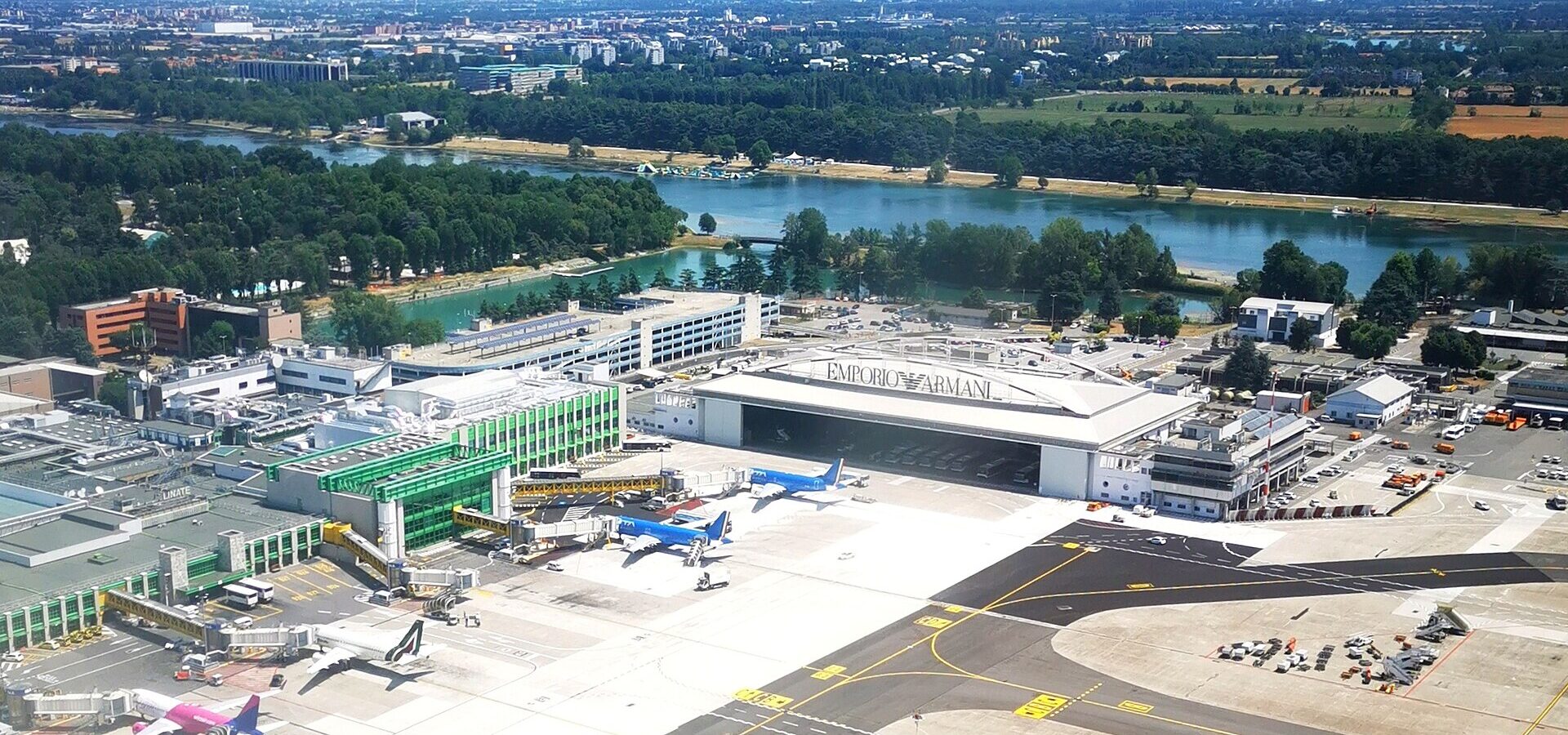
Linate is the airport Milan should have been given for everything. It is seven kilometres from the Duomo, it has one terminal you can cross in four minutes, and since the M4 metro reached it you can be standing in Piazza San Babila twelve minutes after leaving the arrivals hall for €2.20. Malpensa handles three times the passengers and takes five times as long to escape.
The catch, and there is always a catch, is that Linate is small and constrained. Around 11 million passengers used it in 2025 against Malpensa’s 31 million, it has a night curfew, and its route map leans heavily towards European business destinations. You do not choose Linate; Linate is chosen for you by whoever sells you the ticket. When it happens, it is good news.
The short version: getting from Linate airport to Milan is the easiest airport transfer in Italy. Take the M4 blue metro line from the station directly beneath arrivals — twelve minutes to San Babila, one stop from the Duomo, €2.20 on a standard urban ticket, fully step-free, running from about 06:00 to 00:30. The alternatives exist but rarely win: bus 73 costs the same and takes 25 to 40 minutes, and a taxi runs €25 to €35 with no fixed rate. Allow 90 minutes before a Schengen flight and two hours if you are checking a bag. That is genuinely the whole thing.
The M4 metro: why this changed everything
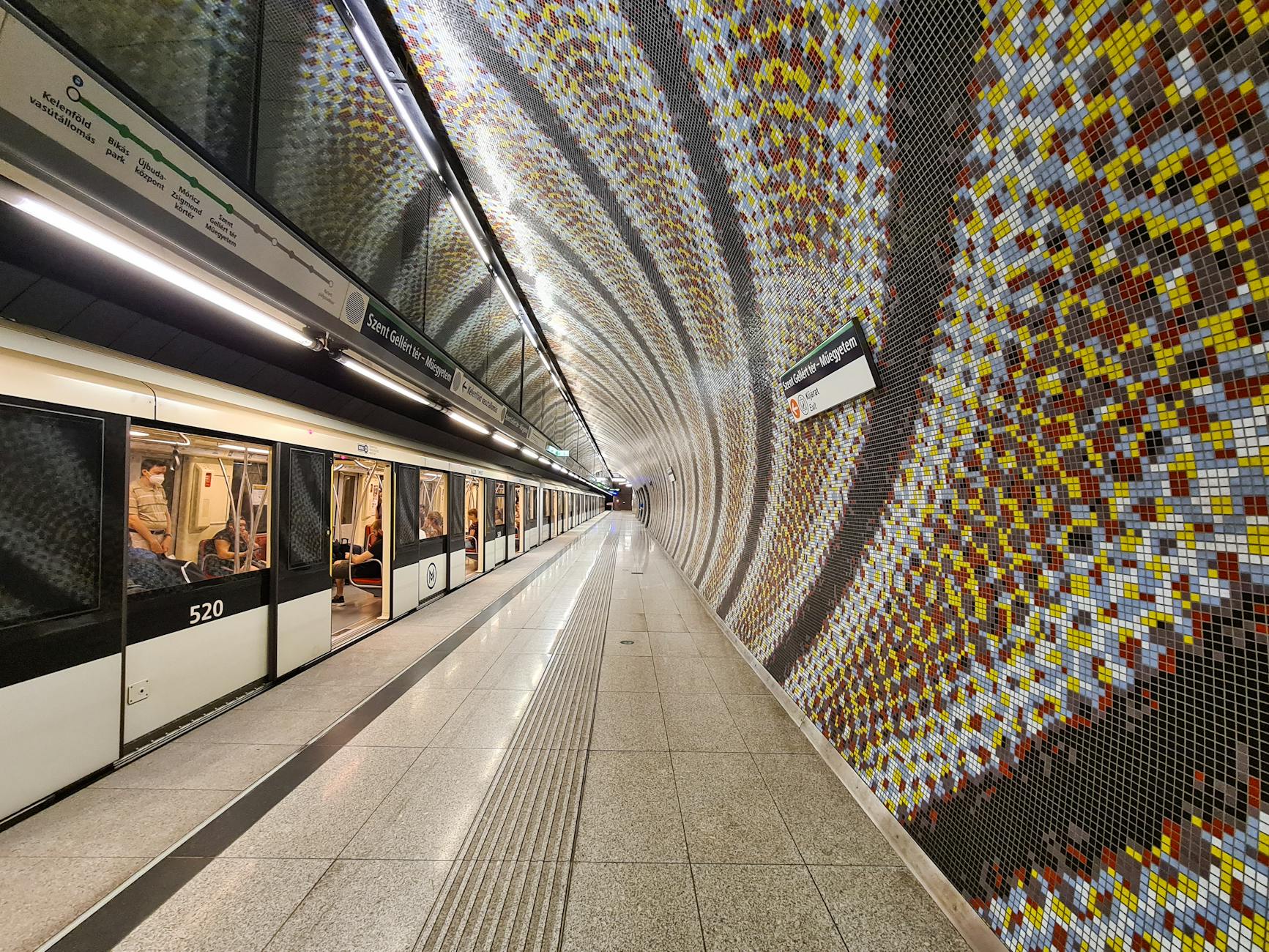
Before the M4 opened, Linate’s proximity was theoretical — you were seven kilometres away and stuck in the same eastbound traffic as everybody else. The blue line removed that problem entirely, and it is now one of the best airport metro links in Europe.
The station sits directly beneath the arrivals level. There is no shuttle, no walkway to another building, no separate ticket type. You clear customs, follow the signs down, and you are on a platform. From the airport the line runs:
- Linate Aeroporto → Repetti → Forlanini FS → Argonne → Susa → Dateo → Tricolore → San Babila
San Babila is the one that matters: it is an interchange with the M1 red line, which puts Duomo two stops away, and it is a walkable ten minutes from the cathedral if you would rather stretch your legs. Dateo is worth knowing if you are staying towards Porta Venezia, and Forlanini FS connects to suburban rail.
The fare is the ordinary Milan urban ticket at €2.20, valid 90 minutes, which also covers your onward metro or tram leg — unlike the Malpensa Express, where the airport ticket stops at the terminus. Contactless tap-in works at the gates, so a bank card is all you need. Our Milan metro guide covers day passes and the carnet if you are going to be using the network heavily.
Running times and the last-flight problem
The M4 runs daily from around 06:00 until about 00:30. That window was deliberately stretched to cover the last arrivals of the day, which is a genuinely thoughtful piece of planning and means most late Linate landings can still take the metro. It does not cover everything, though — a badly delayed evening flight can still put you on the wrong side of the last train.
If you are landing near midnight, our guide to arriving in Milan late at night covers what runs and what does not.
Step-free the whole way
This deserves its own line because so few airport links manage it: the route from the Linate arrivals hall to the M4 platform, and from the platform to street level at San Babila, is step-free throughout. Lifts, level boarding, platform-edge doors. If you are travelling with a wheelchair, a pushchair or simply an enormous suitcase, Linate is the easiest arrival in northern Italy by a distance.
The alternatives, and when they are worth it
Bus 73 and X73
Bus 73 has been the Linate workhorse for decades and still runs, from the stop outside arrivals to San Babila, at the same €2.20 as the metro. It takes 25 to 40 minutes depending on traffic, which on a bad afternoon means it can take three times as long as the M4 for the same money. The X73 is the limited-stop version and is quicker.
So why take it? Two reasons only: the bus runs at hours the metro does not, and if your accommodation happens to sit on the 73’s route, the door-to-door time can beat a metro journey plus a walk. Otherwise, the M4 has made bus 73 an answer to a question nobody asks any more.
Taxi
Unlike Malpensa, Linate has no fixed flat rate into the city. The meter runs, and a trip to the centre typically lands between €25 and €35 — more in heavy traffic, more again late at night or with a large bag surcharge. Milan taxis are white, queue at the marked rank outside arrivals, and are perfectly honest; the people who approach you inside the terminal are neither. Our guide to taxis and ride-sharing in Milan explains which apps work here and which do not.
A taxi makes sense from Linate in three situations: you are three or four people splitting it, you are arriving with more luggage than a metro carriage wants, or it is outside the M4’s hours. On a solo trip to a central hotel, paying €30 to save ten minutes over a €2.20 metro is hard to justify.
Private transfer and car hire
A pre-booked transfer costs roughly what a taxi does and buys you a driver holding a sign, which is worth something at the end of a long day with children. Car hire desks are in the terminal, but think carefully: Linate sits just outside the city, and central Milan is ringed by the Area C congestion charge at €7.50 a day plus the much larger Area B low-emission zone, both camera-enforced with fines running from roughly €80 to €335. Hiring a car at Linate to drive into Milan is close to the worst possible use of one. Our guide to renting a car in Milan spells out where the boundaries fall.
Inside the terminal
Linate has a single terminal on three levels — arrivals at ground level, departures above it, and lounges above that. It was renovated relatively recently and it shows: bright, calm, legible signage, and short enough that you can see one end from the other.
- Gates: around fifteen, which tells you everything about the scale. Nothing is a long walk.
- Security: generally quick. The constraint is the morning business bank, roughly 06:00 to 08:30, when half of corporate Milan flies to Rome.
- Food and shopping: adequate rather than exciting. A handful of cafes and bars, a small duty-free, one or two sit-down options. It is an airport built for people who do this twice a week and do not want to linger.
- Lounges: on the upper level, primarily airline and pay-per-entry lounges. For a flight from Linate, where you might spend an hour airside in total, they are difficult to justify.
How early to arrive
- Hand luggage only, Schengen: 90 minutes is genuinely enough here. That is not advice I would give for Malpensa.
- With a bag to drop: two hours.
- Morning peak, 06:00–08:30: add half an hour regardless.
The border position is worth a note. Linate is overwhelmingly a Schengen airport, so most passengers never see passport control at all. If you are arriving from outside the EU on a non-EU passport, the Entry/Exit System has been running at Italian airports since April 2026 — biometric registration instead of a stamp, slow the first time and fast afterwards. Linate’s small border hall handles it fine at normal volumes, but a wide-body arrival at the wrong moment can back it up.
Where to stay if you are flying from Linate
Almost nobody should stay near Linate. This is the opposite of the Malpensa situation: the airport is so close to the centre that an airport hotel buys you nothing except a duller evening. Even for a 06:30 departure, the maths works from a central hotel — the M4 starts around 06:00, and if that is too late for your flight, a €30 taxi from the Duomo at 05:00 still costs less than most airport hotels and takes twenty minutes on empty roads.
So stay in the city. The San Babila end of the M4 puts the Duomo, the Quadrilatero and Brera all within a short walk, which makes the area around hotels near the Duomo unusually convenient for a Linate trip. Porta Venezia, a few minutes further on, is cheaper and better for eating. Our full where to stay in Milan guide breaks the neighbourhoods down properly.
The one exception is a very early connection where you are arriving into Milan the night before on a late train. In that case the Centrale district makes sense simply because you can get off a train and into a bed — and the M4 does not reach Centrale, so budget for a taxi across the city in the morning.
Linate for connections and onward travel
Linate is a poor connecting airport and a good starting point. Because it is almost entirely point-to-point European traffic, genuine airside connections are rare, and any itinerary that has you changing planes here on separate tickets should be treated with suspicion: you will clear landside, collect bags and check in again.
What it is excellent at is handing you straight to the rest of Italy. San Babila is one M1 stop from Duomo and a short hop from Cadorna and Centrale, which means you can land at Linate and be on a high-speed train to Florence or Venice inside an hour. That is a genuinely useful trick for anyone using Milan as an entry point rather than a destination, and the mainline side of it is covered in our Milan train travel guide. Heading north instead? The lakes are reachable the same way — see our Milan to Lake Como transport guide.
The honest verdict: Linate’s real limitations
Two things genuinely constrain this airport, and neither is fixable.
The first is the night curfew. Linate sits inside the urban area and cannot operate overnight. A badly delayed evening arrival does not simply land late — it can be diverted to Malpensa, which turns a twelve-minute metro ride into a fifty-kilometre coach transfer at midnight. It is uncommon, but if you are booking the last flight of the day into Linate, know that this is the failure mode.
The second is route availability. One runway and a short one at that means Linate serves European city pairs, mostly, with a business skew: Rome, Paris, London, Frankfurt, Madrid, Amsterdam. Long-haul is Malpensa’s business and low-cost is largely Bergamo’s. If your flight is not sold into Linate, wishing will not change it — and the comparison across all three is laid out in our Milan airports guide.
There is also a straightforward pricing reality: because Linate is the convenient airport, fares into it are often higher than the equivalent into Bergamo or Malpensa. Whether the premium is worth it depends on your trip. For two nights in the city centre, an hour saved each way and a €2.20 transfer instead of a €15 one closes a lot of that gap. For a week based at Lake Como, it does not, because you would rather land at Malpensa anyway.
Frequently asked questions
How do I get from Linate airport to Milan city centre?
Take the M4 blue metro line from the station directly under arrivals. Twelve minutes to San Babila for €2.20, then one stop on the M1 to Duomo or a ten-minute walk. Bus 73 and taxis are the alternatives, at the same fare and €25–35 respectively.
How far is Linate from Milan?
About seven kilometres east of the Duomo — by far the closest of Milan’s three airports, and the reason the metro link works so well.
What time does the M4 stop running?
Roughly 00:30, starting again around 06:00. The late finish was designed around the last flights of the evening, but a significant delay can still leave you outside it.
Do I need a special airport ticket for the M4?
No. A standard €2.20 Milan urban ticket covers the whole journey and stays valid for 90 minutes, including onward metro and tram legs. Contactless card tap-in works at the gates.
Is there a flat-rate taxi fare from Linate?
No. Malpensa has a fixed €110 rate; Linate does not. The meter runs and a central journey usually costs €25 to €35.
How early should I arrive at Linate?
Ninety minutes with hand luggage, two hours with a bag to check, and add thirty minutes in the 06:00–08:30 business peak. The terminal is small and nothing is far.
Can I get from Linate to Malpensa directly?
There are coach services between the two, but allow well over an hour and treat any same-day connection between them as risky. If your itinerary requires it, build in a long buffer — the routes are compared in our Milan airport transfers guide.
Final thoughts
Linate is the least complicated airport in this city and requires almost no planning. Land, walk down the escalator, tap a card, arrive at San Babila. The only decisions worth making in advance are whether your flight lands late enough to worry about the metro’s last service, and whether there are enough of you to make a taxi sensible.
Everything else you would normally research about an airport — terminals, shuttles, transfer options, how early to leave the hotel — Linate simply does not require. Save that energy for the city instead: our things to do in Milan and where to stay in Milan guides are the better use of your planning time.