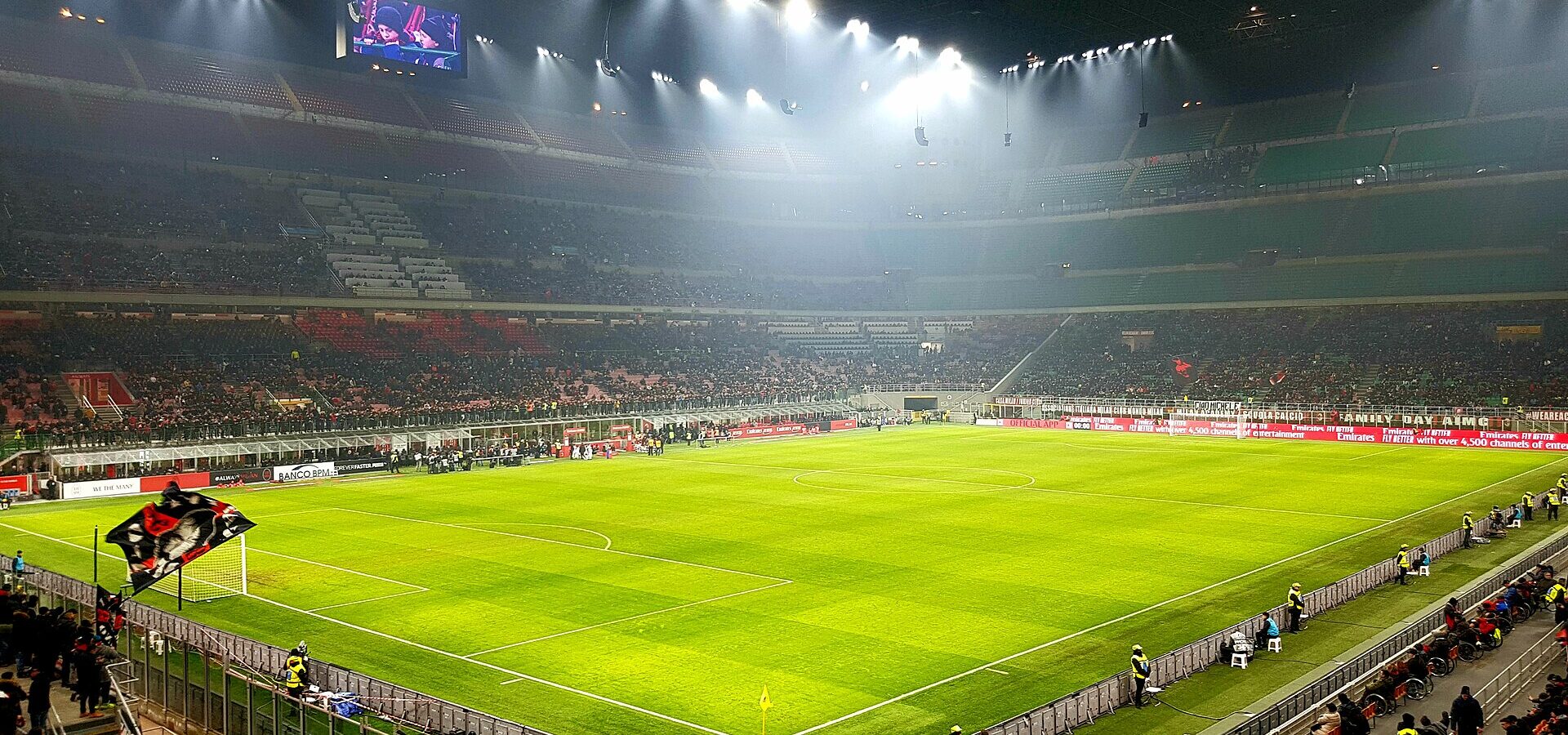
There is no away end at the Milan derby. Both clubs are at home, both curve are full of season-ticket holders who have sat in the same plastic seat for twenty years, and the two halves of a city of 1.4 million people are separated by nothing more than a running track’s width of stewards. It is the strangest big fixture in European football, and it is the single hardest ticket in Italy for a visitor to get hold of.
The Milan derby — the Derby della Madonnina — is played twice a season at San Siro, once with AC Milan as the nominal home club and once with Inter. In 2026–27 the first leg falls on Saturday 31 October 2026 at 20:45, Milan at home, with the return scheduled for matchday 24 in mid-February 2027. Tickets go on sale through the home club only, and the good seats are gone in the loyalty-card phases before general sale ever opens. Realistically you need a club loyalty card for the presale phases (Milan’s Cuore Rossonero or Inter’s Tessera Siamo Noi, which costs €15 and lasts six years); otherwise you wait for general sale, subject to availability, and accept a third-tier seat at a top-category price of roughly €70–150. Resale marketplaces do not work: Italian tickets are personalised and photo ID is checked at the turnstile. And if you cannot get in, a good sports bar on derby night is genuinely not a consolation prize.
What follows is how the fixture actually works: the calendar, the sales phases in order, what a seat costs, what the night is like, and what to do if the answer is no.
What the Derby della Madonnina is
The derby takes its name from the Madonnina, the statue that stands atop the Duomo. The name tells you something about how Milan understands the fixture: not as a sporting rivalry with a geographical basis, but as an argument about who owns the city.
The split is not really about neighbourhoods. Both clubs play in the same building, which removes the usual geography of a derby entirely. Historically Inter was the club of the professional middle class and Milan the club of the workers and of the families who came north from the south for factory work; seventy years of television have diluted that beyond recognition, but you still hear it invoked in bars, usually as a joke that is not entirely a joke. What survives intact is the intensity. The two clubs have met more than 240 times in official competition, including Champions League ties that are still argued about in the present tense, and no season passes without the fixture reshaping somebody’s year.
Why it feels different from other derbies
Because nobody travels. In Rome or Manchester or Glasgow, half the ground arrives from somewhere else and leaves under police escort. At San Siro both sets of supporters come out of the same tram stops, drink in the same bars off Via Novara beforehand, and go home afterwards on the same overloaded M5. Both curves put on choreographies, and the streets outside are mixed and loud. It is a hostile ninety minutes wrapped inside a fairly good-natured evening.
When the Milan derby is played
Serie A plays a home-and-away round robin, so the derby comes round twice a league season, with the clubs alternating which of them is designated the home side. The fixture list is drawn in early June for the season that starts in August, and the derby dates are among the first things the Italian press reports.
- First leg, 2026–27: matchday 10, Saturday 31 October 2026, 20:45, AC Milan as the home club.
- Return leg: matchday 24, mid-February 2027, Inter as the home club. Serie A moves individual matches within a matchday for television, so treat the exact date and kick-off time as provisional until the league confirms the round, which usually happens four to six weeks out.
There can also be a third or even fourth derby in a season. The two clubs are regularly drawn together in the Coppa Italia, and they have twice met in the Champions League knockout rounds. Those fixtures are announced at much shorter notice and disappear faster, because the ticket pool released to the public is smaller.
Kick-off times and what they mean for a trip
The first leg kicks off at 20:45 on a Saturday. That matters more than it sounds. A late evening kick-off means a late return to the centre, so eat before the match and think twice about an early flight the next morning. On the other hand it leaves the entire day free: the derby is an evening event bolted onto an otherwise ordinary Milan Saturday, and you can do the Duomo, a long lunch and a gallery before you go anywhere near San Siro.
How to get tickets
This is the part people get wrong, so I will be blunt about it. There is no easy route, and the routes that look easy are the ones that end with you standing outside a turnstile holding a piece of paper that does not work.
The home club sells the whole ground
For each derby, one club is the home club and it sells every ticket in the stadium, including the sectors where the other club’s supporters sit. If Milan are at home, you buy from acmilan.com. If Inter are at home, you buy from inter.it. There is no separate away allocation to hunt down, because in the usual sense there is no away team.
Both clubs require a free account — MyMilan on one side, an inter.it profile on the other — created and verified before the on-sale opens. Do that the moment you decide you want to go, not on the morning tickets drop. Verifying an email address while a queue is moving is exactly how people lose the seat they wanted.
The sales phases, in the order they happen
- Season-ticket holders. They already have the seat. This alone absorbs most of both curve and a large share of the lower ring.
- Loyalty-card and club-member phases. Milan’s Cuore Rossonero card and Inter’s Tessera Siamo Noi (€15 excluding shipping, valid for six years) are the two to know. Inter also runs INTERISTA loyalty subscriptions and separate Inter Club member windows. For an ordinary league game these phases are a convenience. For the derby they are effectively the sale.
- Sponsor and bank presales. Inter has run Mastercard exclusive windows; both clubs use partner presales from time to time, and they are announced with little notice.
- General sale. Whatever is left, which for a derby means the expensive third tier, scattered single seats and restricted views.
The practical consequence is simple: buy the card. Twenty euros to convert a “probably not” into a “probably yes” is the best value in Milanese football, and the card keeps working for years afterwards, including for the ordinary fixtures where it saves you nothing but is nice to have. The full mechanics of each club’s system — where to apply, what the card unlocks, how the sectors are priced — are in our guides to buying AC Milan tickets and buying Inter tickets.
Why resale sites do not work
Italian tickets for Serie A are nominative. The buyer’s name is printed on the ticket and the stewards at the turnstile check photo ID against it. This is enforced properly at San Siro, and it is enforced most rigorously at exactly the fixtures where you are most tempted to buy from a stranger on the internet.
Both clubs operate an official change-of-name process, and both run or authorise secondary channels where a resold ticket is re-issued in the new buyer’s name. Those are fine, and they are the only resale worth touching. A general marketplace listing that arrives as a PDF in somebody else’s name is not fine, whatever the seller’s rating says. The test is one question: can the seller explain the specific mechanism by which your name ends up on the ticket? If they cannot, there isn’t one.
Hospitality: the honest assessment
If the sale has been and gone, official hospitality is the remaining legitimate route. Both clubs sell packages bundling a seat in a premium sector with food and drink, and for a derby these run from a few hundred euros to well over a thousand a head. They are not a swindle, exactly — you get a good seat, a comfortable evening and a guaranteed ticket in your own name, which on this fixture is worth something. But you are paying five to ten times face value for the guarantee, and you are watching from the calmest part of a stadium whose entire appeal that night is that it is not calm. I would rather watch this particular match in a bar than from a hospitality box, and I say that as someone who has done both. Take it as a real opinion rather than a hedge.
What a derby ticket costs
The home club sets the prices for each fixture and announces them with the derby sale. As a guide to what to expect at face value:
- Curva, either end: roughly €40–80 when available, which for a derby is rarely.
- Terzo anello (third tier), sides and corners: roughly €70–150. This is the tier most visitors actually end up in.
- Secondo anello (middle tier): roughly €150–250.
- Primo anello and the central lower ring: €250 and upwards.
- Official hospitality: €500–1,500 or more per person.
Set that against a mid-table midweek league game, where a third-tier seat can be had for about €30 and a curva ticket sometimes for €10–20, and the size of the fixture premium is obvious. Prices change every season and by opponent category, so treat these as bands rather than quotes and check the home club’s own price list for your specific match before you budget.
Is the third tier worth it?
At San Siro, unusually, yes. The terzo anello is high and steep and a genuinely long climb up the spiral ramps, and in most stadiums the equivalent seat would be a punishment. From up there you are well placed to take in both choreographies across a bowl of about 75,000 people. From the lower ring you can see the tifo behind your own goal and almost nothing of the display at the other end. For any other fixture I would take the middle tier. For the derby I would take the third every time.
Derby matchday: what the evening is like
Before
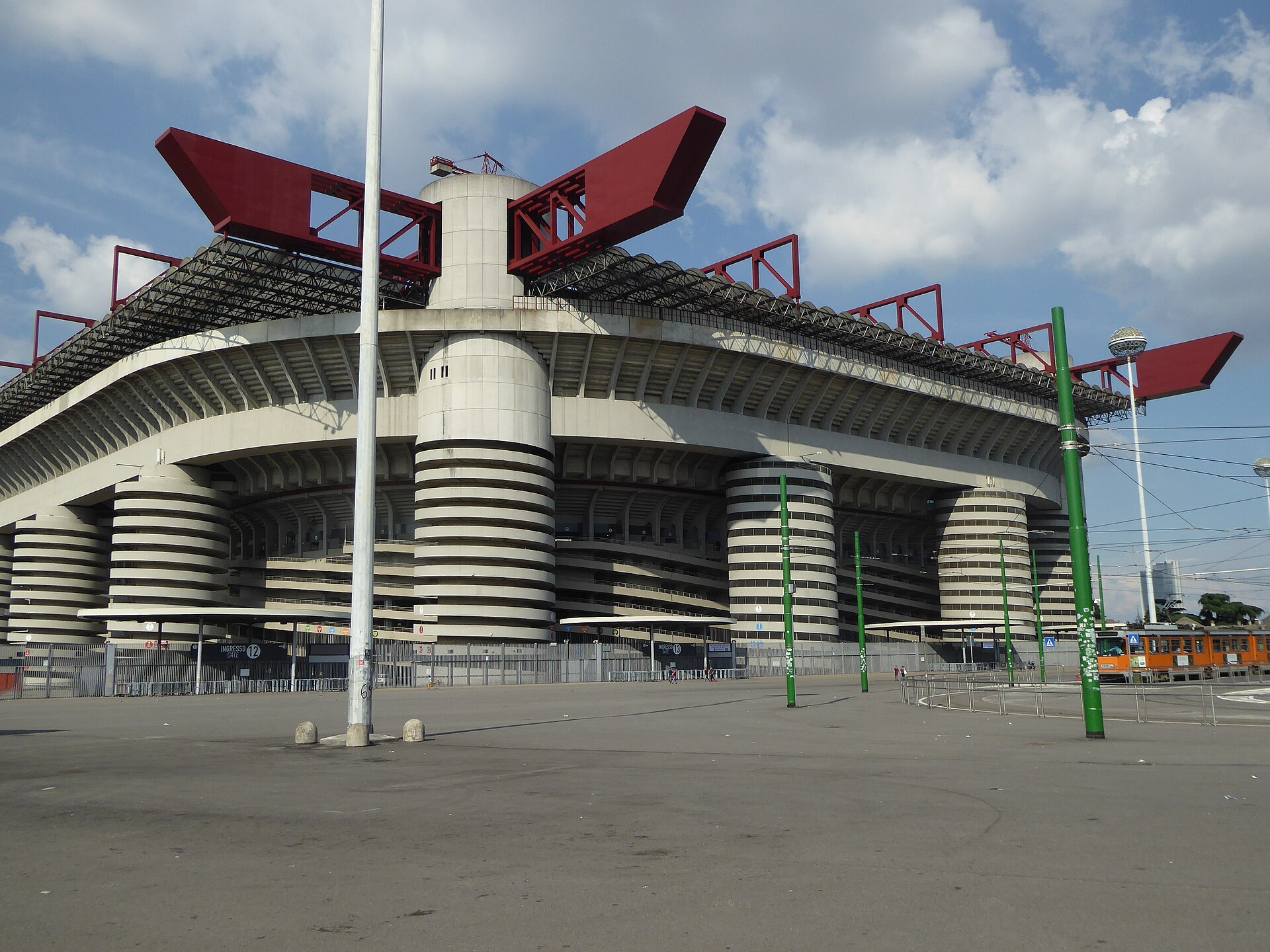
The area around the stadium starts filling about three hours out. Piazzale Axum and the streets off Via dei Piccolomini turn into a market of scarves, flags and plastic cups of beer, with a permanent haze of grilled sausage from the panino trucks. It is worth arriving early for this even though there is nothing to do except stand about and look at people, because it is the part of the evening that no television camera ever shows and the part you will remember alongside the goals.
Take the M5 to San Siro Stadio and give yourself considerably more time than seems necessary. Bag and bottle restrictions apply and ID is checked at the entrance, so read the club’s matchday rules before you set out.
The transport in full detail, including the two tricks for getting out again afterwards, is in our guide to getting to San Siro.
During
Get to your seat well before kick-off, because the build-up is part of the show. After that, expect ninety minutes of continuous noise and a stadium that sounds physically different from a normal Serie A crowd.
Afterwards
Do not sprint for the metro. Seventy-odd thousand people leave at once, and ATM runs crowd-management measures around the stadium station after a match. Walking to Lotto, where the M1 and M5 meet, is one of the alternatives ATM lists for getting away, so it is worth considering instead of joining the queue at San Siro Stadio. Check ATM’s San Siro page for that night’s arrangements.
If you cannot get a ticket
This is the likeliest outcome, and it is genuinely fine. Milan on derby night is a city watching a single match. Every bar with a screen is full, a good half of them have a declared allegiance, and the noise when a goal goes in rolls down the street from three directions at once, about a second before you see it happen on the screen.
The bars that show it properly — including which ones take sides, and which you should avoid wearing the wrong shirt into — are in our guide to where to watch football in Milan.
The other option, if you are in Milan on entirely the wrong week, is the San Siro stadium tour — it opens at 09:30 and closes at 17:00 from November to March (18:00 from April to October), and covers the dressing rooms, the tunnel, pitchside and the museum. Match days and events can change the hours and the route, so check the opening calendar when you book. It is not a derby, obviously, but it does take you to the edge of the pitch.
The stadium’s future
If you would rather sleep within walking distance of the ground, our guide to where to stay near San Siro covers the hotels and what the area is actually like.
Worth knowing if you are planning ahead. San Siro is scheduled to be replaced: Milan City Council approved the €197m sale of the stadium and its surrounding land to the two clubs on 30 September 2025, and preparatory works have started — the historic southern ticket office was demolished in June 2026. Against that, on 6 October 2026 the Lombardy administrative court declared four of the five appeals from residents’ and civic associations inadmissible and rejected the fifth, and an investigation into whether the sale process was manipulated has also been reported. Nobody can honestly tell you when the last derby at the Meazza will be played, and anyone who gives you a date is guessing. Do not build a trip around a demolition timetable; check where things stand before you plan.
Practical planning notes
- Create the club account weeks ahead and buy the loyalty card at the same time. Cards are posted, but the card number usually works for buying while the physical card is still in transit.
- Watch the home club’s own site for the on-sale announcement rather than relying on a general fixture calendar. Derby sales typically open several weeks out and move through the phases in a matter of days.
- Book the hotel before the ticket. Milan hotel prices respond to any big San Siro night, and a derby weekend is a poor time to be improvising. Our guide to where to stay in Milan covers the neighbourhoods, and basing yourself centrally and travelling out is usually the better call anyway.
- Bring the actual ID you bought the ticket with. Not a photograph of it on your phone. The turnstile check is a real check.
- Sit where your ticket says and dress neutrally if you are unsure. The two sets of supporters are in the same building with no fence between the sides, and the sectors are adjacent rather than segregated in the way you may be used to.
- Budget for a taxi that will not come. Ride-hailing surges hard after full time and drivers avoid the cordon. Walking to a metro that is one stop further away is the reliable plan; see our Milan taxis guide for what is realistic.
Frequently asked questions
How often is the Milan derby played?
Twice every Serie A season as a matter of course, plus any Coppa Italia or European meetings, which happen more often than you would expect from two clubs sharing a city and a stadium. In 2026–27 the league fixtures are 31 October 2026 and matchday 24 in mid-February 2027.
Which club is the home team?
They alternate. Both play at San Siro, so the designated home club is the one that sells the tickets, keeps the gate receipts and gets the run of the stadium for the day. Milan’s supporters occupy the Curva Sud and Inter’s the Curva Nord regardless of who is nominally at home — the ends do not swap.
Can I buy a derby ticket on the day?
Essentially no. Ordinary Serie A fixtures often have availability in the week of the game and sometimes at the ticket office on the day itself. The derby does not. If you are reading this in the week of the match without a ticket, plan for a bar and enjoy it.
Are the tickets on resale marketplaces genuine?
Often they are perfectly genuine, and that is precisely the problem — a genuine ticket in somebody else’s name will not get you through the turnstile, because the ID is checked against it. Use the clubs’ own change-of-name process or their authorised resale channels, or do not buy at all.
Is it safe for a neutral or for a family?
Yes, with the ordinary caution any 75,000-capacity football match deserves. There is no travelling support to segregate, the policing is heavy and competent, and the atmosphere outside is loud rather than menacing. I would not take a small child, simply because of the noise, the flares and the crush at the exits, but a teenager will remember it for the rest of their life.
What should I do with the rest of derby day?
Treat it as a normal Milan Saturday until about 17:00 and then leave early. The Duomo rooftop, an aperitivo in Brera or on the Navigli and a proper early dinner all fit comfortably in front of an evening kick-off, and you will not feel like eating at half past eleven when you finally get back into town.
Do I need to speak Italian?
No. The club ticketing sites both have full English versions, the stewards deal with foreign visitors constantly, and nothing about the evening requires you to say anything more complicated than showing a ticket. A few Italian phrases will make the bars before and after considerably more fun, though.
Final thoughts
The Milan derby is one of the two or three football occasions in Europe that genuinely lives up to the way it is sold, and getting into it is a logistics problem rather than a luck problem. Buy the loyalty card, make the account early, be watching when the sale opens, and accept a third-tier seat without complaint — on this fixture it is the best view in the building anyway. If it does not come off, spend the money you saved on beer in a bar full of people who care far too much about the result, which is the same experience at a lower resolution and about a tenth of the price. Either way, do it while the Meazza is still standing.