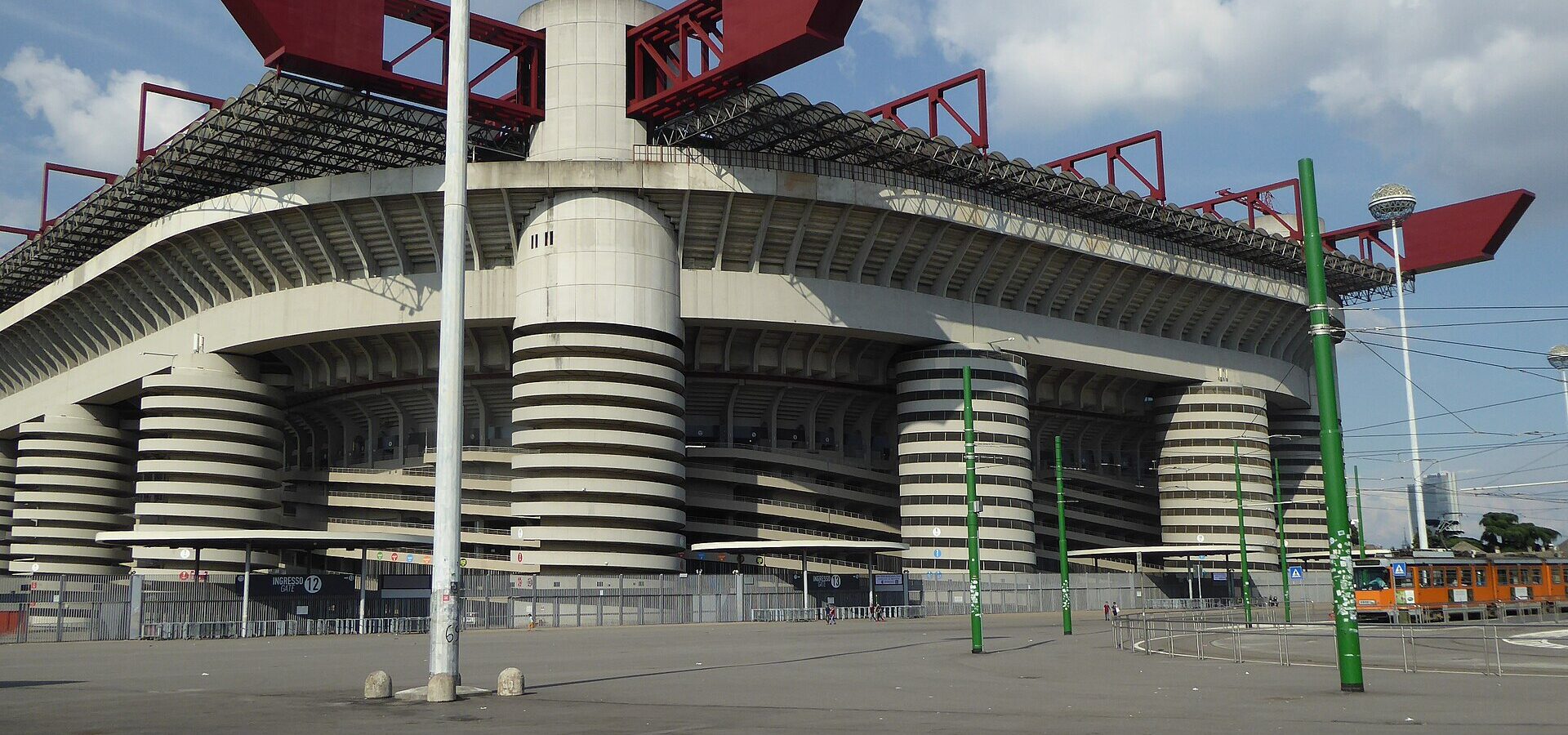
The metro station at San Siro is the last stop on the M5, and on a matchday most of a full stadium leans on it at once. It does this reasonably well going in and badly coming out. Almost everything worth knowing about getting to a game at the Meazza follows from that single asymmetry.
The short version on how to get to San Siro: take the M5 lilac line to San Siro Stadio, which is a two-minute walk from the turnstiles. From the Duomo that means M1 red to Lotto and a change to the M5 for three stops, via Segesta and San Siro Ippodromo, on an ordinary €2.20 urban ticket; allow extra time for the walk and the wait at the interchange. Tram 16 runs from the city centre to the stadium at street level — slower, but prettier. Leave the centre about two hours before kick-off for a big game and 90 minutes for an ordinary one. Coming back is the hard part: rather than queueing for the M5 at the stadium with everybody else, walk to Lotto or south to Bande Nere on the M1 and board there.
Below: every route in, what each one actually costs and takes, when to leave, what the security check involves, and the three ways out that most visitors never find.
Where San Siro actually is
The Stadio Giuseppe Meazza sits about 5–6 km west-northwest of the Duomo, in the San Siro district, between the racecourse and the ring road. The main address is Piazzale Angelo Moratti, with the tour and museum entrance on Via Piccolomini. It is a long walk from the centre through unremarkable residential streets, so for most visitors this is a public transport journey.
That distance is the reason the area feels detached from the rest of Milan. There is no old centre out here, no piazza worth photographing, and outside matchdays the neighbourhood is quiet suburban apartment blocks. It also means that once the game finishes you are a metro ride from dinner, which is worth planning for.
By metro: the M5
The M5 — lilac on the map, sometimes described as purple — is the driverless line, and its western terminus is San Siro Stadio. The station sits directly at the foot of the stadium’s spiral ramps, two minutes from the turnstiles. There is no shuttle, no long walk and no ambiguity: you come up the escalator and the building is in front of you.
Getting onto the M5 from the centre
- From the Duomo: M1 red line westbound to Lotto, change to the M5, three stops to San Siro Stadio. Lotto is the only change.
- From Milano Centrale: M2 green line to Garibaldi FS, then change to the M5 towards San Siro Stadio. Centrale itself is not on the M5, so it is one change rather than a single train.
- From Porta Garibaldi or Isola: M5 direct to San Siro Stadio, no change needed.
- From Navigli or Porta Genova: M2 green to Garibaldi, then M5.
Any of these is covered by the standard ATM urban ticket at €2.20, valid 90 minutes, which is enough for the whole journey including the change. Contactless works at the gates — tap the same card in and out and it charges the right fare. If you are making the round trip plus other journeys in the same day, a daily ticket is usually the better buy; our Milan metro guide covers the ticket types and how the gates work.
The catch with the M5
The M5 is a light metro with shorter, narrower trains than the M1 or M2. It was not built to empty a 75,000-seat stadium, and on a big night the platform at San Siro Stadio is managed with queue barriers and staff letting people down in batches. Going to the game this is invisible — arrivals are spread over three hours. Coming back is another matter, so allow extra time to get out of the ground and onto a train.
Note also that the M5 stops earlier than the other lines: last departures from the terminus are around midnight, against roughly 00:30 on the M1, M2, M3 and M4. For a 20:45 kick-off that is fine. For a match that goes to extra time and penalties, or if you stay for a drink near the ground, check the last train before you settle in.
By tram: line 16
Tram 16 runs from the city centre out to San Siro, terminating by the stadium. It is slower than the metro, and the journey time depends on the traffic, but it has two things going for it on a matchday. It runs above ground, so you watch Milan turn from centre to suburb on the way out. And on the way back it picks up from a stop that most of the crowd walks straight past on their way to the metro.
Same €2.20 fare: tap a contactless card at the reader on board. Trams get held up by matchday road closures, so do not cut the timing fine in that direction. Our Milan tram guide explains the network and the older orange cars.
By bus
Bus 49 stops at San Siro Stadio M5, and the Q78 serves the Portello–San Siro area; check the right stop and any matchday diversions on ATM’s GiroMilano planner. They are useful if your hotel happens to sit on one of those routes, and largely pointless otherwise — for anyone based centrally the metro or the tram will always be quicker. Same ticket, same fare.
By taxi or ride-hailing
Getting there by taxi is fine: expect roughly €15–25 from the city centre depending on time of day and traffic, more in the evening when the higher night tariff applies from 21:00. Give the driver Piazzale Axum or Piazzale Moratti rather than “San Siro”, which is also a district and a racecourse.
Getting back by taxi is a different proposition entirely. Roads immediately around the ground are closed or restricted on matchdays, ride-hailing surges hard the moment the whistle goes, and drivers avoid the area because they cannot get out of it. A car ordered from outside the ground can take a long time to arrive, if it comes at all. If you are set on a taxi, walk fifteen minutes away from the stadium first and order from a normal street. Our guide to taxis and ride-hailing in Milan covers the apps that actually work in the city.
Driving and parking
Don’t, unless you have a specific reason to. The stadium sits outside Area C, so the congestion charge is not the problem — the problem is that official parking around the ground is limited, fills hours ahead, and empties into gridlock afterwards. Residents’ streets nearby are heavily restricted and ticketed on matchdays. If you are driving in from a lake or from the airport, the sensible move is to park at an outlying metro station with a car park — Lampugnano on the M1 or Famagosta on the M2 — and take the train in for the last leg.
Driving on a matchday is its own ordeal: our guide to parking in Milan covers the residents’ schemes that surround the ground when the car parks fill.
When to leave
This is where most visitors get it wrong, usually by an hour.
- Ordinary Serie A fixture: leave the centre 90 minutes before kick-off. You will arrive with time to look around, buy something from a stall and find your gate without hurrying.
- Big league fixture, Champions League night or the derby: leave two hours before. The security cordon is set wider, the queues at the turnstiles are longer, and the climb to the third tier takes ten to fifteen minutes on its own once the ramps are busy.
- Third tier, any fixture: add fifteen minutes for the ramps. They are eleven storeys of spiral concrete and they move slowly when full.
- Stadium tour rather than a match: nothing special — the area is empty, the M5 is quiet, and twenty minutes from the centre is plenty.
For the derby specifically, treat every number above as a floor rather than a guide — our Derby della Madonnina guide covers what that particular evening does to the area.
The other reason to be early is that the pre-match hour outside is genuinely part of the experience. The streets off Via dei Piccolomini fill with scarf sellers, beer stands and panino trucks, and there is a decent amount of noise and smoke and shouting well before anyone goes inside. Arriving at 20:40 for a 20:45 kick-off gets you a seat and none of that.
Getting in: security, bags and ID
The checks at San Siro are real, and they are the second most common reason visitors have a bad evening after buying an invalid ticket.
- Photo ID is checked against the ticket. Serie A tickets are nominative — the buyer’s name is printed on them — and the steward will compare the name to your document. Bring the physical ID you bought with, not a photo of it.
- No large bags. There is no reliable bag drop. A small shoulder bag is normally fine; a rucksack or anything approaching cabin-bag size will be refused at the outer cordon and you will have nowhere to put it.
- No bottles, cans or glass, no umbrellas with a point, no flagpoles, no laser pointers. Banners above a certain size need advance authorisation from the club.
- Alcohol restrictions apply around the ground for high-risk fixtures, which in practice means the beer stands stop serving earlier than you expect.
- Enter by the gate printed on your ticket. The rings are accessed from different ramps and the stewards will not let you cross between sectors once inside. Walking round the outside of San Siro to the correct gate takes ten minutes.
Everything about which sector to aim for, and what each one costs, is in our guides to AC Milan tickets and Inter tickets.
Getting out afterwards
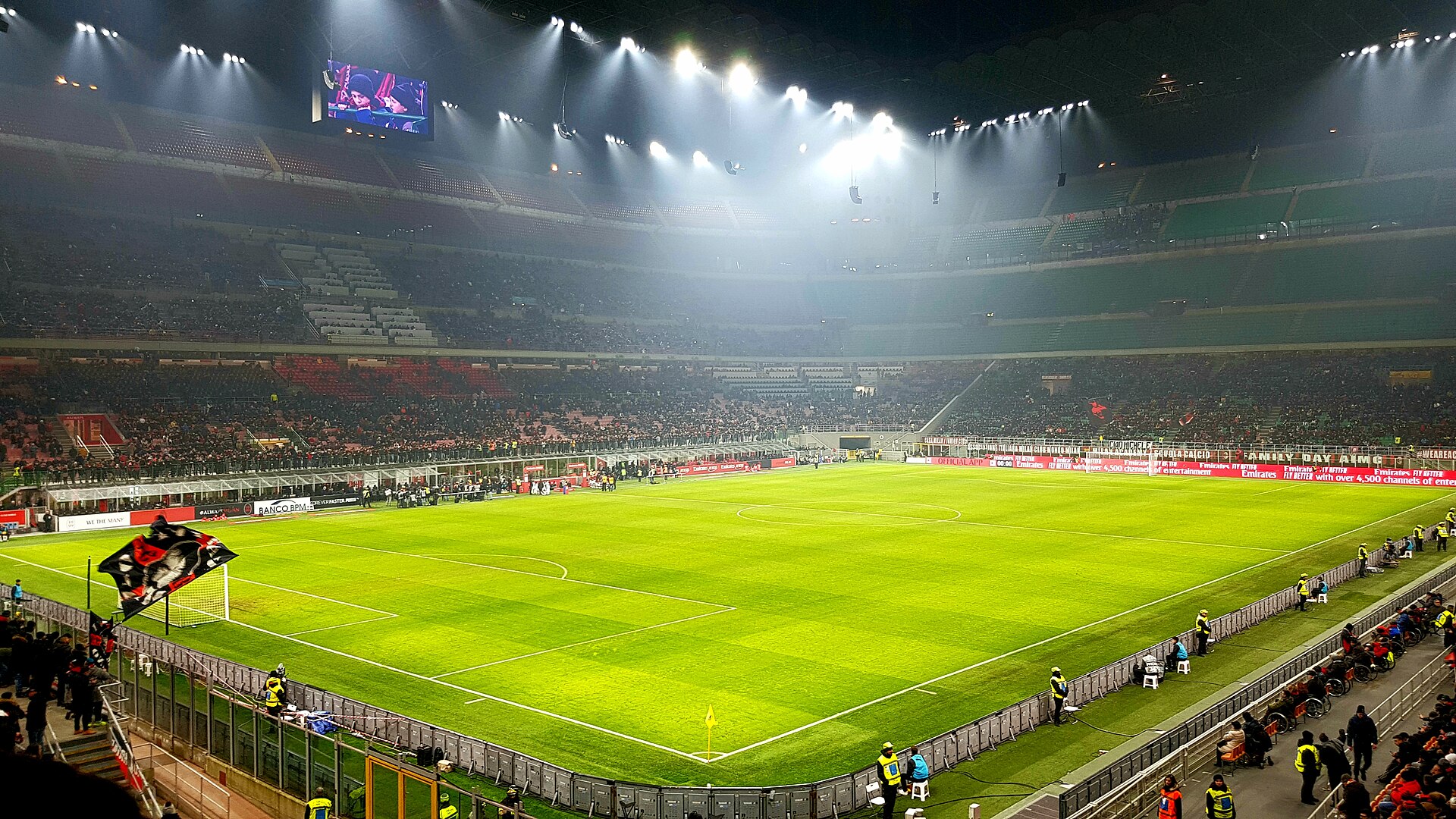
The single most useful thing in this guide. When the whistle goes, everybody walks to the same station, and San Siro Stadio cannot take them. On a full house, expect to queue just to reach the platform, standing outside in whatever the weather is doing.
There are three better options, in ascending order of effort:
1. Stay in your seat for ten minutes
The cheapest fix. Let the first surge go, watch the players do their lap, and leave when the stands are half empty. You lose ten minutes and skip twenty-five of queueing. Stewards will move you along eventually but they are in no hurry.
2. Walk to Lotto
About fifteen to twenty minutes east along Via Caprilli or Piazzale Lotto. Lotto is an interchange between the M1 and the M5, so you get two lines instead of one, you board before the trains fill, and the M1 runs later than the M5. It feels like the long way round, but it keeps you out of the queue at the stadium.
3. Walk south to Bande Nere
Roughly twenty minutes south to the M1 at Bande Nere. Fewer people go this way than to Lotto, the streets are ordinary residential Milan rather than a crowd, and the M1 takes you straight into the centre via Cadorna, Cairoli and the Duomo. Best option if you want to eat somewhere on the way back in.
A fourth option, if the weather is poor and you are not in a hurry, is simply to have a drink near the ground and let the whole thing dissolve. Wait long enough and the station is back to normal.
Late trains
For a 20:45 kick-off the metro is still running normally when you leave the ground: the M5 runs until around midnight and the M1 until around 00:30. If something drags on — extra time, a delayed kick-off, a long walk — and you miss those, ATM’s night buses take over; check the routes on atm.it before the game. It is not a disaster to miss the last train, but it is a slow ride.
The way to skip all of this is to sleep within walking distance — our guide to where to stay near San Siro weighs that against staying centrally.
Getting to San Siro from the airports
People do arrive on the day of a game, and it works if you plan for it. From Malpensa, take the Malpensa Express on the Centrale line, get off at Milano Porta Garibaldi and change there to the M5 towards San Siro Stadio — one change in all. From Linate, the M4 to San Babila, then M1 to Lotto, then M5: allow an hour. From Bergamo, the coach to Centrale takes 50 to 60 minutes before you even start on the metro, so allow at least an hour and three quarters. Our airport transfers guide has the full comparison.
All of these assume no baggage. Turning up at the turnstile with a suitcase will not work — there is no left luggage at the stadium, and Centrale’s left-luggage office is the practical solution.
The way to avoid the entire problem is to sleep within walking distance — our guide to where to stay near San Siro covers the hotels and the trade-off against staying centrally.
Accessibility
The M5 is fully step-free, with lifts at San Siro Stadio and level boarding from platform edge doors, which makes it by far the best route for anyone with reduced mobility. The stadium has designated wheelchair positions and accessible entrances, but these must be booked through the club in advance rather than bought on general sale — both Milan and Inter run a dedicated process for disabled supporters and a companion. Not every tram on line 16 is step-free, so the tram is not a dependable option for wheelchair users. Our Milan accessibility guide covers the wider picture.
Frequently asked questions
What is the nearest metro station to San Siro?
San Siro Stadio, the western terminus of the M5 lilac line, two minutes’ walk from the stadium. San Siro Ippodromo, one stop before, is closer to the racecourse and is a slightly quieter alternative for boarding on the way home.
How long does it take to get to San Siro from the Duomo?
It is one metro ride with a single change: M1 to Lotto, then the M5 for three stops to San Siro Stadio. On a matchday, allow plenty of extra time, because the platforms are busy and you may not get on the first train.
Do I need a special ticket for the metro on matchdays?
No. The ordinary €2.20 urban ticket covers it, and there is no stadium supplement. A match ticket does not include transport, unlike some European grounds.
Is it safe walking around San Siro at night?
Yes. The area is ordinary residential Milan with a large crowd passing through it, well policed on matchdays, and the walk to Lotto or Bande Nere is on lit main streets with plenty of other people doing the same thing. Normal city sense applies — watch your pockets in the crush — and our guide to Milan scams covers what to look out for near any big crowd.
Can I get to San Siro for the stadium tour the same way?
Yes, and it is far easier because nothing is busy. M5 to San Siro Stadio, walk two minutes, and the tour entrance is on the Via Piccolomini side. Details of the visit itself are in our San Siro stadium tour guide.
How early do the turnstiles open?
Generally around two hours before kick-off for a league match, sometimes earlier for high-profile fixtures. Getting in early is the right call if you are in the third tier or if it is raining, since there is very little shelter outside.
Final thoughts
Working out how to get to San Siro is not complicated: it is one metro line, one tram and a €2.20 ticket. What separates a good evening from a tedious one is entirely a question of timing — leaving the centre earlier than feels necessary, and refusing to join the queue for the M5 at full time when a twenty-minute walk to Lotto gets you home sooner. Do those two things and the logistics disappear, which on a night at the Meazza is exactly what you want them to do.