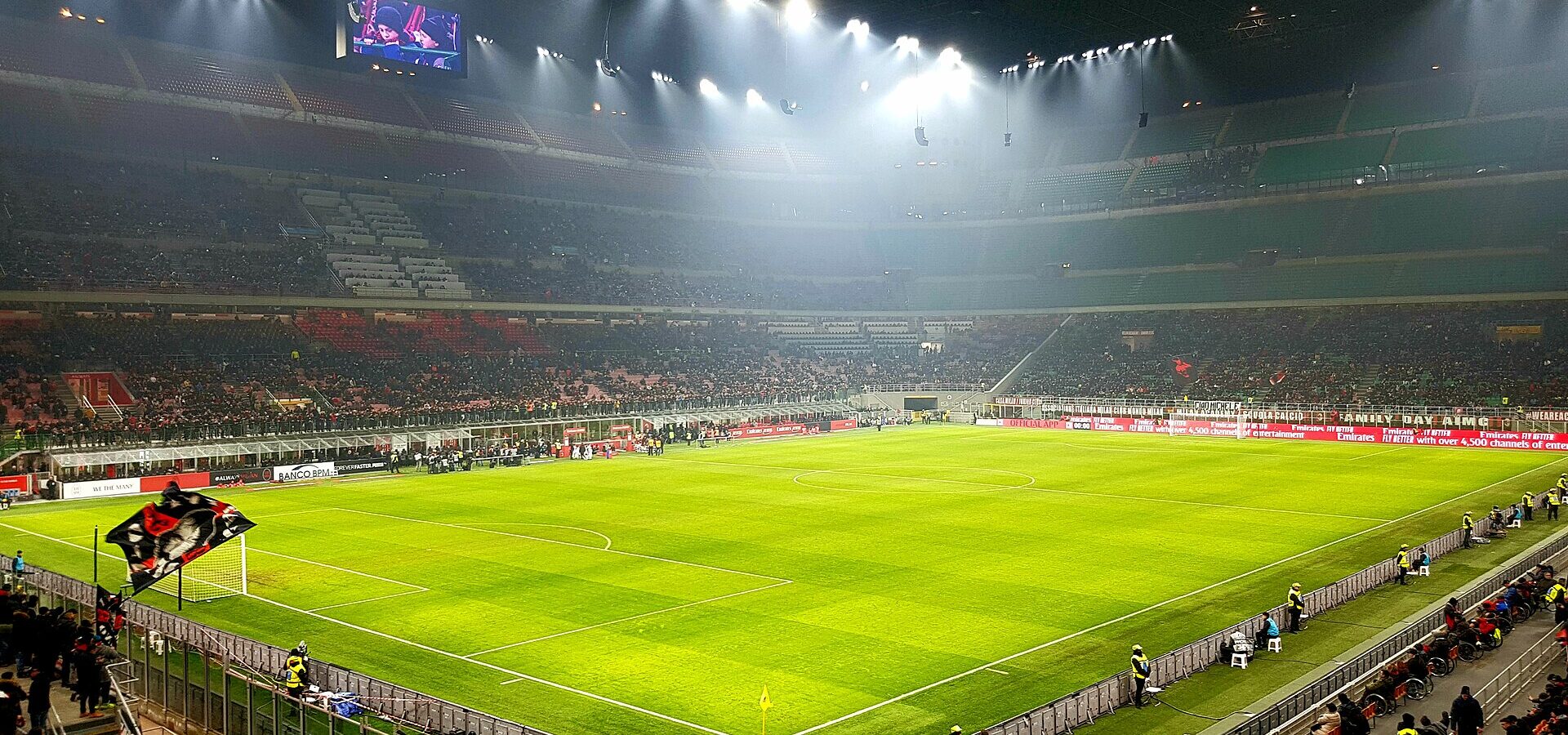
You can watch AC Milan at San Siro for about ten euros. Not for a friendly, not from a screen in the concourse — an actual seat at an actual Serie A match, in the end where the ultras stand, for less than a round of drinks in the centre of Milan. The catch is not the money. The catch is that Italian football ticketing is built around a personalisation system that quietly voids most of the tickets tourists buy, and almost nobody explains it before you have already paid.
Buy AC Milan tickets from acmilan.com, from the Casa Milan ticket office, from the club’s flagship store on Via Dante, or from a Vivaticket point in Italy — and nowhere else. You will need a free MyMilan account, and every ticket must carry the real name of the person using it, who must show matching photo ID at the turnstile. For an ordinary league match, general sale is plenty and seats are usually still available in the week of the game, from roughly €10–30 in the Curva Sud or the upper ring. For the derby or Juventus, buy the €20 Cuore Rossonero card first: it is valid four years and it puts you in an exclusive sales phase ahead of the public. Never buy from a general resale marketplace, because the name on the ticket will not be yours and you will be turned away.
The rest of this guide is the detail: the sales phases, the sectors and what they cost, the ID rule in full, how to change a name legitimately, and the specific traps.
Where to buy, in order of preference
1. The official website
The club sells directly through its own booking platform, reachable from acmilan.com. This is the cheapest route, the only one guaranteed to produce a valid personalised ticket, and the one to use unless you have a reason not to.
You need a MyMilan account, which is free and takes a few minutes. Set it up before tickets go on sale rather than in the middle of an on-sale, because for high-demand fixtures the queue does not wait while you verify an email address.
2. Casa Milan
The club’s headquarters on Via Aldo Rossi has a ticket office, and it will sell you tickets in person. It is also where the Mondo Milan museum and the main club store are, so a trip out there can be a morning rather than an errand.
This is the useful fallback if the website is fighting you, if a payment card is being refused, or if you want a human being to sort out a name problem.
3. The flagship store on Via Dante
Central, easy to reach on foot from the Duomo, and it sells match tickets as well as shirts. For a visitor already in the city centre who has decided at short notice to go to a game, this is the path of least resistance.
4. Vivaticket points
Vivaticket is a national ticketing network with sales points across Italy. It is an official channel, so tickets bought here are valid, but there is little advantage over buying online unless you happen to be standing in front of one.
What not to use
General ticket-resale marketplaces — the ones that aggregate seats for every event in Europe — are where visitors lose money on Italian football. The problem is structural rather than fraudulent: the ticket may well be real, but it carries the original buyer’s name, and Italian stadium regulations mean a named ticket presented by somebody else is not a valid ticket. You will be refused at the turnstile, and the marketplace’s guarantee will not have you inside the ground by kick-off.
If someone is selling you a “guaranteed” San Siro ticket and cannot explain how the name on it will become your name, the answer is that it will not.
The name rule, in full
This is the part that catches people out, so here it is completely.
- Every ticket is issued in the name of the person who will use it. You enter the full name of each attendee at the point of purchase — not just the buyer’s.
- Photo ID is checked at the turnstile. For visitors, that means a passport. The name on the document must match the name on the ticket.
- Children need documentation too. Bring whatever identity document a child travelling internationally has.
- Names can be changed, officially. The club runs a change-of-name process through its own ticketing platform, generally with a cut-off before the match and sometimes a small fee. If your plans change, use this rather than hoping the steward will not look.
- Spelling matters. Enter names exactly as they appear on the passport, including middle names if the passport carries them in the given-name field.
The reason for all this is Italian public-order legislation around football rather than anything the clubs invented, and it applies at every Serie A ground. Stewards enforce it because they are required to.
When tickets go on sale
Sales run in phases, and which phase you can buy in depends on what you hold.
- Season-ticket holders first — including the window in which they can release their own seats for resale.
- Cuore Rossonero members next, in an exclusive phase.
- General sale last, open to anyone with a MyMilan account.
For most league fixtures, general sale opens two to three weeks out and there is no urgency at all — you can buy in the week of the match and choose from a decent spread of seats. For the derby, Juventus, Napoli and Champions League knockout ties, the earlier phases can absorb most of the good areas before general sale opens.
One quirk worth knowing: Serie A confirms kick-off times for television relatively late, often four to six weeks ahead. Tickets sometimes go on sale before the exact time is fixed. If you are flying in for a specific match, avoid non-refundable flights until the time is confirmed.
Cuore Rossonero: worth it or not?
The Cuore Rossonero card — CRN — costs €20 and is valid for four years, and its practical function for a visitor is a place in the queue ahead of the general public.
Buy it if: your trip is built around a specific high-demand fixture — the Derby della Madonnina above all, or Juventus — and your dates cannot move. Twenty euros spread over four years to convert “probably not” into “probably yes” is trivially good value.
Skip it if: you are going to an ordinary league match, or you are flexible about which game you attend. General sale will do the job and you will save the twenty euros and the registration faff.
You buy it online through the club site once you have a MyMilan account, or in person at Casa Milan.
Where to sit at San Siro
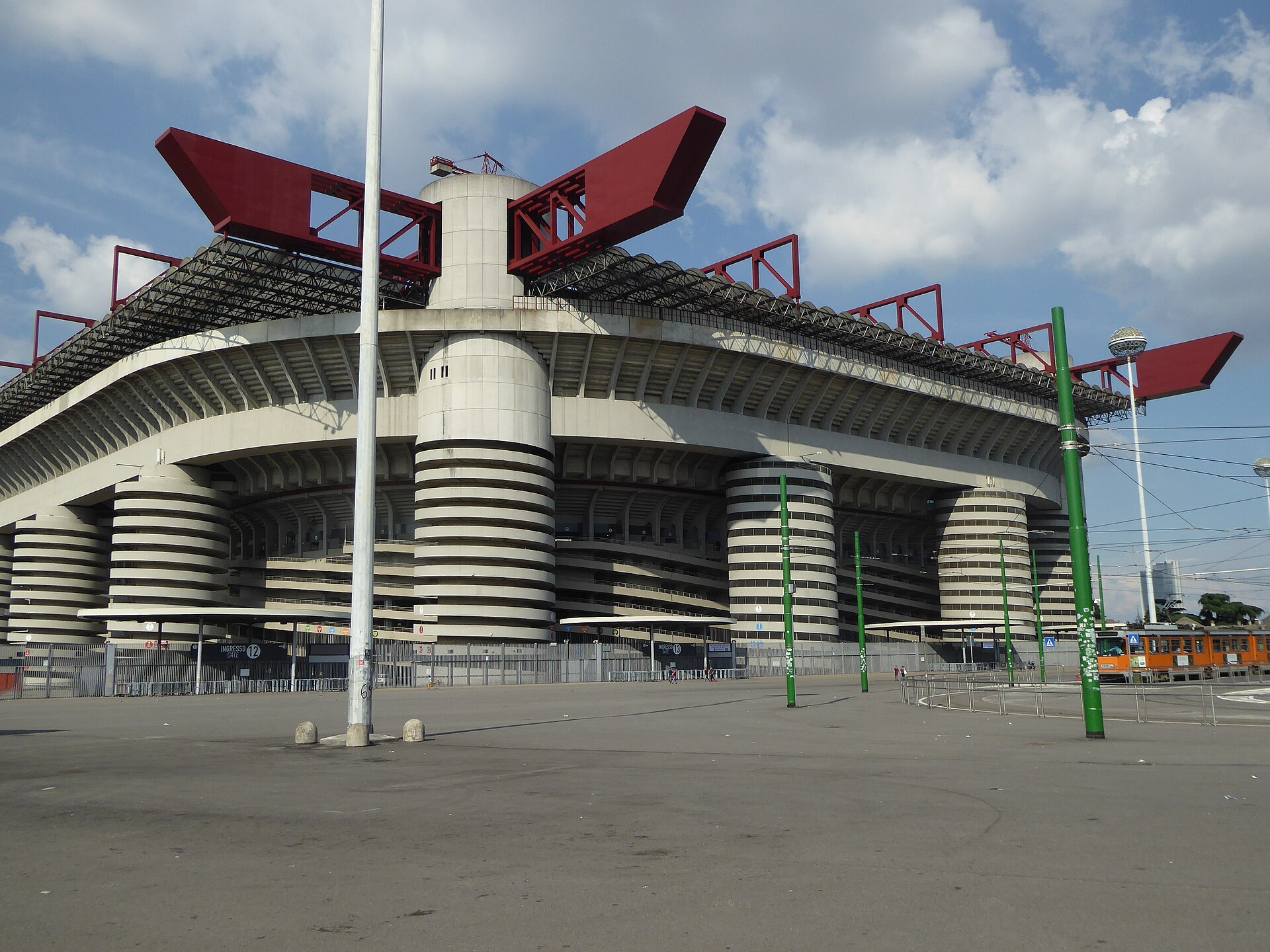
San Siro’s seating plan is two long sides and two ends, each split into three rings. On the plan, the sides are the Tribuna Rossa (red) and Tribuna Arancio (orange); the ends are the Curva Nord and Curva Sud, shown in green and blue. For a Milan match, the Curva Sud is the home ultras’ end.
Each of those is divided into primo anello (first ring, closest to the pitch), secondo anello (second, the middle tier) and terzo anello (third, the steep upper deck added for Italia ’90).
The options, honestly assessed
- Curva Sud — the cheapest seats in the ground and the loudest. Tickets have run from around €10 for a small fixture to €30 and up for a big one. Everybody stands for ninety minutes, there are flags in front of you, and you will see perhaps two thirds of the football. Take it for the experience, not for the match.
- Terzo anello laterale and the corners — the best cheap seats that are actually seats, often around €30 for a mid-table Serie A game. Very high and very steep, with a superb view of the shape of the game and a distant view of the players. Not for anyone uneasy about heights, and genuinely cold in midwinter.
- Secondo anello Rosso or Arancio — my recommendation for a first visit. The middle tier of the long sides, typically somewhere around €50–90 depending on the opponent, and the best balance in the stadium: high enough to read the play, close enough to see faces, and with the choreography in both curves laid out in front of you.
- Primo anello — the lower tier, roughly €60–110. Closest to the pitch and the most atmospheric of the seated options, though the sightlines from the very front rows are flatter than you would like.
- Premium and hospitality — the club sells hospitality packages under the Club 1899 banner. Comfortable, catered, expensive, and quiet.
All of these prices move with the opponent. Serie A clubs price by fixture category, and the same seat can cost three times as much for the derby as for a Monday-night game against a promoted side. Check the price list for your specific match on the club’s own site — any figure you read anywhere, including here, is a guide to the shape of the pricing rather than a quote.
Getting to the match
The M5 lilac metro runs to San Siro Stadio, its terminus, on a standard €2.20 urban ticket; change onto it at Garibaldi FS from the M2, or at Lotto from the M1. Tram 16 is the slower, nicer alternative from the centre, and the wider network is explained in our Milan transport guide. Arrive early — security queues for 75,000 people are not fast — and expect the metro home to be a crush.
The full matchday transport picture, including how to avoid the worst of the exit, is in our getting to San Siro guide.
Buying for a group
Groups are where the name rule bites hardest, so plan it before you open the booking page.
Collect everybody’s full name exactly as it appears on their passport, in advance, in a single list. You will be entering all of them during the purchase, often against a session timer, and hunting through a group chat for how a friend spells their middle name is how you lose the seats you had selected.
Seats are not always allocated together automatically. Where the platform lets you pick, pick; where it does not, buy in one transaction rather than several, which gives the system the best chance of keeping you in a block. For a group of six or more in a busy sector, accept that you may end up in two adjacent rows rather than one.
If somebody drops out, use the official change-of-name process rather than passing the ticket along. And if somebody’s passport is in a different name from the one they gave you — a maiden name, a shortened first name — fix it before the day, not at the turnstile.
What a match actually costs, all in
Useful for budgeting a football trip rather than just a ticket:
- Ticket — €10–30 for a cheap seat at an ordinary fixture, €50–90 for the comfortable middle tier, considerably more for a big game.
- Cuore Rossonero card — €20, and only if you need the early access. Spread across four years if you come back.
- Metro, both ways — €2.20 each way on a standard urban ticket, or free if you already hold a day pass. The Milan metro guide covers the fare options.
- Food before the game — whatever you would spend on dinner anyway, and worth doing properly rather than inside the ground.
- A shirt, if you must — the flagship store on Via Dante and Casa Milan both sell them, at the same price.
For a standard league match in the upper ring, with transport, you are realistically looking at under €40 a head before food. That is less than a lot of the ticketed attractions in the city centre, and it is a considerably better story afterwards.
Other Milan tickets worth knowing about
- AC Milan Women play at a small ground in the city, and tickets are cheap and easy. If your dates do not line up with a men’s fixture, this is a genuinely good afternoon and you will get in without any of the above drama.
- Milan Futuro, the club’s under-23 side, plays in the lower divisions with its own ticketing.
- The Mondo Milan museum at Casa Milan covers the club’s history and trophies, separately from the San Siro stadium tour. If you are a Milan supporter rather than a football tourist, this is the one you actually want.
- The San Siro stadium tour — €31, opening at 09:30 and closing at 17:00 from November to March and 18:00 from April to October. Hours can change on matchdays and event days. Details in our San Siro stadium tour guide.
The other side of the city works differently, and in places more cheaply — the comparison is in our Inter Milan tickets guide.
What to do on the day
- Bring your passport. Repeated because it is the number-one reason visitors miss kick-off.
- Travel light. Large bags are not allowed and there is no cloakroom to rely on.
- Arrive at least forty minutes early, and ideally more. Turnstiles open around two hours before.
- Eat first. Stadium catering is poor and the queues are long.
- Wear red and black or wear neutral. Not the away team’s colours, anywhere except the away section.
- Download or print the ticket in advance. Mobile signal around a full San Siro is unreliable.
Frequently asked questions
How much are AC Milan tickets?
From roughly €10 in the Curva Sud for a low-category fixture, around €30 for the upper ring at an ordinary league match, and €50–110 for the middle and lower rings. Big fixtures cost substantially more across every sector. The club prices by opponent category, so check the list for your specific match.
Where is the official place to buy AC Milan tickets?
The club’s own website, the Casa Milan ticket office, the flagship store on Via Dante, and Vivaticket sales points in Italy. Those four are the official channels; everything else carries risk.
Do AC Milan tickets have to be in my name?
Yes. Every ticket is personalised and photo ID is checked at the turnstile. If you buy for a group, you enter each person’s real name at purchase, and each of them brings matching ID.
Can I transfer an AC Milan ticket to someone else?
Only through the club’s official change-of-name process, which runs on its ticketing platform with a deadline before the match and sometimes a fee. Handing over a ticket informally does not work — the name will not match at the gate.
Is the Cuore Rossonero card worth it?
For a high-demand match, yes: €20 for four years to get into an earlier sales phase is cheap insurance. For an ordinary league fixture, no — general sale is more than adequate.
Can I buy AC Milan tickets on the day at the stadium?
For lower-category fixtures there is often availability, but do not rely on it, and you will still need to provide your name and show ID. Buying online the week before is easier and usually cheaper.
What is the best seat at San Siro for a first visit?
Secondo anello, Rossa or Arancio, ideally towards a corner. You get height, a full view of both curves’ choreography, and a seat you can actually sit in. The Curva Sud is a better story and a worse view.
How early do AC Milan tickets go on sale?
Usually two to three weeks before the match for general sale, with season-ticket holders and Cuore Rossonero members served first. Kick-off times are often confirmed later than tickets go on sale, so be careful with non-refundable travel.
What happens if the match is moved?
Tickets remain valid for the rescheduled time in almost all cases — it is your flights that are the problem, not your ticket. This is the strongest argument for booking flexible travel around a Serie A fixture.
Final thoughts
Strip away the bureaucracy and this is one of the cheapest great experiences in European football. Thirty euros puts you in the third ring of a seventy-five-thousand-seat stadium that will not exist in its current form for many more years, watching a club with seven European Cups, in a city where the game genuinely matters.
Do three things and nothing will go wrong: buy from the club, put the right names on the tickets, and take your passport. Everything else is detail.
The wider picture — the stadium’s future, matchdays, the derby and what else there is to watch in the city — is in our football in Milan guide.
Supporting the other lot, or just going to whichever match falls on your dates? The equivalent walkthrough is our Inter Milan tickets guide.
And for the one match that breaks all these rules, see our Derby della Madonnina guide.