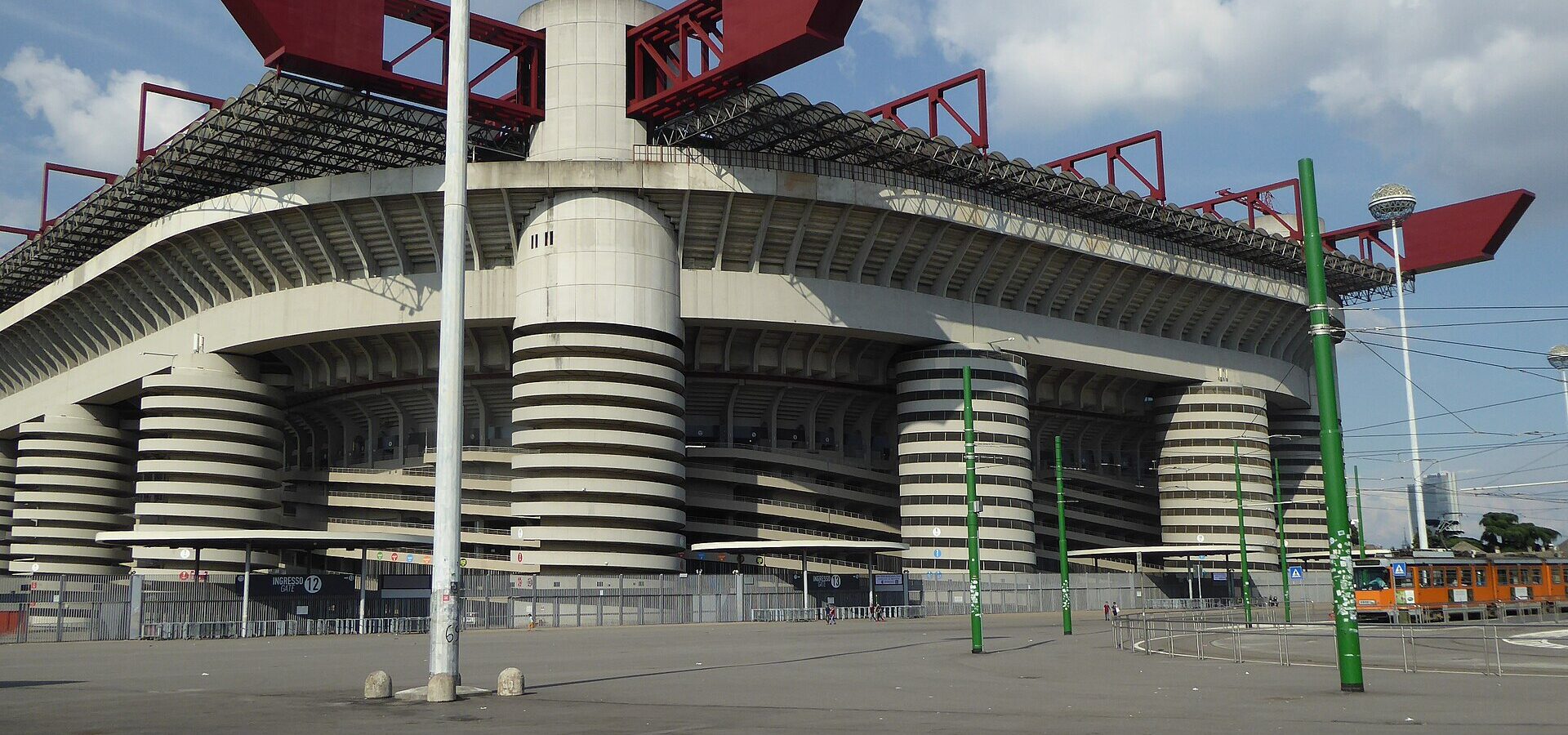
Go now. That is the first and most important thing in this guide, and it is not a sales line. San Siro has been sold to the two clubs that play in it, UEFA has declared it unfit for Euro 2032, the historic southern ticket office was demolished in June 2026, and the plan on the table is to knock down most of the stadium and build a new one on the same site. The demolition date has slipped repeatedly and has been fought in court — but the direction of travel is one way, and the ground that hosted two European Cup finals, a World Cup semi-final and the Milano-Cortina opening ceremony is on borrowed time.
Here is everything a visiting fan needs. San Siro — officially the Stadio Giuseppe Meazza — is shared by AC Milan and Internazionale, which makes it one of the very few grounds in world football used by two clubs in the same division. It holds around 75,000. Between them the two clubs play 19 home league matches each, roughly from mid-August to late May, plus cups and Europe, so on most weekends of the season there is football at San Siro. Buy tickets only from the clubs’ own sites or their official partners, buy them in the name of the person who will use them, and bring the matching photo ID to the turnstile or you will not get in. Get there on the M5 lilac metro to San Siro Stadio. And if there is no match while you are in town, the stadium tour and museum costs €31 and is genuinely worth doing.
What follows is the whole thing: how the two clubs work, how the ticketing actually operates, how to get out to the ground and back, what happens on a matchday, and what to do if you cannot get in.
Two clubs, one stadium
Milan’s football rivalry starts with a schism. Milan Foot-Ball and Cricket Club was founded in 1899 by a group including an Englishman from Nottingham named Herbert Kilpin, which is why the club is “Milan” and not “Milano” to this day. In 1908 a faction broke away over the club’s reluctance to field foreign players and founded Football Club Internazionale — a name chosen precisely to make the point.
They have shared a stadium since 1947. San Siro was built in 1926 by Piero Pirelli, of the tyre family, as a ground for Milan; Inter moved in twenty years later and never left. In 1980 it was renamed after Giuseppe Meazza, who had the excellent judgement to play for both.
You will hear both names used. Locals and the clubs mostly say San Siro, which is also the name of the district. Official documents and the more pedantic broadcasters say Meazza. They are the same building.
- AC Milan — red and black, rossoneri. Curva Sud is their end.
- Internazionale — blue and black, nerazzurri. Curva Nord is theirs.
The practical consequence for a visitor is excellent: with two clubs sharing a ground, there is football at San Siro far more often than at a normal stadium. In a busy week you can get a league match on the Saturday and a European tie on the Wednesday, in the same seat, watching different teams.
What is happening to San Siro
This is the part every other guide is vague about, so let us be precise about what is known and honest about what is not.
What has happened. Milan’s city council approved the sale of the stadium and the surrounding land to AC Milan and Inter for around €197 million. UEFA has ruled the ground unfit to host matches at Euro 2032. Preparatory work has started around the site, and the historic ticket office on the southern side was demolished in June 2026. The clubs’ stated plan is a new stadium on the same land, finished in time for Euro 2032, with most of the existing Meazza demolished.
What is not settled. Five appeals from residents’ associations and civic groups went before the Lombardy regional administrative court, which declared four inadmissible and rejected the fifth on 6 October 2026. In April 2026 prosecutors opened an inquiry into whether the sale process was manipulated. Groundbreaking has been targeted and re-targeted more than once. Anyone who tells you the date San Siro will close is guessing.
What it means for you. For the seasons immediately ahead, both clubs are still playing here and the stadium tour is still running. If seeing San Siro matters to you, do not put it off to a trip in three years’ time. Check the current position before you book anything built around it, because this story moves.
There is a real argument on the other side, incidentally, and it is worth knowing if you get talking to anyone in a bar near the ground. San Siro’s sightlines are poor from parts of the third ring, the concourses are cramped, the roof leaks and accessibility is bad by modern standards. Plenty of Milanese think a new stadium is overdue. Plenty of others think selling a public monument to two private clubs for €197 million was a scandal. Both views are held strongly and neither is stupid.
The season, and when to come
Serie A runs from around mid-August to late May, with each club playing 19 home league matches. Add the Coppa Italia from autumn onwards and European football on Tuesdays, Wednesdays and Thursdays, and San Siro is in use most weeks between August and May.
- Fixtures are confirmed late. Serie A moves kick-off times for television, often only four to six weeks in advance. A match listed as “Sunday” months out can end up at 12:30, 15:00, 18:00 or 20:45. Do not book non-refundable travel around a kick-off time that has not been confirmed.
- There is a winter break of a couple of weeks around Christmas and New Year. Check before planning a football trip for early January.
- Autumn and spring are the pleasant times to watch. A 20:45 kick-off in January at San Siro is genuinely cold — the upper rings are exposed and the roof does not help.
- The big matches — the derby, Juventus, Napoli, and Champions League knockout ties — sell out fastest and cost most.
Milan’s wider calendar of what is on when is in our Milan events and festivals calendar.
Getting a ticket
Italian football ticketing is more bureaucratic than most visitors expect, and the bureaucracy is where trips go wrong. Four rules cover almost everything.
1. Tickets are personal, and ID is checked
Every ticket carries the name of the person who will use it, and you must present matching photo ID at the turnstile. This is not a formality that gets waved through. If you buy four tickets, you enter four sets of real names at the point of purchase, and each of those people needs their passport or ID card on the day.
The corollary matters: you cannot buy a ticket in your name and give it to a friend. There is an official change-of-name process for most matches, run through the club, usually with a deadline and sometimes a fee. Use that rather than hoping.
2. Buy from the club or an official partner
Both clubs sell directly through their own websites, and both use official ticketing partners. Because of the name rule, tickets bought on general resale marketplaces frequently carry someone else’s name and are simply not usable — you will be turned away at the gate and you will not get your money back. This is the single most common way visitors lose money on Italian football.
Legitimate resale, where it exists, happens through the club’s own platform, where the name is transferred properly. If a site is not the club’s or its named partner, treat it as a gamble.
3. Sales open in stages
Tickets are typically released to season-ticket holders first, then to club members, then to the general public, over a period of roughly two to three weeks before the match. For an ordinary league fixture against mid-table opposition, general sale is usually more than enough and seats remain available in the week of the game. For the derby or a Champions League knockout tie, the general-sale window can be brief and the good areas go immediately.
4. Membership helps for the big games
Both clubs run paid membership schemes that give earlier access to ticket sales along with other benefits. If your trip is built around a specific high-demand fixture and the dates cannot move, membership is worth the cost purely as a queue position. For a normal league match it is unnecessary.
The full step-by-step for the rossoneri is in our AC Milan tickets guide.
And for the nerazzurri, our Inter Milan tickets guide.
Where to sit, and what it costs
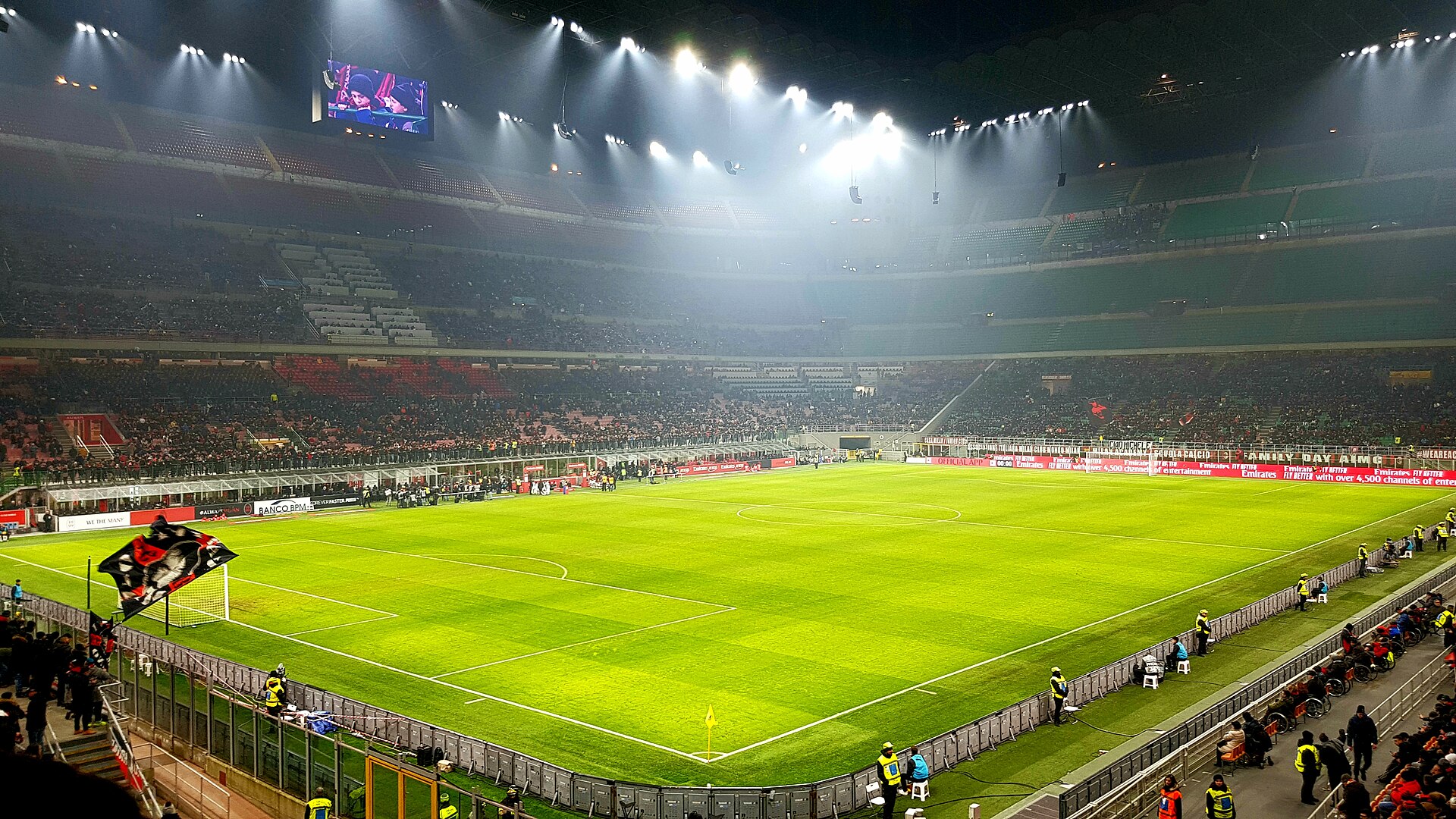
San Siro is a three-ring bowl and the ring you choose changes the experience more than the price difference suggests.
- Primo anello (first ring) — closest to the pitch, best for seeing the game as a game. The lower corners are usually the best value in the ground.
- Secondo anello (second ring) — the middle tier, a good compromise of height and proximity, and generally the sensible default.
- Terzo anello (third ring) — added for Italia ’90, very high and very steep. The view of the whole pitch is superb and the view of individual players is distant. Not for anyone who dislikes heights, and cold in winter.
- Curva Sud and Curva Nord — the ultras’ ends, Milan and Inter respectively. Standing, singing, flags, flares, and nobody sits down for ninety minutes. Extraordinary atmosphere and not the place for a first-time visitor with children.
- Tribuna — the main stands along the sides. Most expensive, most comfortable, quietest.
Prices swing enormously with the opponent. An ordinary league match against mid-table opposition can start in the low tens of euros in the upper ring, while a derby or a European knockout tie in the tribuna runs into the hundreds. Check the club’s own price list for your specific fixture rather than trusting a general figure, because Serie A clubs price by category and the same seat can cost three times as much for a different opponent.
The Derby della Madonnina
Milan against Inter, twice a season in the league, named after the golden Madonnina on top of the Duomo that looks over the whole city.
It is one of the great derbies in football, and it has a quality that few others do: both sets of fans occupy the same stadium every other week, so it is a derby without an away trip. Both curve fill with choreography, the noise is genuinely startling, and the city stops.
Practically, it is the hardest ticket of the season and the most expensive. If it is the reason you are coming, plan around the sales windows, consider club membership for the earlier access, and have a fallback: watching the derby in a bar in Milan is not a consolation prize, it is a very good night out in its own right.
Everything about the fixture, including how to get in and where to watch if you cannot, is in our Derby della Madonnina guide.
Getting to San Siro
The stadium is about six kilometres north-west of the Duomo, which sounds far and is not. Milan’s transport handles 75,000 people rather well — the full network is explained in our Milan metro guide.
Metro M5 (lilac)
The obvious answer. The M5 runs to San Siro Stadio, which is the line’s terminus and is a few minutes’ walk from the turnstiles. From the city centre, change onto the M5 at Garibaldi FS (from M2) or Lotto (from M1). A standard urban ticket covers it — €2.20, valid 90 minutes — and contactless works at the gates.
Allow more time than the journey planner says on a matchday. The platforms at San Siro Stadio queue heavily before kick-off and even more heavily afterwards.
Tram 16
The nicer option, and my preference. Tram 16 runs from the city centre out to San Siro, above ground, through ordinary Milanese neighbourhoods, on an old tram. It takes longer than the metro and it is far more pleasant, and after the match it is often quicker to walk five minutes to the tram than to join the crush at the metro.
Bus and taxi
Bus 49 serves the area, and additional services run on matchdays. Taxis are plentiful before a match and effectively impossible in the half hour after one; if you want a taxi at full time, walk fifteen minutes away from the ground first and order from there. Ride-hailing behaves the same way.
Driving
Don’t. Parking around San Siro on a matchday is scarce, expensive and heavily policed, and much of central Milan is inside Area C, which costs €7.50 a day on weekdays. The metro exists.
Getting away afterwards
Seventy-five thousand people leave at once. Three approaches work:
- Leave five minutes early, if you can bear to. It saves half an hour.
- Stay put for twenty minutes. Bars around the ground are open and busy; the crowd thins fast.
- Walk to Lotto (about twenty minutes) and pick up the M1 or M5 there, away from the worst of the queue.
If your match is a 20:45 kick-off, note that the metro’s last departures are around 00:30 and night buses NM1–NM4 replace it afterwards, on the same tickets. Late-night options are in our Milan transport guide.
Matchday: what actually happens
Before the game
Turnstiles open around two hours before kick-off, and it is worth using that time. The area around the ground fills with stalls, food vans and supporters, and the Ippodromo Snai San Siro racecourse is right next door with Leonardo’s giant bronze horse standing outside it — a monument to a sculpture Leonardo da Vinci designed in the 1490s and never cast.
Get through security earlier rather than later. Queues at the gates build steeply in the last thirty minutes and the checks are not quick.
Security and what you cannot bring
- Photo ID matching the ticket name. Non-negotiable. Passport for visitors.
- Bags are restricted. Large bags are not permitted and there is no cloakroom worth relying on. Bring as little as possible.
- No bottle tops, no glass, no cans. Bottles are decapped at the gate.
- Alcohol restrictions apply in and around the stadium for certain matches, and can be imposed by the local prefect on a fixture-by-fixture basis.
- No flares, obviously, whatever you see coming out of the curve.
- Colours. Wearing the away side’s shirt in a home section is a genuinely bad idea, and stewards will move you.
Food, drink and facilities
Honestly: poor by modern standards, and this is one of the better arguments for the new stadium. The concourses are narrow and the catering is basic — panini, beer, coffee. Eat before you come. The neighbourhood around the ground has plenty of options and Milan’s food generally is far better than anything you will be sold inside a football stadium; start with our Milan food guide.
The atmosphere
Worth setting expectations. The two curve generate a spectacular, organised, continuous noise — drums, choreography, banners the height of a stand. The rest of the ground is often much quieter than an English visitor expects, particularly in the tribuna, and Italian crowds whistle rather than boo. For a big European night it is one of the great atmospheres in football. For a Monday-night league game against a struggling side, it can be surprisingly flat.
The stadium tour and museum
If there is no match while you are in Milan — or if there is one and you want to see the place properly anyway — the tour is good, and given the stadium’s future it has an added poignancy.
- Price: €31 for everyone aged 7 and over; under-6s free.
- Hours: daily 10:00–17:00, with departures roughly every 20 minutes. Allow about an hour.
- Includes: the dressing rooms, the players’ tunnel, pitchside, and the museum with both clubs’ trophies and shirts.
- Closed on matchdays, and on the day before a Champions League match. Check the official site before travelling out there — this catches people out constantly.
- A separate Skywalk experience is sold, and a VR attraction was announced for autumn 2026.
Our dedicated write-up of the visit is in the San Siro stadium tour guide.
For matchday transport in more detail — timings, the tram, and the crush afterwards — see our getting to San Siro guide.
If you cannot get a ticket
Watching football in an Italian bar is not a downgrade. Milan is a city where the game is on in half the bars in the neighbourhood, and a derby watched in a packed bar in Isola or Navigli with a plate of something and a crowd who care enormously is a better evening than a bad seat in the third ring.
What to look for: a neighbourhood bar rather than a sports bar aimed at tourists, a television visible from the room rather than one screen in a corner, and a crowd already there an hour before kick-off. Navigli, Isola and Porta Romana are all reliable. Our best bars in Milan and Navigli guide are good starting points, though for a match you want the unglamorous places rather than the cocktail bars.
Two other options worth knowing: Casa Milan, the club’s headquarters on Via Aldo Rossi, has a museum and the main club store, and it is open on non-matchdays; and both clubs’ training grounds — Milanello for Milan, Appiano Gentile for Inter — occasionally open sessions to the public, though you should not plan a day around it without checking.
No ticket, or the wrong week entirely? Our guide to where to watch football in Milan covers the pubs and neighbourhood bars that carry the fixtures.
Other sport in Milan
Football is not the whole story, and if your dates do not line up with a San Siro fixture there are alternatives.
- Horse racing at the Ippodromo Snai San Siro, immediately beside the stadium — flat racing at one of Europe’s handsomer racecourses, with the Leonardo horse at the gate.
- Basketball — Olimpia Milano play at the Unipol Forum in Assago, reachable on the M2. Italian basketball is well supported and tickets are far easier to get than football ones.
- Formula 1 — the Italian Grand Prix at Monza, half an hour north-east by train, in early September. The Autodromo is also open to visit at other times.
- AC Monza play at the U-Power Stadium in Monza, an easy train ride and a much easier ticket than San Siro if you simply want to watch Italian football live.
- The 2026 Winter Olympics came through here in February 2026, with the opening ceremony held at San Siro itself — a strange and rather wonderful use of a football ground.
Milan’s other great spectator weekend happens fifteen kilometres north at the Autodromo — our Italian Grand Prix at Monza guide covers doing the race from a city base.
Eight mistakes visitors make
Every one of these has cost somebody a match. In rough order of how often I have seen it happen:
- Buying from a general resale marketplace. The ticket arrives in a stranger’s name and is worthless at the turnstile. This is the big one, and the money is rarely recoverable.
- Turning up without ID. Your ticket, your passport, matching names. Leaving the passport in the hotel safe because you did not want to carry it is a genuinely common way to miss kick-off.
- Booking flights around an unconfirmed kick-off time. Serie A moves matches for television, sometimes six weeks out and occasionally later. A Sunday fixture can end up at 12:30 or at 20:45, and those are different weekends.
- Assuming the stadium tour runs on a matchday. It does not, nor on the day before a Champions League game, and people travel out there to find the doors shut.
- Arriving twenty minutes before kick-off. Security queues at 75,000 capacity are not quick. Two hours early is not excessive; forty minutes is the minimum that works.
- Wearing the away shirt in a home area. Stewards will move you, and you will have spoiled your own evening for no reason.
- Planning to eat inside. The catering is poor and the queues are long. Eat before you travel out.
- Trying to get a taxi at full time. Not going to happen. Walk to Lotto, or wait twenty minutes in a bar.
Why football in Milan is worth the effort
All the bureaucracy above is real, and it is worth saying plainly why it is worth going through.
Milan is one of a very small number of cities where two clubs of genuine European stature share a single ground. That means the stadium is in use roughly twice as often as a normal one, so a visitor’s chances of catching a match are far better than in London or Madrid; it means the building itself is neutral ground, decorated for whichever club is at home that week; and it means the derby is played without either side travelling, which produces a fixture where both ends of the stadium mount full choreography at the same time.
It also means the city carries its football more visibly than most. Bar televisions, shirts on the metro on a Saturday afternoon, the two club stores in the centre, the flow of people out to the M5 in the late afternoon — football in Milan is not something that happens in a stadium on the edge of town and stays there. It runs through the week, and it is one of the few things about this rather formal, rather buttoned-up city that is genuinely loud.
And the ground is on its way out. Not next month, and possibly not for several years given how the legal position is going — but it is going. That is not a reason to panic-book, but it is a reason to say yes if the dates happen to work.
A football weekend in Milan
If you are building a trip around a match, this shape works:
- Friday — arrive, eat properly somewhere central, and check the confirmed kick-off time one more time.
- Saturday morning — the city: Duomo, Galleria, and whatever else fits. Our two days in Milan itinerary covers the ground efficiently.
- Saturday afternoon — out to San Siro two hours before kick-off. Eat near the ground, walk round the outside, look at the horse.
- Saturday evening — the match, then stay near the ground for twenty minutes rather than joining the crush.
- Sunday — the stadium tour if there is no match on (it is closed if there is), or Casa Milan, or a day out to Lake Como, which is an hour away.
More ways to fill the non-football hours are in our things to do in Milan guide and the full Milan itineraries guide. If you have not booked a bed yet, start with where to stay in Milan — for a football trip, anywhere on the M1 or M5 is sensible.
Frequently asked questions
Can I just turn up and buy a ticket at San Siro?
Sometimes, for an ordinary league match against unglamorous opposition, tickets remain available in the days before and on the day. For anything bigger, no. And because tickets are personalised, buying at the last minute still means providing your name and showing ID, so it is not the casual walk-up you may be used to.
Do I need ID to get into San Siro?
Yes. Every ticket carries a named holder and photo ID is checked at the turnstile. Bring your passport. A ticket bought in someone else’s name will not get you in.
How much are tickets for AC Milan or Inter?
It depends enormously on the opponent. An ordinary league match can start in the low tens of euros high up in the third ring; a derby or a Champions League knockout tie in the main stand runs into the hundreds. Check the club’s price list for your specific fixture rather than a general figure.
Which is better, Curva or Tribuna?
Curva for atmosphere, Tribuna for comfort and for actually watching the football. First-timers who want the noise without the intensity should look at the second ring near a corner — you get the choreography in view and a seat you can sit in.
How do I get to San Siro from the Duomo?
Metro M5 to San Siro Stadio, changing at Garibaldi FS or Lotto, on a standard €2.20 urban ticket. Tram 16 is the slower and more enjoyable alternative. Allow extra time in both directions on a matchday.
Is San Siro being demolished?
That is the plan. The clubs bought the stadium and its land from the city, UEFA has ruled it unfit for Euro 2032, and preparatory works have begun. But the timetable has slipped repeatedly and there is live litigation, so no date should be treated as fixed. If seeing San Siro matters to you, do not wait.
Can I do the stadium tour on a matchday?
No. The tour does not run on match days, or on the day before a Champions League match. Check the official site before making the trip out there.
Is San Siro safe for families and neutrals?
Yes, in the tribuna and the ordinary ring seating. The curve are a different proposition — not dangerous, but loud, dense, standing throughout and not somewhere to take a small child. Avoid wearing the away team’s colours anywhere except the away section.
Which club should a neutral watch?
Whichever is playing on the day you are free. If both are at home in the same week, take the bigger opponent — the atmosphere follows the fixture, not the club.
Final thoughts
San Siro is not the best-appointed stadium in Europe. The concourses are cramped, the catering is dismal, the third ring is a long way from the pitch and the roof lets water through. Everything the developers say about it is true.
It is also, on a European night with both rings full and a curva in full voice, one of the great sights in football — a vast concrete cylinder wrapped in spiral ramps and red girders, sitting in a suburb next to a racecourse, holding seventy-five thousand people who care very much. There will be a new stadium and it will be more comfortable and it will not be this.
So if you are in Milan and there is a match on, go. If there is not, do the tour. Buy from the club, put the right names on the tickets, take your passport, get the M5 out and the tram back, and eat before you go in.