The Museo del Novecento Milan is the one museum I send art-curious travelers to before any other 20th-century stop in the city. It sits inside the Arengario, the blocky travertine palace on the south side of Piazza del Duomo, which means you can walk out of the cathedral, cross the square, and be looking at a Boccioni sculpture inside of ten minutes. This is Milan’s premier 20th-century Italian art museum, built specifically to give the city’s enormous holdings of Futurism, Metaphysical painting, Arte Povera, and postwar abstraction a permanent home. I’ve been back four times in three years, and the collection still surprises me.
Most first-time visitors to Milan budget for the Duomo, the Last Supper, and maybe Brera, then run out of time. The Museo del Novecento is the one I’d add even at the cost of cutting something else. The building itself is a Mussolini-era civic project repurposed by Italo Rota into one of the most coherent museum interiors in Italy, and the view of the Duomo from the fourth floor is the cleanest you’ll get without paying for cathedral roof access.

Why it’s worth your time
Three reasons, in order of importance. First, the collection. The Museo del Novecento opened in December 2010 with around 400 works on display, drawn from the Civic Collections of Milan and curated to walk you through the entire arc of Italian 20th-century art. You start with Pellizza da Volpedo’s pre-Futurist social realism, move into Boccioni and Balla and the Futurist explosion, hit Morandi’s quiet still lifes and de Chirico’s Metaphysical squares, and end up with Fontana’s slashed canvases and Manzoni’s white surfaces. There is no other museum in Italy where you can do this in 90 minutes under one roof.
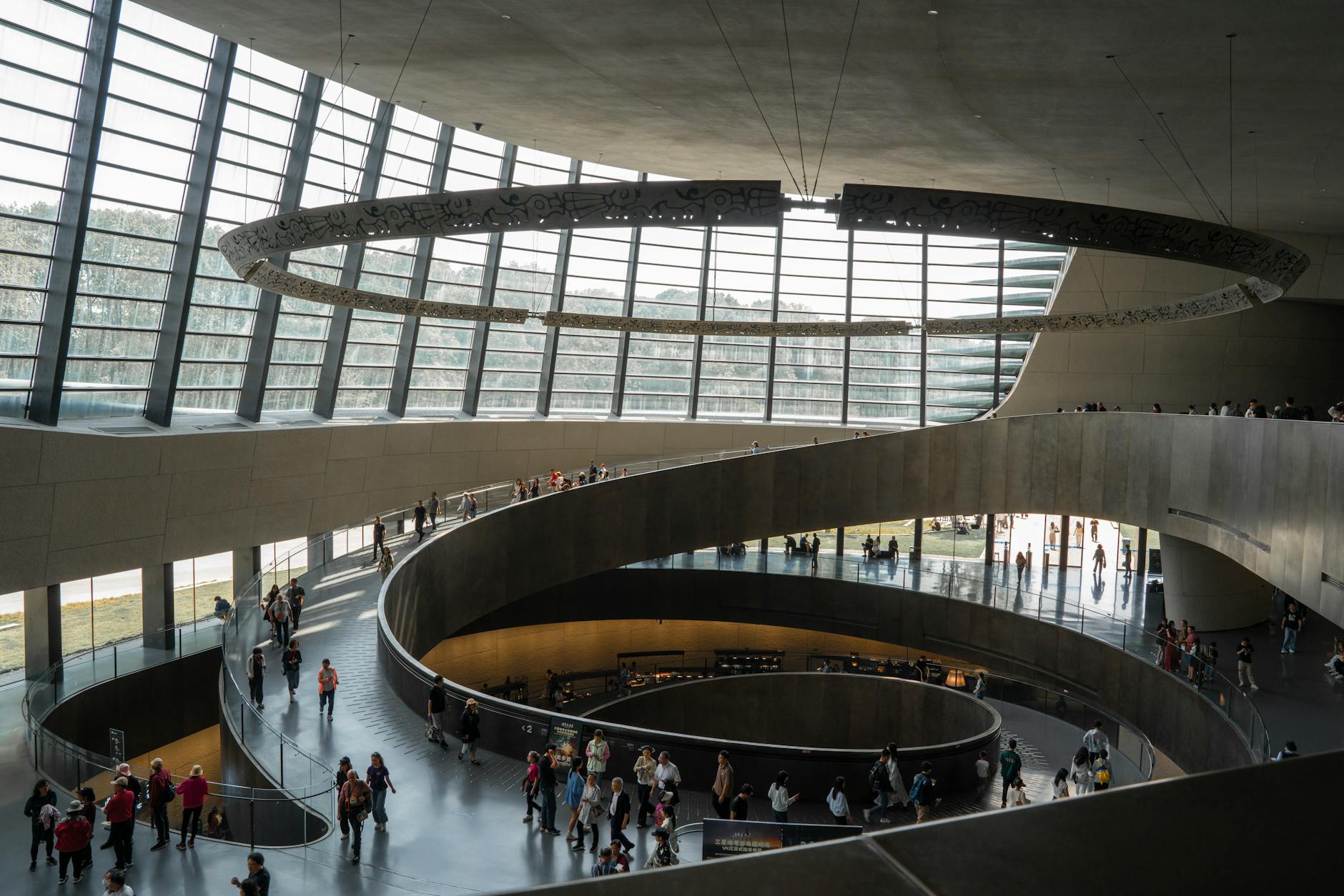
Second, the building. The Arengario was designed in the late 1930s as a Fascist civic platform — the balcony facing the Duomo was literally engineered for Mussolini to address crowds from. Rota’s 2010 conversion threaded a helical concrete ramp through the central void, which means you ascend through the collection rather than working through corridors. It’s one of the few museums where the architecture is part of the experience instead of fighting it.
Third, the location. Almost every major Milan attraction sits within a 15-minute walk: the Duomo (60 seconds), the Galleria Vittorio Emanuele II (3 minutes), La Scala (6 minutes), the Castello Sforzesco (12 minutes). You can fold the Novecento into any central-Milan day without redesigning your itinerary.
Getting there: address, hours, tickets
The museum is at Piazza del Duomo 8, 20123 Milano. The entrance is on the cathedral side of the Arengario, not the Via Marconi side, which is a mistake I made the first time. Look for the glass doors under the colonnade — there’s almost always a short line snaking along the arcade.
Metro: Duomo station on lines M1 (red) and M3 (yellow). Exit toward Piazza del Duomo and the Arengario is the building immediately on your left as you face the cathedral. From Milano Centrale, the M3 yellow line takes about 8 minutes.
Hours: Tuesday to Sunday, 10:00 to 19:30, with Thursday extended to 22:30. Closed Mondays, December 25, and January 1. Last entry is one hour before closing. The Thursday late opening is the visit I recommend if you’re staying central — the crowds thin out after 18:00 and the light through the upper-floor glass over the Duomo is at its best from about 19:00 onward in summer.
Ticket: €10 full price, €8 reduced (visitors aged 18-25, groups of 10+), free for under-18s, EU students of art history, and disabled visitors with one companion. Free entry on the first Sunday of every month (time-slot reservation required — book online or you won’t get in).
Tickets are sold at the door and online via Vivaticket. I buy at the door for normal-day visits — there’s rarely more than a 10-minute wait — and online only for free Sundays, which book out a week ahead in high season.
The Arengario building itself
If you read nothing else about the museum, read this section, because the architecture explains the entire visitor experience. The Arengario is two symmetrical buildings (north and south wings) designed by a four-architect team — Piero Portaluppi, Giovanni Muzio, Pier Giulio Magistretti, and Enrico Agostino Griffini — and built between 1936 and 1956. Construction began under the Fascist regime as a propaganda platform for the regime’s mass rallies in the Duomo square, was bombed during the war, and was finally finished in austere postwar form after Mussolini was already dead. The facade is stripped classicism in travertine, with four bas-reliefs by Arturo Martini that you can still read on the front elevation if you stand back across the piazza.
The interior is where it gets interesting. When Milan decided to convert the south wing into the Museo del Novecento in the late 2000s, the architects Italo Rota and Fabio Fornasari gutted the central drum and installed a continuous helical concrete ramp that spirals upward through the building. You ride an escalator down from the entrance hall and then climb the spiral on foot, which means your first artwork is Pellizza da Volpedo at the bottom of the spiral and your last is Fontana up at the top under the glass roof. The progression is chronological and physical at the same time. It’s the closest thing Milan has to the Guggenheim New York’s rotunda, and arguably more functional because the galleries actually open off the ramp at each level.
Top masterpieces: what to actually look at
The full collection is over 4,000 works with roughly 500 on display at any time. These are the pieces I make sure to see on every visit.
1. Boccioni’s Unique Forms of Continuity in Space (1913)
This is the marquee object — the bronze figure striding forward, its musculature blurred into aerodynamic flames, that you’ve seen on the back of the Italian 20-cent euro coin. Forme uniche della continuità nello spazio is Umberto Boccioni’s manifesto cast in metal: the human body dissolved into pure forward motion. The Museo del Novecento holds one of the original posthumous casts (the plaster original is at São Paulo, and casts also exist at MoMA and the Met). Stand to its left at about 45 degrees — the sculpture is engineered to be most legible from that angle, where the leading thigh becomes a sail.
2. Boccioni’s Triptych of States of Mind (1911)
Stati d’animo — three large canvases titled The Farewells, Those Who Go, and Those Who Stay — is Boccioni’s attempt to paint emotional time at a train station. The numbers and steam in The Farewells are legible; the horizontal blue strokes of Those Who Go are pure velocity; Those Who Stay is a downward grid of grief. Together they’re probably the most ambitious single Futurist statement in painting. Give them ten minutes, not two.
3. Modigliani’s Portrait of Paul Guillaume (1916)
The Modigliani room holds several portraits, but the small Ritratto di Paul Guillaume — the Parisian dealer who first championed Modigliani — is the one I return to. The elongated neck, the green-tinged background, the unfocused eyes: it’s a textbook Modigliani and one of the few in any Italian museum. After his death in 1920, most of his work scattered to Paris and New York.
4. Morandi’s still lifes
Giorgio Morandi spent his life painting bottles and tins in his Bologna studio, and the Novecento has a room of small canvases that read like a single extended meditation. The colors are gray-pink, dust-yellow, bone-white. After the Futurist noise downstairs, this room is the museum’s exhale. I usually sit on the bench for five minutes.
5. De Chirico’s Metaphysical paintings
Giorgio de Chirico’s empty Italian piazzas, with their long shadows and faceless mannequins, invented the visual language that Surrealism would later borrow. The Novecento holds several including The Mysterious Bath and The Disquieting Muses variants. The arcades in his paintings are recognizably Italian — pay attention to how the building you’re standing in (the Arengario) is itself an arcaded piazza building from roughly the same period.
6. Lucio Fontana’s Spatial Concepts
The top-floor rooms are dedicated almost entirely to Fontana. The slashed canvases — Concetto spaziale, Attese — are everywhere here, in red, in white, in egg-shell pink. The neon spiral installation Struttura al neon per la IX Triennale di Milano hangs in a dedicated room and is the single best Fontana environment outside the Hangar Bicocca. The slashes look easy until you’ve seen 30 of them; then you start noticing the variation in pressure, angle, and rhythm.
7. Marinetti and the Futurist documents
Filippo Tommaso Marinetti, the Futurist movement’s founder and publicist, has a room of typographic experiments, parole in libertà (words in freedom) compositions, and original 1909 manifesto editions. This is where you actually understand what Futurism was as a project rather than just as a painting style.
8. Kandinsky and Picasso
The Novecento has a handful of foreign masters to provide context for the Italian work — a Kandinsky abstract from his Munich period, a small Picasso, a Braque or two. Don’t spend long here. Better Kandinskys exist in Munich and better Picassos in Paris. The Italian rooms are why you came.
9. The Mattioli Collection (the recent addition)
In 2021 the museum secured long-term loan of the Mattioli Collection, the world’s most important private Futurist holding, valued at around €143 million. Twenty-six additional works by Boccioni, Carrà, Severini, Russolo, and Balla now hang alongside the existing 35-piece Futurist core. The combined Futurist collection at the Novecento is now widely considered the strongest of its kind anywhere. The Mattioli rooms are integrated into the chronological hang rather than siloed off.
One note on Il Quarto Stato, Pellizza da Volpedo’s enormous painting of marching workers from 1901: that painting was the museum’s signature piece from 2010 to 2022, when it moved to the Galleria d’Arte Moderna on Via Palestro for conservation and display reasons. If seeing it is the entire point of your visit, check current location before you go. The Novecento now opens with other Pellizza studies and his preparatory canvases.
The view of the Duomo from the top floor
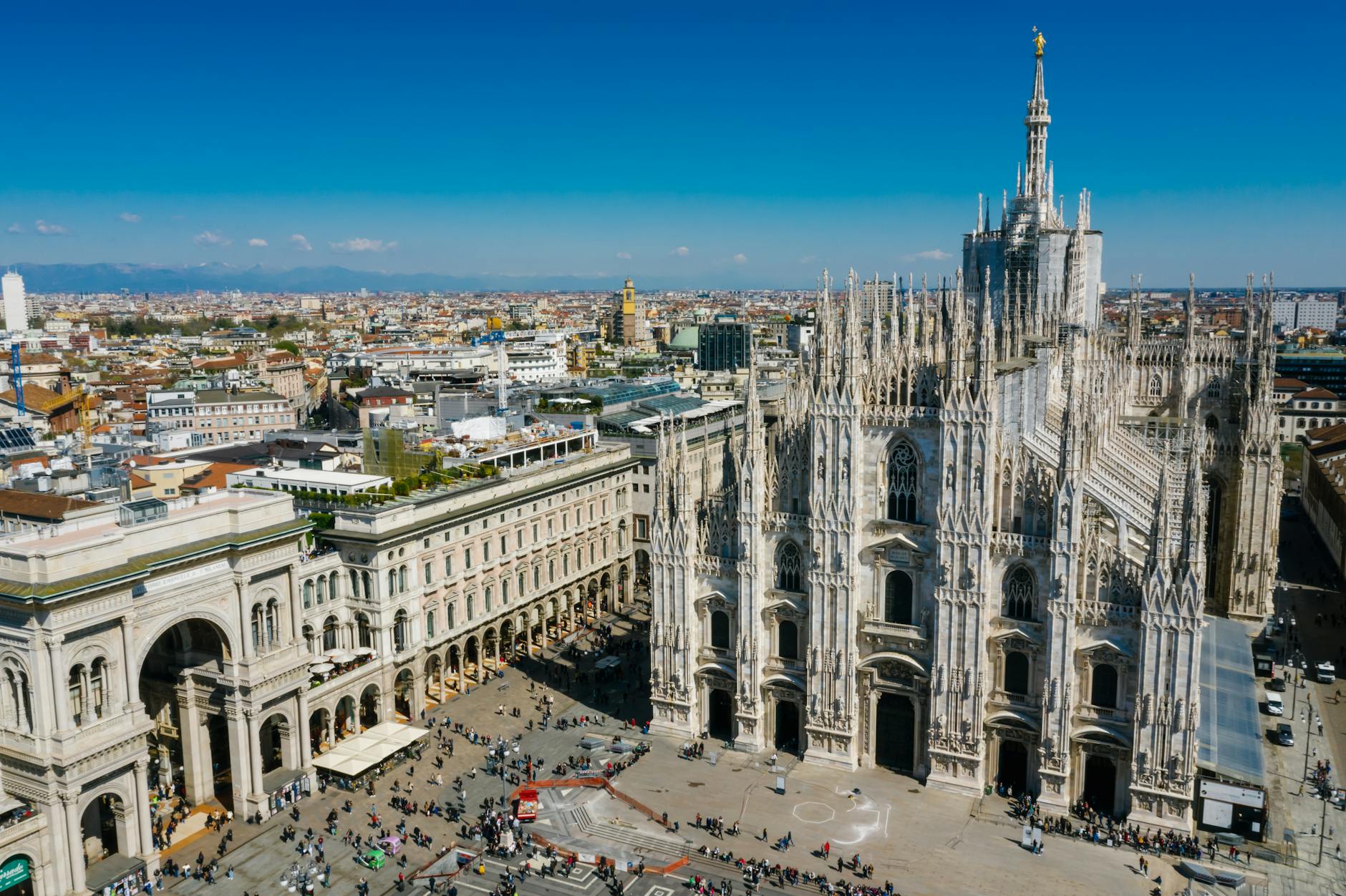
Walk through the entire collection, up the spiral, into the top-floor Fontana rooms, and then keep going to the panoramic gallery at the front of the building. This is the room with the floor-to-ceiling glass facing the Duomo. You are roughly level with the cathedral’s upper buttresses, separated by about 70 meters of empty piazza, and the view is unobstructed.
It’s a small reason to visit but a real one. Most rooftop views of the Duomo cost money — the cathedral terraces are €16 by stairs or €18 by lift — and most show you the spires from above. The Novecento gives you the entire west facade and rose window at near-eye level, included in your €10 ticket. I’ve taken better photos of the Duomo from this window than from any other indoor vantage in the city. Go at sunset if you can; the marble turns pink.
Where to eat nearby
The Duomo neighborhood has a deserved reputation for tourist-trap restaurants, but there are good options if you know where to walk. My short list:
- Cracco in Galleria — Carlo Cracco’s flagship sits inside the Galleria Vittorio Emanuele II, three minutes from the museum. The ground-floor café (espresso, brioche, panini) is reasonable. The upstairs restaurant is not. Worth the walk-through either way.
- Spazio Niko Romito — on the third floor of Mercato del Duomo, the modern food hall opposite the cathedral. Italian fine dining at lunch-set prices (around €35 for three courses). The view of the Duomo from the window seats is the second-best view of the cathedral on this list.
- Luini — the historic panzerotti bakery on Via Santa Radegonda, two minutes north of the Duomo. Fried filled-dough pockets for €3.50. Eat standing on the street; that’s the tradition.
- Trattoria Milanese — eight minutes west on Via Santa Marta. Old-school Milanese cooking: cotoletta, risotto giallo, ossobuco. Reservation recommended for dinner.
- Camparino in Galleria — the original Campari bar, 1915, on the corner of the Galleria. Order a Negroni and sit at one of the outdoor tables. Touristy and worth it once.
Practical tips
- Combined tickets: A €12 combined ticket gets you into both the Museo del Novecento and Casa Boschi-Di Stefano, the preserved 1930s apartment of collectors Antonio Boschi and Marieda Di Stefano on Via Jan in the Porta Venezia district. Casa Boschi holds about 300 20th-century works in domestic-scale rooms — Sironi, de Pisis, Morandi, Fontana — and it’s free with the combined pass, though Casa Boschi itself is free admission anyway. The ticket bundle saves nothing on price but is convenient.
- Thursday late opening: 18:00-22:30 is the best window of the week. Locals come after work; tour groups have left.
- Photography: Permitted in the permanent collection without flash. No tripods. Temporary exhibitions vary — check the signage at each entrance.
- Audio guide: €5, available in English, French, German, Spanish, and Italian. I find it useful for the Futurism rooms specifically — the historical context is dense and worth having explained. For Morandi and Fontana the audio guide adds little.
- Cloakroom: Free and mandatory for bags larger than a small daypack. Don’t bring a wheeled suitcase.
- Bookshop: The ground-floor shop has the best Italian 20th-century art catalogue selection in Milan. The Boccioni monograph (the heavy one) is worth the suitcase weight if you read Italian or even if you don’t.
Best time to visit
The museum is comfortably uncrowded compared to the Duomo or Last Supper. Even in peak July you rarely wait more than 15 minutes to enter, and the galleries themselves feel spacious. That said, I have favorites:
- Thursday 18:00-21:00: the local-evening visit. Quiet, well-lit, the museum bar serves wine.
- Sunday morning at 10:00: opens to a small crowd that thins as people drift toward lunch. By 11:30 several rooms will be empty.
- First Sunday of the month: free entry, but you’ll need a timed reservation and the museum is genuinely busy. Worth it if you’re traveling on a budget; skip if you’re not.
- Avoid: Saturday afternoons from 14:00 to 17:00, when Italian families combine the museum with Duomo-square shopping.
Plan on 90 minutes for a focused visit, 2.5 hours if you want to read everything and sit with Morandi. I’ve never spent less than an hour even on a quick lap.
Pairing the visit with other central sights
The Novecento is the easiest museum in Milan to combine with other Duomo-square attractions. A few sequences I’ve used:
Half-day, morning: Duomo cathedral interior at 09:00 (free entry to the church, €10 for the terraces), Museo del Novecento at 10:30, lunch at Spazio Niko Romito. You’ll be done by 14:00 with the most important square in Milan covered.
Full art day: Museo del Novecento in the morning (10:00-12:30), lunch in the Galleria, then walk fifteen minutes north to the Pinacoteca di Brera for 14:30-17:30. Brera covers Italian art from the 14th to 19th centuries, the Novecento picks up from there — together they’re the most complete art tour in Milan.
Evening sequence: Aperitivo at Camparino in Galleria at 18:00, Museo del Novecento (Thursday late opening) 19:00-21:30, dinner at Trattoria Milanese 22:00. This is my preferred Thursday in central Milan.
If you want to extend the 20th-century thread further, the Fondazione Prada in the southern Largo Isarco district takes the story into contemporary art, and the commercial galleries in the Brera and Porta Venezia districts are where you see what’s happening now. For a broader overview see the full Milan museums guide and a sample three-day itinerary.
FAQ
How long should I spend at the Museo del Novecento?
Ninety minutes is the realistic minimum to see the highlights. Two to two-and-a-half hours if you want to actually read the labels in the Futurism rooms, sit with the Morandis, and walk the panoramic gallery facing the Duomo. I’ve never managed it in under an hour; the spiral ramp alone takes 20 minutes if you actually stop at each level.
How does it compare to the Pinacoteca di Brera?
They cover different centuries, so the comparison is about period rather than quality. Brera holds Italian painting from the 14th to early 20th centuries — Mantegna, Raphael, Caravaggio, Hayez — in a converted Jesuit college north of the Duomo. The Novecento picks up where Brera leaves off and covers the entire 20th century. If you only have time for one, choose by interest: Brera for Renaissance and Baroque masters, Novecento for modern art. Both deserve a half-day each, and they’re a 15-minute walk apart.
When is the Museo del Novecento free?
Three regular slots: the first Sunday of every month (reservation required), the first Tuesday after 14:00, and the third Tuesday after 14:00. Under-18s are always free. EU citizens aged 18-25 pay the reduced €8 rate.
Can I take photographs?
Yes in the permanent collection, no flash and no tripods. Phone photography is welcome. Selfie sticks are banned. Temporary exhibitions sometimes have separate rules — check signage at the entrance to each show.
Is the museum accessible for wheelchair users?
Yes. Lifts run the full height of the building alongside the spiral ramp, so you can reach every floor without using the spiral itself. The entrance has step-free access from the Piazza del Duomo arcade. Disabled visitors enter free and a companion enters free with them. There are accessible restrooms on the ground and third floors.
Is there a café inside?
Yes — the top-floor restaurant Giacomo Arengario has a terrace overlooking the Duomo. It’s a proper restaurant (lunch around €40, dinner around €70) but the bar serves coffee and aperitivo at café prices, and you don’t need a museum ticket to enter the restaurant. The view is essentially the same as the museum’s panoramic gallery one floor down.
Final thoughts
The Museo del Novecento is the Milan museum that most directly rewards the time you spend in it. The collection is curated rather than encyclopedic — you don’t fight through three lesser rooms to get to one good one. The building is part of the city’s actual 20th-century history, not a generic palazzo. The view at the top is genuinely free if you’ve already paid your €10. And it’s right next to the Duomo, which solves the logistical question of when to fit it in.
If you’re spending three days in Milan and you’ve already booked the Last Supper and the Duomo terraces, this is the third ticket I’d add. If you’re staying longer and want to understand the city as a 20th-century industrial and design capital — the city of Marinetti, Pirelli, Olivetti, Fontana, Castiglioni — start here. Everything else, from the Fondazione Prada warehouses to the design studios in Tortona, is downstream of the conversation that started in these rooms. For the full city overview see our complete things-to-do-in-Milan guide and the Duomo guide for the cathedral next door.