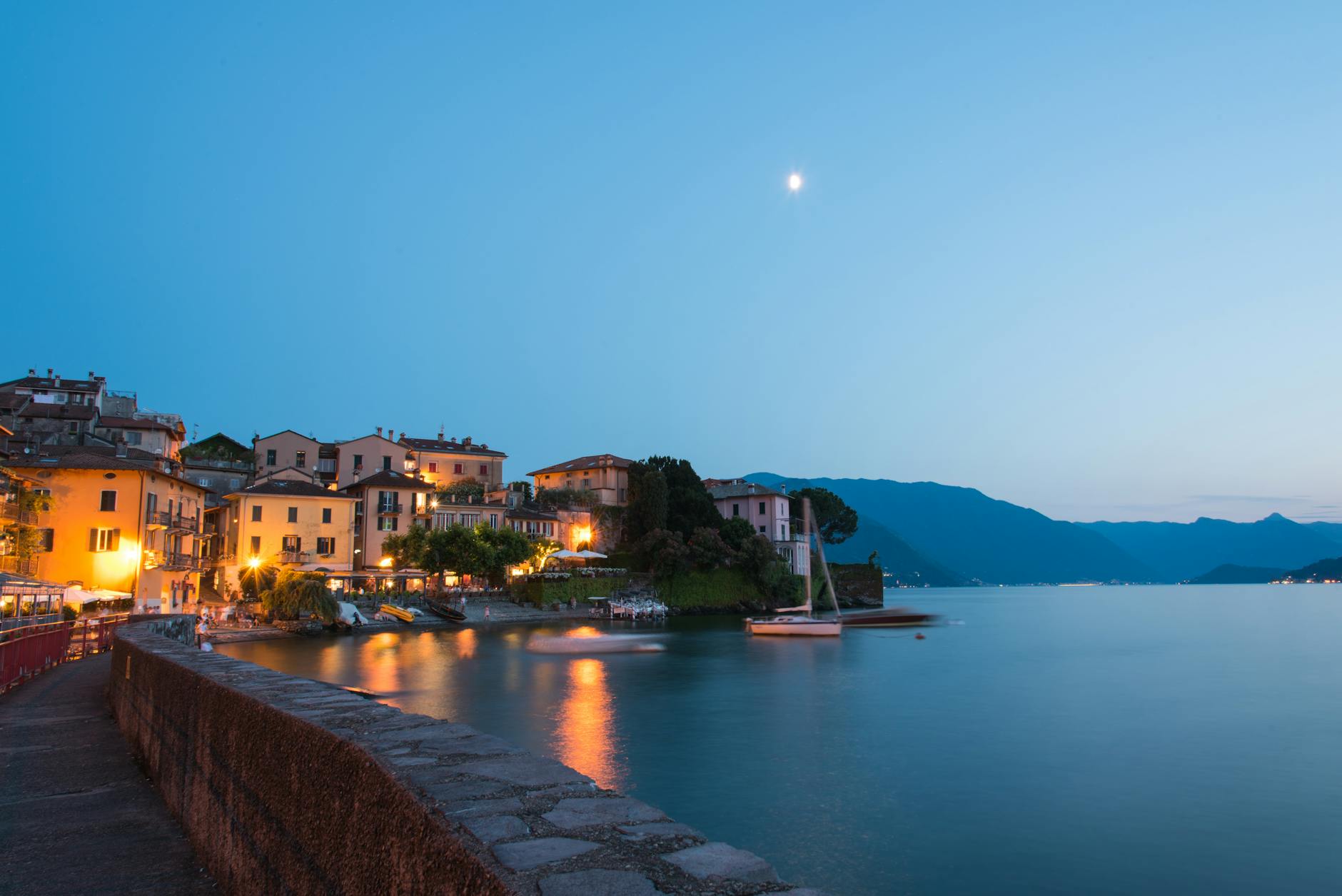
Varenna is the only town on Lake Como with a mainline railway station, which is a boring fact that turns out to be the most important one on the lake. Bellagio is prettier and Como is bigger, but you can be standing on Varenna’s waterfront an hour and a bit after leaving Milano Centrale, with no bus, no ferry and no changes. Nowhere else comes close.
It is also, quietly, the town I would send most first-time visitors to. It is small, steep and photogenic in a slightly weathered way, it empties in the evening when the day boats leave, and it costs less than the shore opposite.
Varenna Italy sits on the eastern shore at the centre of the lake, an hour from Milano Centrale on the Sondrio and Tirano line, with ferries to Bellagio and Menaggio taking fifteen to twenty minutes for around €5.50. The four things to do are the Passerella lakeside walkway (free), Villa Monastero’s gardens (€13, or €15 with the house museum, closed Tuesdays outside high summer), Villa Cipressi next door, and the twenty-minute climb to Castello di Vezio (around €7) for the best view on this side of the lake. The station is uphill from the town, so allow ten to fifteen minutes with luggage. Stay overnight if you can: Varenna after six is a different and much better place.
Getting to Varenna
This is Varenna’s whole advantage, so it is worth being precise.
Trains run from Milano Centrale towards Sondrio and Tirano and call at Varenna-Esino. The journey takes roughly an hour depending on whether you catch a regionale or a regionale veloce. There is no change, no bus and no boat involved, and the fare is a standard regional one rather than an airport-style premium.
Two practical points nobody warns you about. First, the station is above the town, not in it — the walk down to the waterfront takes ten to fifteen minutes and is genuinely steep. It is fine with a rucksack and tiring with a wheeled suitcase. Coming back up at the end of your stay is worse; if you are carrying a lot, budget for a taxi.
Second, the station is called Varenna-Esino and sits on a line where some services stop and some do not. Check that the train you are boarding actually calls there rather than running through.
From the airports, Varenna is reached via Milano Centrale in all cases. From Malpensa that means the Malpensa Express to Centrale and then the mainline north, roughly two and a quarter hours in total — the routes are compared in our Malpensa to Lake Como guide. The full picture from the city is in Milan to Lake Como transport.
Arriving by ferry
Ferries connect Varenna with Bellagio and Menaggio across the central triangle, taking fifteen to twenty minutes for around €5.50. This is the crossing that makes a base in Varenna work: everything on the mid-lake is a short boat ride away.
Varenna has more than one landing stage, and the car ferry and the passenger services do not always use the same one. Read the pier signage rather than a map pin, especially if you are timing a return.
Ticket types, day passes and the seasonal timetable changes are covered in our Lake Como ferry guide.
The Passerella: the walk that defines the town
Varenna’s waterfront is not a promenade in the usual sense. The old village comes down to the water so steeply that there was never room for a road, so instead there is the Passerella degli Innamorati — the lovers’ walk — a narrow walkway bolted to the rock just above the surface of the lake, running from the ferry pier round to the old harbour.
It is free, it takes about ten minutes at a slow pace, and it is the single best thing in Varenna. On a calm evening the water is right under your feet and the lights of Bellagio are across the water; when there is a wind the lake comes over the railing and it is closed. Do it twice, once in each direction, at different times of day.
At the far end you come into the old harbour at Riva Grande, a small square of coloured houses with restaurant tables spilling onto the shingle. This is the picture of Varenna that appears everywhere, and it is genuinely as good as advertised.
Villa Monastero and Villa Cipressi
Varenna’s two villas sit side by side on the southern edge of the town, a few minutes’ walk from the harbour, and you can comfortably do both in an afternoon.
Villa Monastero
A twelfth-century Cistercian convent that became a private residence and is now a museum and conference centre. What you come for is the botanical garden, which runs for a long stretch along the shoreline in a narrow terraced strip: citrus, palms, agaves, cypresses and statuary, with the lake immediately below.
Tickets, checked against the villa’s own site: €13 for the gardens alone, €15 for the gardens plus the Casa Museo, with reduced rates for over-65s and a youth rate for 15 to 25s. Children under 14 go free.
Opening hours change substantially through the year and this catches people out:
- April and May, September: 09:30–19:30, closed Tuesdays.
- June to August: 09:30–20:00, open daily.
- October: 10:00–18:00, closed Tuesdays.
- November to March: 10:00–17:00, closed Tuesdays and Wednesdays.
The Tuesday closure outside high summer is the thing to write down. It is the most common wasted walk in Varenna.
The house museum is worth the extra two euros if you like interiors — it is a proper preserved residence rather than a few roped-off rooms, and the Nobel-laureate physics connection gives it an unexpected second life as a conference venue.
Villa Monastero’s waterside terrace is one of four gardens worth paying for on this lake — the others are in our Lake Como villas and gardens guide.
Villa Cipressi
Immediately adjacent, and now a hotel, with terraced gardens dropping to the water that are open to non-residents for a modest admission. Prices vary depending on how you buy, so check at the gate rather than through a reseller.
Honest comparison: Monastero’s gardens are longer, more varied and better value. Cipressi’s are smaller but arguably the more beautiful setting, with the cypresses and terraces stacked right above the lake. If you are doing one, do Monastero. If you have an afternoon, do both — they adjoin, so it costs you nothing in walking.
Castello di Vezio: the climb worth making
Above Varenna, on the shoulder of the hill, sits a ruined eleventh-century castle with a square tower and a terrace, and it delivers the best view on the eastern shore — straight down onto the town, across to Bellagio, and up the northern arm towards the mountains.
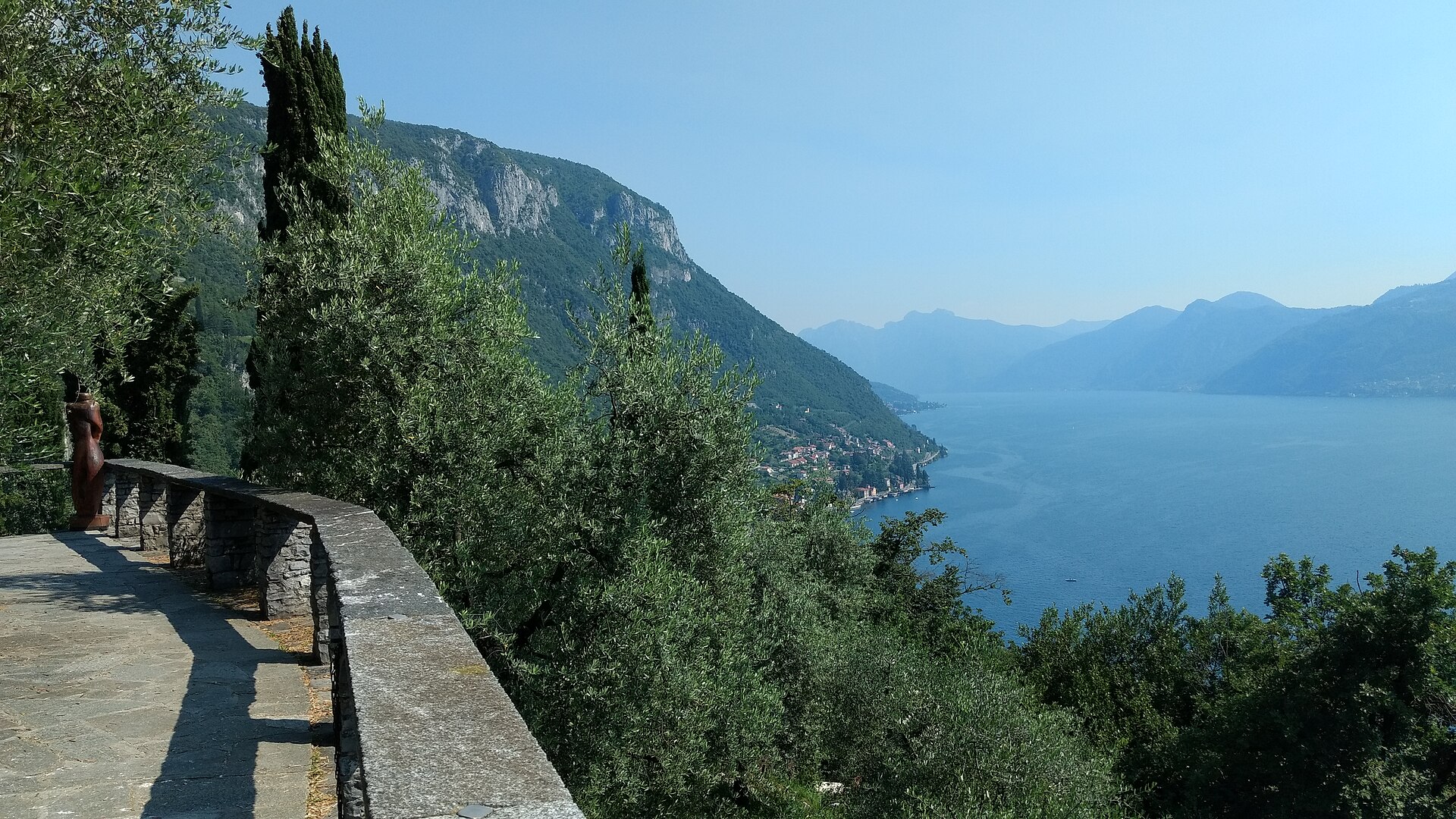
Admission is around €7. It is open daily from March to November, and at weekends and public holidays only from December to February.
The walk up takes about twenty minutes on a stepped mule path from the top of the village, and it is steep enough to be a proper climb rather than a stroll — take water in summer. You can also drive or taxi to Vezio and walk down, which is the sensible option if the heat is serious.
Two things make it more than a viewpoint. There is a falconry operating at the castle with birds on display and flying demonstrations, and there are the ghosts: white plaster figures posed around the grounds, a slightly eccentric art installation referencing a local legend. Children find both far more interesting than another garden.
Eating and drinking in Varenna
Varenna is small, which cuts both ways. The number of restaurants is limited, so booking in high season is genuinely necessary rather than a precaution; but because the town has a resident population and a slower rhythm than Bellagio, the average standard is better and the prices are gentler.
Order the lake, not the sea. Risotto con pesce persico — perch in butter and sage over risotto — is the local signature and Varenna does it well. Lavarello, the whitefish, is the reliable second choice. Missoltini, sun-dried and pressed shad served with polenta, is the properly traditional order and an acquired taste. For wine, look to the Valtellina just up the valley, whose Nebbiolo-based reds are excellent and almost never exported.
The tables down at Riva Grande, on the shingle by the old harbour, carry a view premium like anywhere else on the lake, but here it is a smaller premium and the setting genuinely earns it. Up in the village, along the steps and in the little squares, prices drop again.
One quirk worth knowing: a good deal of Varenna shuts down between roughly November and March, including many restaurants and both villas. In winter this is a very quiet town.
Where to stay in Varenna
Staying overnight is the point of Varenna. From about six in the evening the day-trippers are gone, the Passerella empties, and you get a small Italian village on a lake rather than a viewing platform.
- Higher end — the converted villas, including Villa Cipressi itself, where you sleep in the gardens you would otherwise pay to walk around.
- Mid-range — small hotels around the harbour and on the slope above it. Some have lake views, some have views of the wall opposite; the difference in price is real and so is the difference in experience.
- Cheaper — rooms up near the station and in Perledo, the village above. Less convenient, considerably cheaper, and the walk down is downhill in the morning.
Book early for June to September. Varenna has genuinely few beds and the good ones go months ahead.
Deciding between the two shores? We compare them directly in Bellagio vs Varenna: where to stay.
Options across the whole lake are in our where to stay on Lake Como guide.
Walking from Varenna
The eastern shore is steeper than the western one, which makes it worse for gentle lakeside strolls and considerably better for actually getting up into the hills. From Varenna you are on the flank of the Grigne massif, and the paths start at the top of the village rather than a bus ride away.
- The mule track to Vezio — the twenty-minute climb described above, and the obvious first walk. Continue past the castle and the path carries on up towards Perledo and beyond.
- Fiumelatte — a fifteen-minute walk south along the shore to a hamlet with what is claimed to be one of the shortest rivers in Italy, a torrent that runs only from spring to autumn and disappears in winter. It is a curiosity rather than a spectacle, but the walk there is lovely and almost nobody does it.
- The Sentiero del Viandante — a long-distance path running the length of the eastern shore, high above the water, on the line of an old Roman route. You can pick up a section from Varenna and walk north or south for a couple of hours, then drop down to a station and take the train back. This is the best serious walk on the lake and it is astonishingly quiet.
Take proper shoes for any of these beyond the castle path, and water in summer — the eastern shore gets full afternoon sun and there is very little shade on the higher sections.
What Varenna does not have
Being fair about the limitations, because they are real and they decide whether this is the right base for you.
It is small. A dozen or so restaurants, a couple of shops that are not aimed at visitors, and no supermarket worth the name. For a week, you will be taking the ferry for variety, which is fine but is a decision you should make knowingly.
The station is a hill away. Ten to fifteen minutes down, rather more back up, and there is no funicular and no reliable shuttle. Anyone with mobility difficulties or heavy luggage should plan for a taxi at both ends.
It closes in winter. Both villas reduce or shut, restaurants close from November, and the ferry timetable thins. Varenna between December and February is beautiful and largely asleep.
There is no nightlife. A handful of bars, dinner, and a walk along the water. That is the entire evening, and for many people it is exactly the point — but if you want something to do after ten, you want Como or Milan.
Varenna in a day, and in three
Half a day
Train from Milan, walk down, do the Passerella, lunch at the old harbour, Villa Monastero’s gardens, walk back up. That is a complete and satisfying visit and it fits inside a day trip from the city — the timings are in our Lake Como day trip from Milan guide.
A full day
Add the climb to Castello di Vezio in the morning while it is cool, and the ferry across to Bellagio in the afternoon. Twenty minutes each way and around €5.50, which makes it the easiest excursion on the lake.
Varenna is the right place to start a single day on the lake — the full plan is our Lake Como in one day itinerary.
Three days based here
Day one Varenna itself, day two the ferry to Lenno for Villa del Balbianello and on to Tremezzo for Villa Carlotta, day three Bellagio in the morning and Menaggio or a walk in the afternoon. This is the itinerary I would give almost anyone visiting Lake Como for the first time, and Varenna is the right base for it.
Is Varenna better than Bellagio?
They are different propositions and the honest answer depends on what you want.
Varenna wins on: ease of arrival, by a wide margin; price, for both hotels and dinner; quiet, especially in the evening; and the Passerella, which has no equivalent anywhere on the lake.
Bellagio wins on: position, since it looks down two arms at once; grandeur, with the nineteenth-century hotels and the Serbelloni park; and sheer visual drama from the water.
My position: base yourself in Varenna and visit Bellagio. You get the better arrival, the better value and the quieter evening, and Bellagio is twenty minutes away whenever you want it. The reverse also works, but you will pay more for it.
If a proper town with shops and restaurants matters more than either, look at the city at the southern tip — our Como town guide covers it.
Frequently asked questions
How do I get to Varenna from Milan?
Direct train from Milano Centrale towards Sondrio or Tirano to Varenna-Esino, about an hour, no changes. The station is above the town, so allow ten to fifteen minutes downhill to the waterfront.
How much is Villa Monastero?
€13 for the botanical garden, €15 including the Casa Museo, with reduced and youth rates and free entry for under-14s. Closed Tuesdays outside June to August, so check the day before you walk over.
Is the Passerella degli Innamorati free?
Yes, it is a free public walkway along the water between the ferry pier and the old harbour. It closes in rough weather, when the lake comes over the railing.
How long does it take to walk up to Castello di Vezio?
About twenty minutes on a stepped path from the top of the village, and it is steep. Admission is around €7, open daily March to November and weekends only in deep winter.
How long do you need in Varenna?
Half a day covers the town. A full day adds the castle and a ferry to Bellagio. Two or three nights makes it an excellent base for the whole central lake.
Is Varenna a good base for Lake Como?
It is the best base for most visitors: the easiest arrival from Milan, cheaper than Bellagio, and fifteen to twenty minutes by ferry from everything in the central triangle.
Can you swim in Varenna?
Yes — there is a lido south of the villas, and swimming spots along the shore. The water is cold, clear and deep, and warmest in August.
Is Varenna worth visiting in winter?
Only for the quiet. Both villas close or reduce their hours, many restaurants shut from November to March, and the ferry timetable thins considerably.
Final thoughts
Varenna does not try to compete with the town across the water, and it is better for it. What it offers is a village you can arrive at without effort, walk around in an hour, eat well in, and then have largely to yourself once the last boats have gone.
Do the Passerella twice, pay the €13 for Villa Monastero on a day that is not a Tuesday, climb to Vezio early, and take the ferry to Bellagio for an afternoon. That is a near-perfect two days on Lake Como, and it costs a fraction of what most people spend getting less. The wider picture is in our Lake Como travel guide.