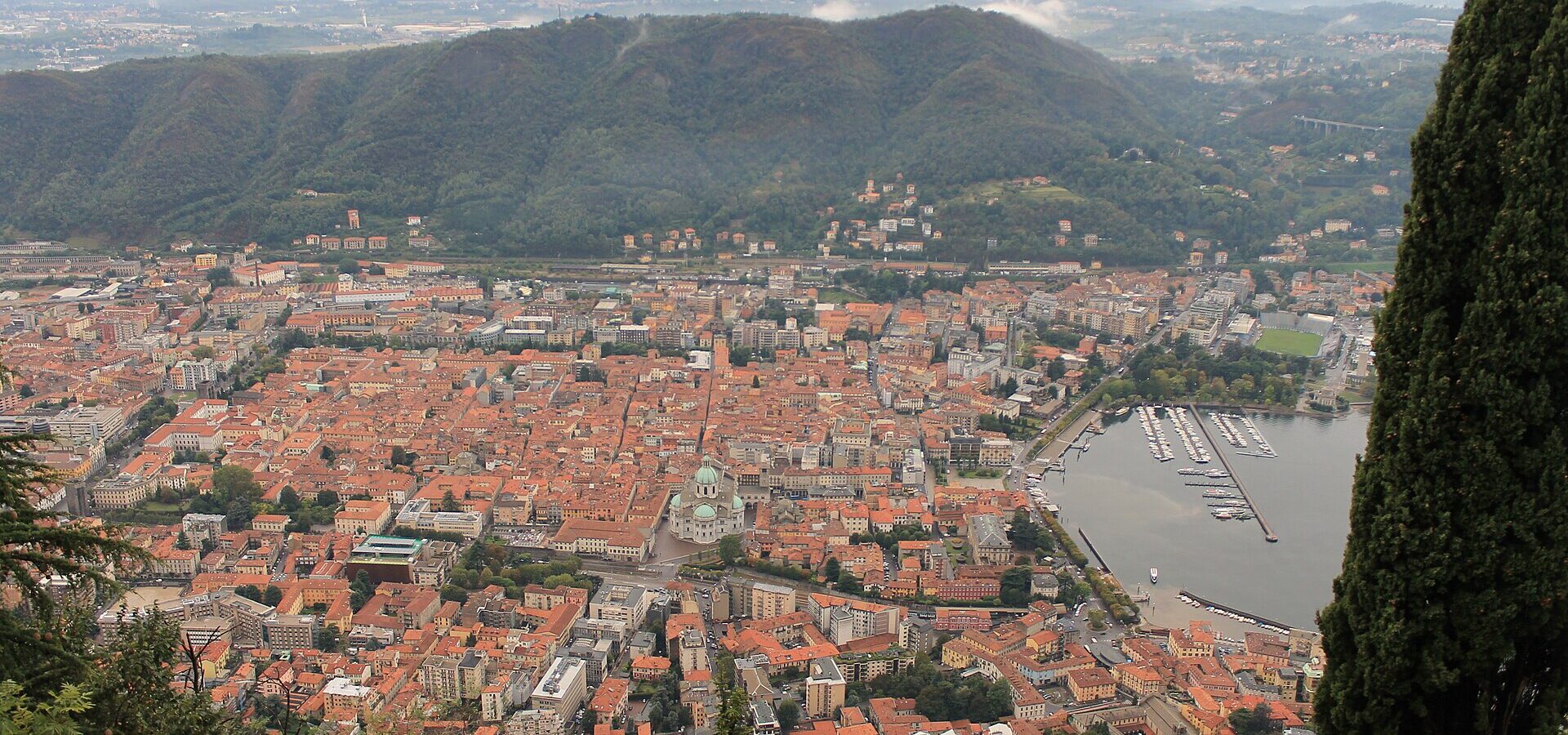
Most people who visit Como never actually see Como. They come off the train at San Giovanni, walk downhill with a suitcase, buy a ferry ticket at the pier and are gone within forty minutes, on their way to Bellagio. The town gets treated as a transport interchange with a nice view — which is a shame, because it is the only place on the lake with a proper Gothic cathedral, a Romanesque basilica, a working silk industry, a genuinely strange collection of 1930s rationalist architecture and a funicular that has been running since Queen Victoria was on the throne.
The best things to do in Como are the Duomo, the Brunate funicular, the lakefront walk out to Villa Olmo and the Terragni rationalist buildings — and you can do all four comfortably in a single day, because the historic centre is a walled rectangle about 500 metres across. Como is the cheapest and easiest part of Lake Como to reach from Milan (roughly 40 minutes by train from Centrale) and it is the best-value place to eat and sleep on the whole lake. It is also two hours by slow boat from the famous mid-lake scenery, which is why it works far better as a day trip or a first night than as a week-long base.
I have been through Como more times than any other town on this lake, mostly in transit, and it took me an embarrassingly long time to stop and give it a day. When I did, it turned out to be the town I would actually want to live in. Bellagio is a stage set. Como is a place where people go to the dentist.
Getting to Como from Milan
Two railway lines, two stations, and they are not interchangeable. Getting this wrong is the single most common Como mistake.
Como San Giovanni
This is the mainline station, served by trains from Milano Centrale on the route up to Chiasso and Lugano. It is the fast option — the quicker services are around 40 minutes — and it is the one most people should use. The catch is that San Giovanni sits up on the hill on the western edge of town, so you arrive with a ten to fifteen minute downhill walk to the lakefront, and a rather less charming uphill one on the way back. With a heavy case, the walk back up Viale Fratelli Rosselli in August heat is character-building.
Note that some Milan–Como services are Swiss-operated EuroCity trains running through to Lugano and Zurich. They stop at Como San Giovanni, they are faster and more comfortable, and they cost more than a regional ticket. If a train appears on the board with a Swiss destination and a supplement, that is why.
Como Lago (Como Nord Lago)
The Ferrovie Nord line from Milano Cadorna ends at Como Lago, and the reason to consider it is that the platform is essentially on the waterfront — you step off the train and you are two minutes from Piazza Cavour and the ferry piers. No hill. The trade-off is time: this route runs closer to an hour, on smaller regional trains, via Saronno.
My rule: arrive at San Giovanni if you are travelling light and want the time back; use Cadorna and Como Lago if you have luggage, a pushchair, or you are heading straight onto a boat. If you are flying in rather than coming from the city, the direct shuttle from Malpensa drops you at Como San Giovanni and skips Milan entirely, which is a much better plan than most people realise.
The broader question of trains, buses and driving up the lake is covered properly in our Milan to Lake Como transport guide, and the whole destination sits under the Lake Como travel guide.
For what the hydrofoil to the mid-lake actually costs, and when the slow boat is the better buy, see our Lake Como ferry guide.
The Duomo: Como’s genuinely great building
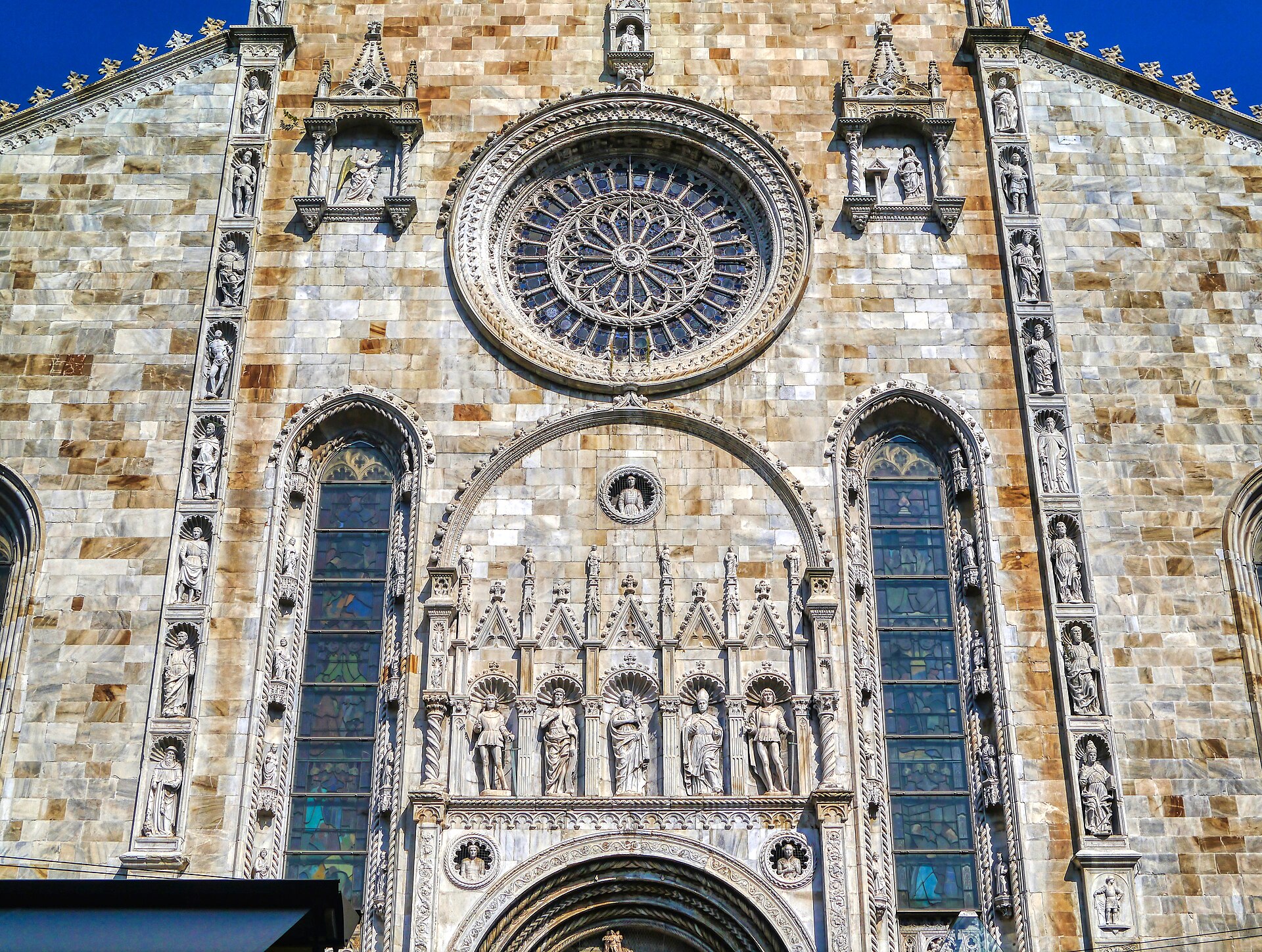
Como Cathedral — the Cattedrale di Santa Maria Assunta — was begun in 1396 and not finished until the 1770s, when Filippo Juvarra capped it with a dome. That gap of nearly four hundred years is the point of the building. You walk towards a Gothic front, step inside a Gothic nave, and then look up into a full-blown eighteenth-century Baroque dome. Most cathedrals that mix periods do it awkwardly. This one gets away with it.
The detail I always send people to look for is on the façade. Flanking the main door are seated statues of Pliny the Elder and Pliny the Younger, both natives of Como, both entirely pagan Romans, sitting in niches on the front of a Catholic cathedral. The city put its famous sons on the church because they were famous sons, and nobody in the fifteenth century seems to have minded. It is a very Italian solution.
Inside, the tapestries hanging in the nave are worth slowing down for — sixteenth and seventeenth century, from Ferrara, Florence and Antwerp — and the carved doors on the north and south sides are by the Rodari brothers, who ran the cathedral workshop for decades.
Practicalities: there is no ticket desk for the nave and you can walk in during normal opening hours, though donations are asked for and the cathedral closes to visitors during services. Charged evening openings and rooftop visits are run periodically and are advertised at the door. Shoulders and knees covered, as everywhere in Italy.
Directly beside it stands the Broletto, the striped medieval town hall, and behind that the Torre del Comune. The whole group — cathedral, town hall, tower — is one continuous fifteenth-century civic ensemble, and Piazza del Duomo is small enough that you can take it all in from one café table.
The Brunate funicular
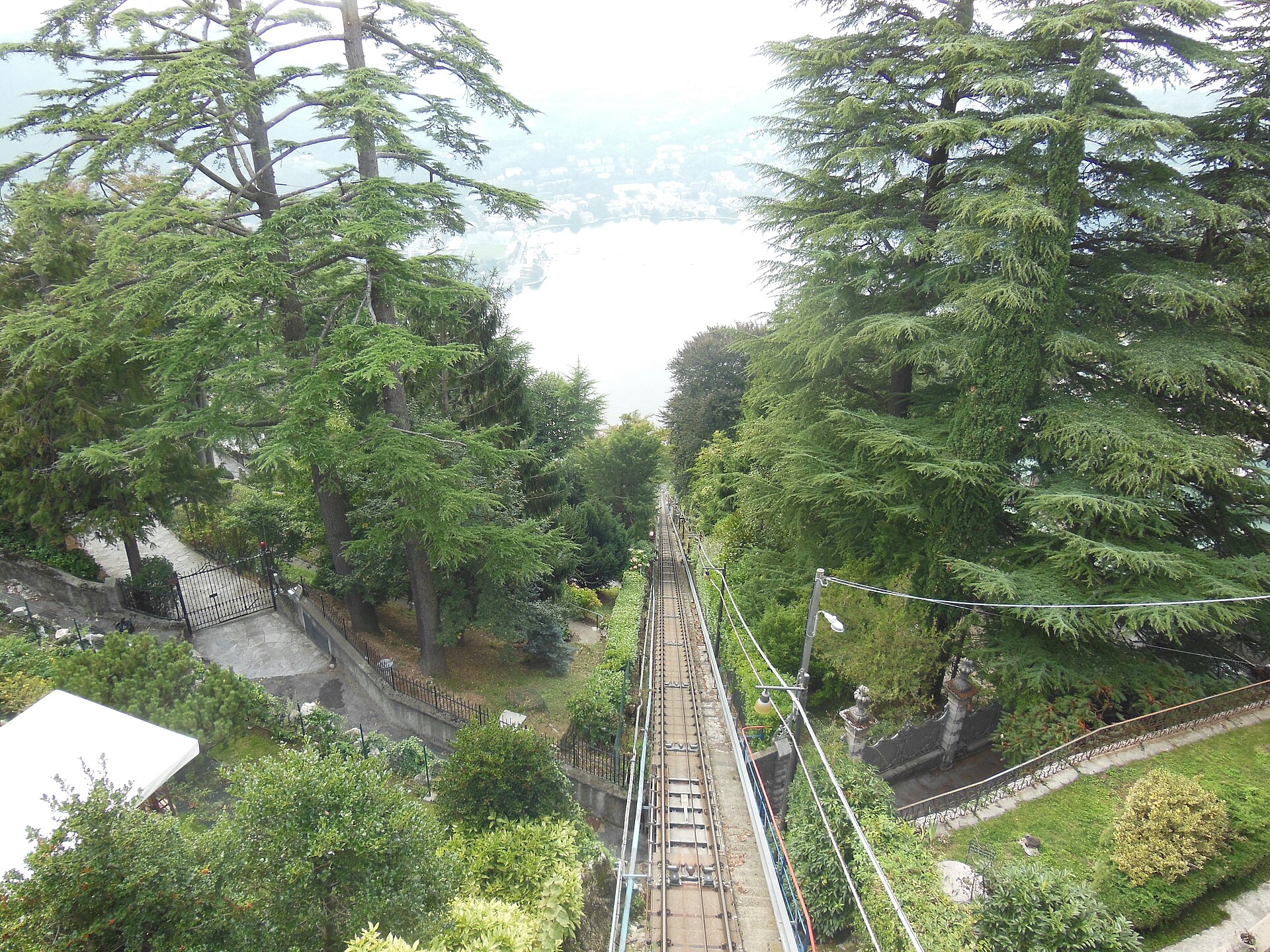
The Funicolare Como–Brunate opened in November 1894 and still does the same job: it hauls you up roughly 500 vertical metres from the lakeshore to the village of Brunate in about seven minutes. It is the most reliably rewarding thing you can do in Como for under ten euros, and the photograph at the top of this page is what you get at the end of it.
Fares in 2026 run around €3.60 for a single and €7.20 for a return; buy the return unless you seriously intend to walk down, which takes about an hour on a stepped mule track and is harder on the knees than it sounds. Departures are roughly every fifteen to thirty minutes, and the service runs from early morning until late in the evening — but the last departure moves with the season and with special events, so read the board at the bottom station before you commit to staying up for sunset. Being stranded in Brunate means a taxi down a long series of hairpins.
The lower station is at Piazza De Gasperi, at the north-eastern end of the waterfront, about ten minutes’ walk from Piazza Cavour. Queues build badly on summer weekends and around sunset; on a July Saturday at 18:00 you can wait forty minutes. Go in the morning if you can, when the light is on the town anyway.
What to do at the top
Brunate itself is a small village of Liberty-style villas built by wealthy Comaschi who wanted to be above the summer humidity. You can stand at the viewpoint by the top station, take your photograph and come straight back down — plenty of people do, and it is a legitimate use of forty-five minutes.
The better version is to keep walking. A signposted uphill path leads in about half an hour to the Faro Voltiano, the lighthouse built in 1927 for the centenary of Alessandro Volta’s death. It is a stone tower with a spiral staircase inside and a small charge to climb it, and on a clear day the view from the top takes in the lake, the Brianza plain and, if the air is doing you a favour, Monte Rosa. It is a proper walk with a proper payoff, and it thins out the crowd dramatically.
The lakefront and Villa Olmo
From Piazza Cavour, the paved lakefront runs west past the Tempio Voltiano and the Monumento ai Caduti, then becomes the Passeggiata Lino Gelpi, a flat waterside promenade that carries on for about a kilometre and a half to Villa Olmo. It is free, it is level, it takes half an hour at an amble, and it passes a run of grand nineteenth-century villas — Villa Saporiti and Villa Gallia among them — whose gardens drop straight into the water.
Villa Olmo itself is a neoclassical pile from the 1780s, designed by Simone Cantoni. The interior has been closed for restoration in recent years and access to the state rooms depends entirely on whether an exhibition is running, so check before you build a day around it. The park, however, is open daily and free: roughly 07:00 to 23:00 from early April to the end of September, and 07:00 to 19:00 through the winter. Next door is the Lido di Villa Olmo, a summer-only lakeside pool and beach club where locals actually swim, which is a much better use of a hot afternoon than queueing for a ferry.
Tempio Voltiano
The little neoclassical rotunda on the waterfront is a museum to Alessandro Volta, who was born in Como in 1745 and gave his name to the volt. It houses his original instruments — the actual batteries, more or less — and it takes about forty minutes. It opens Tuesday to Sunday, 10:00 to 18:00 with last entry at 17:30, and closes on Mondays. Entry is a few euros. Whether you will enjoy it depends entirely on whether the phrase “original voltaic pile” does anything for you; if it does, this is a small pilgrimage.
Rationalist Como: the thing nobody tells you about
This is the section that surprises people, and it is the reason I would give Como a full day rather than a morning. In the 1920s and 1930s, Como became one of the most important sites of Italian rationalist architecture, largely because of one man: Giuseppe Terragni, who was born nearby and did most of his significant work here.
- Casa del Fascio (1932–36) — Terragni’s masterpiece and one of the most studied buildings of twentieth-century Europe. A perfect half-cube of white marble and glass, standing behind the cathedral apse. It is a government office today and the interior is not generally open, but you can walk right up to it. Seeing this Fascist party headquarters standing forty metres from a Gothic cathedral is the single strangest sight in Como, and worth the walk for the disorientation alone.
- Monumento ai Caduti (1933) — the war memorial on the lakefront, a tall stone tower built to a design left by the Futurist architect Antonio Sant’Elia, who was killed in 1916. Terragni realised it.
- Novocomum (1929) — an apartment block near the stadium with a curved glass drum at the corner, which so scandalised Como when the scaffolding came down that it was nicknamed the transatlantico, the ocean liner.
- Asilo Sant’Elia (1937) — a nursery school, and a gentler, sunnier Terragni. Still in use.
None of these charge admission because none of them are museums. You are simply looking at buildings in a working town, which is a very cheap and very good hour.
Silk, and the rest of the old town
Como has spun and printed silk since the sixteenth century and still does — a large share of Europe’s high-end printed silk passes through workshops in and around this town, which is why the shop windows are full of scarves and ties at prices that are not tourist markup so much as actual value. The Museo didattico della Seta, out towards the station in Via Castelnuovo, keeps the old looms, dyeing equipment and printing machinery, with the industrial process laid out end to end. It is a genuine specialist museum rather than a gift shop with a display case, and it is closed on Sundays and Mondays — check the current hours before making the walk out.
Elsewhere in the walled centre, worth ten minutes each:
- Basilica di Sant’Abbondio — eleventh-century Romanesque, five naves, twin bell towers, and a cycle of fourteenth-century frescoes in the apse. It is a fifteen-minute walk south-west of the centre, past the ring road, and it is almost always empty. Architecturally it is the more important church of the two.
- Basilica di San Fedele — in the middle of the old town, on a small square that hosts a market. Twelfth century, built over an earlier church, with a fine carved north door.
- Porta Torre — the surviving 1192 gate tower of the medieval walls, at the southern edge of the centre. You cannot go in, but it fixes the shape of the old town in your head: Como is still, physically, a Roman rectangle.
- Aero Club Como — on the water at the western end of the lakefront, the world’s oldest continuously operating seaplane school, founded in 1930. Sightseeing flights are available and are expensive; watching the planes take off from the lake is free and quietly thrilling.
Eating and drinking in Como
Como is the best-value town on Lake Como for food, by a distance, because it has a resident population that eats out on Tuesdays. The mid-lake resorts price for people who are there for three nights and will not be back.
What to look for on a menu, rather than where exactly to go: missoltini (lake shad, salted, sun-dried and pressed, served with polenta — strong, oily, an acquired taste and a genuinely local one), risotto con pesce persico (perch fillets fried in butter and sage over risotto, the safest lake fish for a first-timer), toc (a slow-beaten polenta with butter and cheese) and pizzoccheri if you are here in the cold months. Drink the local white from the Lugano side or a Franciacorta if you want bubbles.
Practically: the streets inside the walls — Via Vitani, Via Boldoni, the lanes around San Fedele — are where the osterie are, and prices there run noticeably below the tables directly on Piazza Cavour, which are paying for the view. Como also has a covered market and a good Tuesday and Thursday street market, which is how to assemble a lakeside lunch for a few euros. Kitchens close between roughly 14:30 and 19:30, as everywhere in Lombardy; if you arrive off a mid-afternoon ferry and are hungry, that is an aperitivo, not a meal.
Como as a base: the honest verdict
I will be blunt about this, because a lot of guides will not be. If Lake Como’s scenery is the reason you are coming, do not stay in Como town.
The town sits at the very bottom of the south-western leg of the lake. The famous stretch — Bellagio, Varenna, Menaggio, the villas at Lenno and Tremezzo — is at the centre, where the three arms meet. Getting there from Como means either two hours on a slow boat or about 45 minutes on the fast hydrofoil at around €17 each way. Do that daily for a week and you have spent a fortune and a great many hours in a boat seat.
The full breakdown of slow boats, hydrofoils, car ferries and day passes is in our Lake Como ferry guide.
Where Como is excellent is as a day trip from Milan, as a first or last night when you are flying via Malpensa, or as a base for someone who wants a real town with restaurants, shops, a hospital and a nightlife rather than a resort. Hotel prices here are perhaps a third below Bellagio for equivalent quality, and there is a great deal more choice.
We compare every town on the lake for accommodation in our where to stay on Lake Como guide.
If you have decided the mid-lake is where you should be sleeping instead, our Bellagio or Varenna comparison picks between the two.
How long you need, and how to spend it
Half a day covers the Duomo, a wander through the walled centre and the funicular. A full day adds the Villa Olmo walk, the Terragni buildings and a proper lunch. Anything beyond that and you should be getting on a boat.
A day that works, if you are coming from Milan:
- 09:00 — train from Milano Centrale, arrive Como San Giovanni around 09:45. Walk downhill.
- 10:00 — funicular up to Brunate before the queue forms. Viewpoint, or the walk to the Faro Voltiano if the sky is clear.
- 12:00 — back down. Duomo, Broletto, Casa del Fascio behind the apse.
- 13:00 — lunch in the lanes off San Fedele.
- 15:00 — lakefront walk out to Villa Olmo, park, back along the water.
- 17:00 — aperitivo on Piazza Cavour, which is overpriced and worth it once.
- 18:30 — train back, or the twenty-minute hop north to Lugano if you have your passport and want a second country in the day.
If you would rather spend the day on the water than in the town, the Lake Como day trip from Milan guide goes to the mid-lake instead, and the combined Milan and Lake Como itinerary stitches several days together. Como also pairs neatly with a day trip to Lugano, which is barely half an hour further up the same line.
Frequently asked questions
Is Como town worth visiting, or should I go straight to Bellagio?
Worth visiting, but for different reasons. Como is a real city with the lake’s only major church, its best-value food and its most interesting architecture. Bellagio and Varenna have the postcard scenery. If you have one day, most first-timers will be happier at the mid-lake; if you have two, spend one of them in Como.
How long does the train from Milan to Como take?
Around 40 minutes on the faster mainline services from Milano Centrale to Como San Giovanni, or about an hour from Milano Cadorna to Como Lago on the Ferrovie Nord line. Cadorna is slower but delivers you to the waterfront rather than the top of a hill.
Do I need to book the Brunate funicular in advance?
No. You buy at the window or the machine at the lower station. There is no reservation system, which is precisely why the queue on a summer evening is long — go in the morning instead.
Can you swim in the lake at Como?
Yes, at the Lido di Villa Olmo and at a handful of other lidos along the shore, in summer. The water at the very southern tip is warmer and murkier than the mid-lake; if swimming is a priority, the beaches further north are better.
Is Como expensive?
Compared with the rest of Lake Como, no — it is the cheapest place on the lake to eat and sleep. Compared with an average Italian provincial town, yes, moderately. The two things that cost real money here are hotel rooms in peak summer and hydrofoil tickets up the lake.
What is there to do in Como when it rains?
The Duomo, the Tempio Voltiano, the silk museum and the civic museums in Palazzo Volpi will fill a wet day comfortably. The funicular still runs, but there is no point riding into cloud. Rain is also when Como’s arcaded streets and its restaurants come into their own, and when it becomes obvious that this is a town rather than a resort.
Final thoughts
Como is the part of Lake Como you can visit without planning. There is no ferry timetable to reverse-engineer, no villa to book, no risk of arriving on a closed day and finding you have wasted a trip. Get a train, walk downhill, ride the funicular, look at a cathedral that took four centuries and a Fascist office block that took four years, and eat better than you would forty minutes north for two thirds of the money.
It will not give you the shot you have seen on Instagram. That is at the mid-lake, and you should go there too. But of all the towns on this lake, Como is the one I would come back to on a wet Tuesday in November and still enjoy — and that is a better test of a place than a photograph.