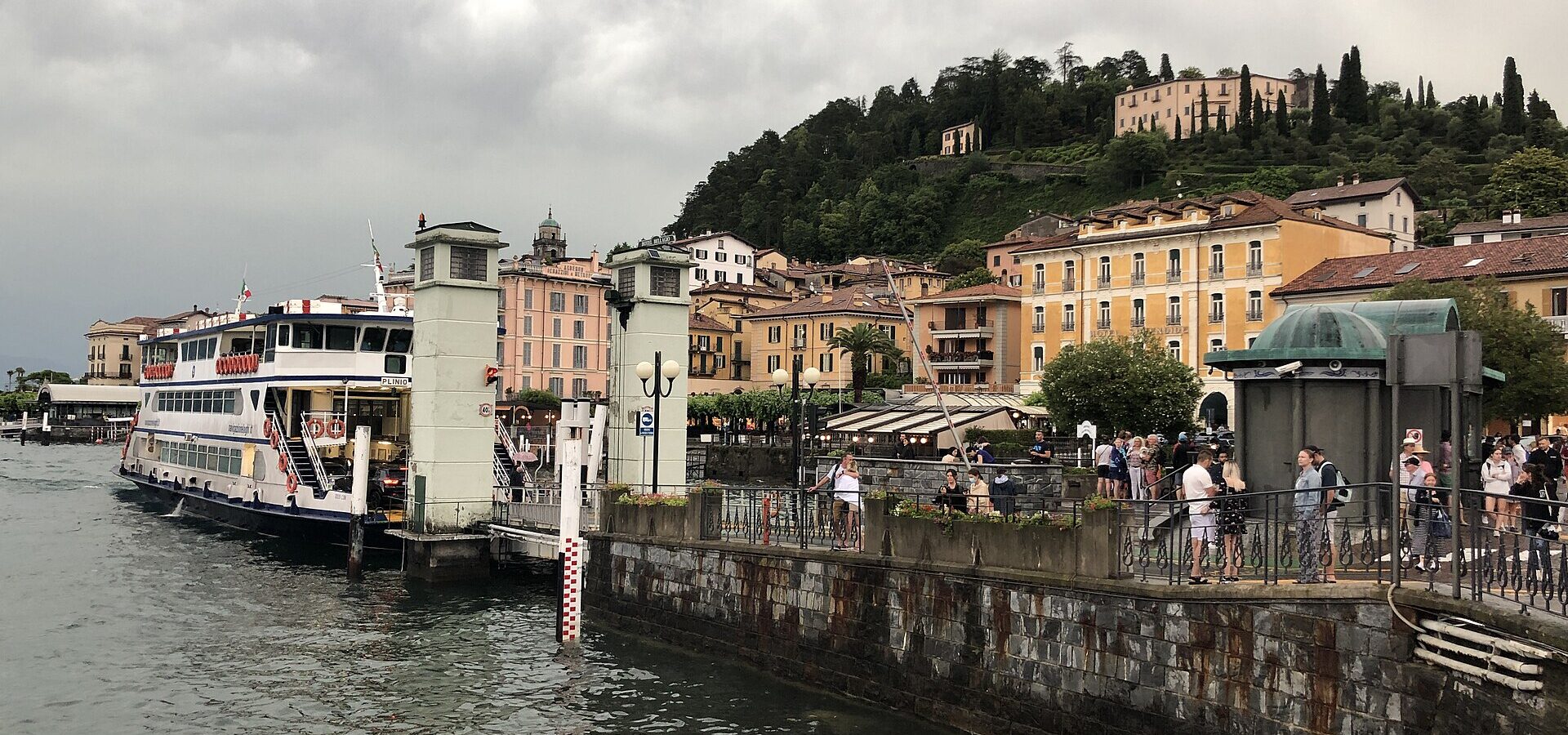
The boats on Lake Como are not a sightseeing cruise. They are the bus service. Schoolchildren use them, builders use them, and the reason the timetable looks so baffling — three different kinds of vessel, four fare structures, columns marked feriale and festivo, whole services that vanish in November — is that it was designed for people who live here, not for you. Once you accept that, the whole thing becomes easy. Try to read it as a tourist attraction and you will spend your holiday stranded at Cadenabbia.
The Lake Como ferry network is run by one state operator, Navigazione Laghi, and it offers three services: the slow battello that stops everywhere, the fast servizio rapido hydrofoil that costs a supplement of about €3–5 and skips most piers, and one car ferry, the traghetto, running the mid-lake triangle between Bellagio, Varenna, Menaggio and Cadenabbia. For 95% of visitors, the only stretch that matters is that triangle: crossings take 15–20 minutes, cost around €5.50 one way, and run frequently enough that you can turn up and go. Buy at the pier ticket window, validate before boarding, and check the operator’s service notices the morning you travel — suspensions on this lake are genuinely common.
I have spent a lot of days on these boats, including two where I got it badly wrong. What follows is the version I wish someone had handed me the first time.
Who runs the boats
Everything scheduled on Lake Como is operated by Gestione Navigazione Laghi, the state-owned company that also runs Maggiore and Garda. There is no competing scheduled operator, no Uber-for-boats, and no rival timetable to compare. If you are looking at a website that is not navigazionelaghi.it and it is selling you a “Lake Como ferry ticket”, you are either buying a private excursion or paying a reseller’s markup on a fare you could buy at the pier in ninety seconds.
Private boat tours absolutely exist and some of them are lovely, but they are a different product at a different price. This guide is about the public service.
The three services, and which one you want
Battello (the slow boat)
The workhorse. A displacement ship with an open rear deck, a covered saloon and usually a bar. It calls at everything, which is precisely the point: the stops are the sightseeing. You pass villa gardens at walking pace, close enough to see people having lunch on their terraces.
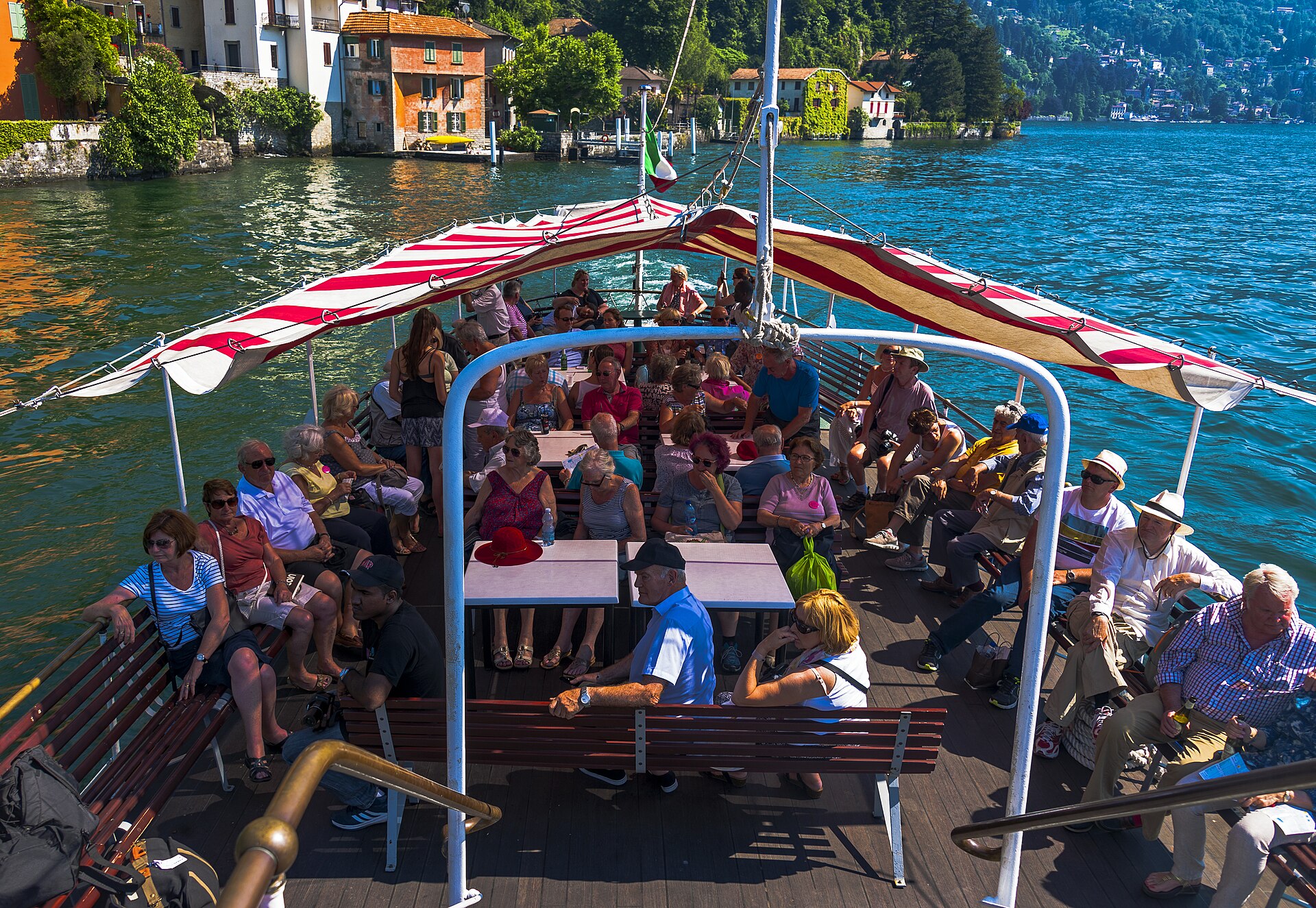
Slow means slow. Como to Bellagio on a battello is about two hours. If your plan involves the length of the lake and a fixed return train, the slow boat is a trap. If your plan is the mid-lake triangle, it is perfect, because those crossings are short anyway and the slow boat runs far more often.
Servizio rapido (the hydrofoil)
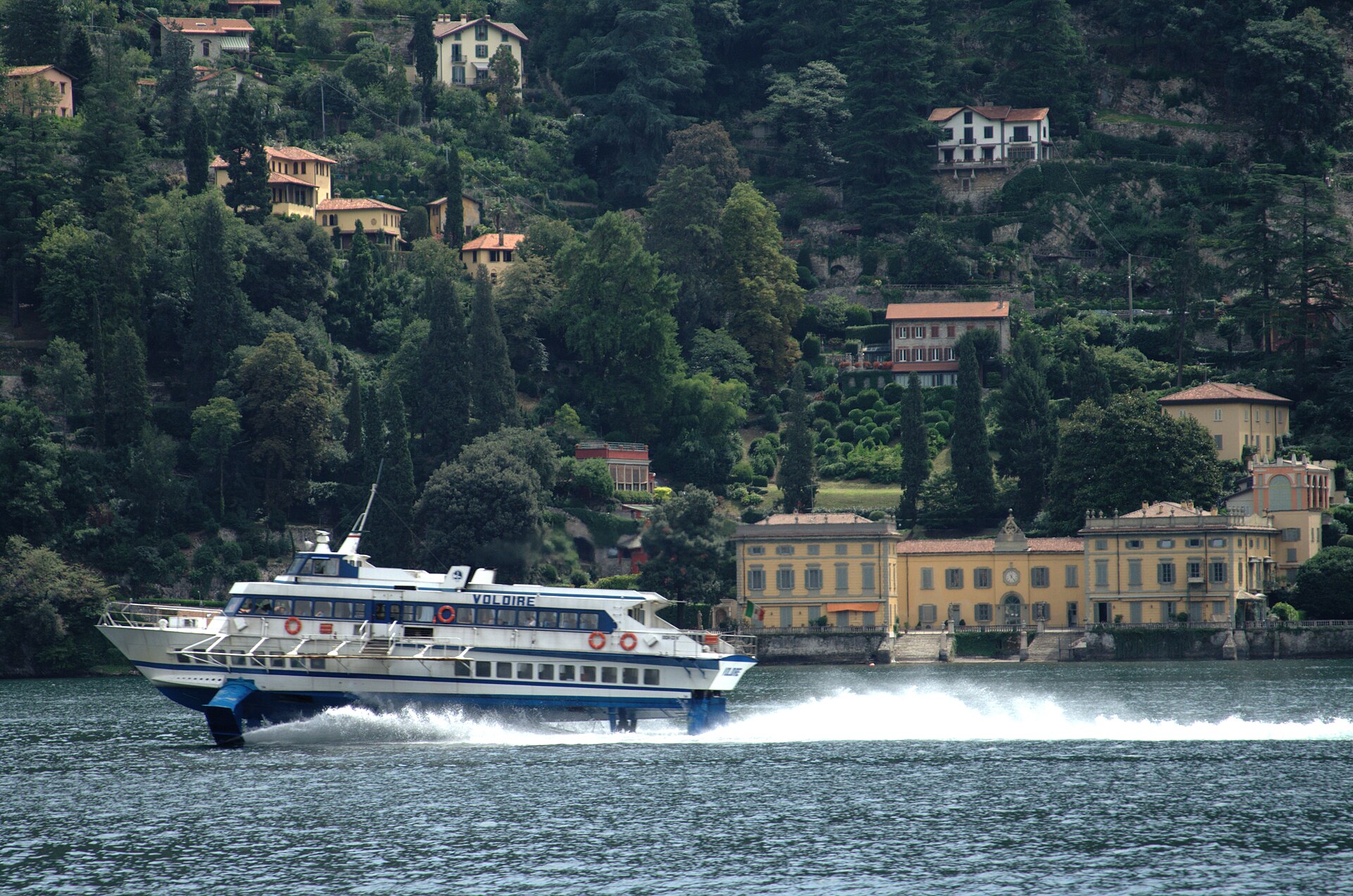
A hydrofoil: enclosed cabin, aircraft-style seats, spray on the windows, no open deck to speak of. It exists to move commuters up and down the long western leg quickly, and it does that well — Como to Bellagio in around 45 minutes rather than two hours.
Two things to know. First, it costs the ordinary fare plus a fast-service supplement of roughly €5, so Como–Bellagio lands around €18 one way. Second, you cannot buy tickets on board, and the crew will not sell you one. Turning up at the pier ninety seconds before departure with no ticket means watching it leave.
My honest view: take the hydrofoil when you need to cover distance and the clock matters. Never take it for the scenery, because there isn’t any — you are in a sealed tube looking through salted glass.
Traghetto (the car ferry)
There is exactly one car ferry route on Lake Como, and it runs the mid-lake triangle: Bellagio–Varenna–Cadenabbia–Menaggio. It takes vehicles, and it takes foot passengers too, usually at the same fare as the slow boat.
This is the single most useful fact in this guide for anyone with a car. The lake is a Y-shape, and driving around the mid-lake from Varenna to Menaggio means a very long detour on narrow lakeside roads. The traghetto crosses in 15–20 minutes. Vehicle fares are on a separate tariff and are charged by vehicle length; you queue in a marked lane at the pier, and in peak season you may not get on the first boat. Come back for the driving question in our Milan to Lake Como transport guide.
The mid-lake triangle: the only bit most visitors need
Lake Como is shaped like an upside-down Y. Como town sits at the bottom of the south-western leg, Lecco at the bottom of the south-eastern one, Colico at the top. Where the three arms meet, the shore towns are close enough together to see each other — and that junction is where Bellagio, Varenna, Menaggio, Cadenabbia and Tremezzo all sit.
Boats shuttle across that junction constantly. Crossings are 15–20 minutes, fares around €5.50, and in high season something is leaving in one direction or another every twenty minutes or so. This is why almost every good Lake Como day is built around the triangle rather than the length of the lake: you get four towns, three villa gardens and as many boat rides as you want, without ever committing to a two-hour sailing.
If you want that day planned out hour by hour, we have done it in our Lake Como in one day itinerary.
The corollary is unkind but true: if you are staying in Como town, the triangle is two hours away by slow boat or around €17 and 45 minutes by hydrofoil, each way. Como is a fine base for other reasons. It is a poor base for ferry-hopping.
Fares, and how they actually work
Navigazione Laghi prices by tratta — the stretch of water you cross — not by a simple flat fare. The full tariff is published as a PDF on the operator’s rates page, revised each spring; the current sheet runs from 1 April 2026. That PDF, not a blog, is the thing to check the week you travel.
The shape of it:
- Ordinary single, mid-lake crossing (Bellagio–Varenna, Bellagio–Menaggio, Varenna–Cadenabbia and so on): around €5.50.
- Fast-service supplement: €3 on a mid-lake hop and €5 from Como to Bellagio, on top of the ordinary fare.
- Como–Bellagio: around €17 on the hydrofoil in about 45 minutes; substantially less, and about two hours, on the slow boat.
- Children 4–11 travel at roughly half the adult fare; under-4s go free. Bring proof of age if it is borderline.
Free-circulation (day) tickets
The pass that most visitors should consider is the biglietto di libera circolazione — a day ticket giving unlimited travel within a defined stretch. Recent pricing has run at roughly €17.50 for a central-lake day covering the Bellagio–Varenna–Menaggio–Cadenabbia triangle, around €27 for a Como–Bellagio version, and around €32 for a whole-lake day. Treat those as indicative and confirm at the window, because they move with the annual tariff.
The arithmetic is straightforward. A central-lake day pass pays for itself on the fourth crossing. If your plan is Varenna → Bellagio → Menaggio → back to Varenna, that is three crossings and you are only a euro behind, but you stop queueing at ticket windows all day — which on an August afternoon at Bellagio is worth more than the money.
If your plan is one crossing there and one back, buy singles and ignore the pass.
Circular tickets
A quieter option worth knowing about, particularly from Como. These are round trips that let you break the journey at intermediate stops, priced by how far up the lake you go. Published examples from the operator: Como–Urio at €10.40 adult and €5.80 for children 4–11; Como–Nesso at €16.70 and €9.30; Lecco–Onno at €11.00 and €5.60. For a lazy afternoon out of Como with a lunch stop in a village nobody has heard of, this is the best-value thing on the lake and almost no visitor buys it.
Buying and using tickets
The pier ticket office is the default and it is fine. Every significant landing stage has a window or a machine, both with English. Buy online through the operator’s site if you like, but there is rarely an advantage: these are not reserved-seat services and there is no cheaper advance fare.
Practical rules that will save you grief:
- Validate before you board. Paper tickets need stamping in the machine at the pier. An unvalidated ticket is treated as no ticket, and inspectors do work these boats.
- You cannot buy hydrofoil tickets on board. Slow-boat tickets can sometimes be bought on board with a surcharge at unstaffed stops, but do not plan around it.
- Arrive ten minutes early in summer. Boarding on the mid-lake triangle is a scrum, and the good seats on the rear deck go instantly.
- Trenord sells combined train-and-boat tickets from Milan, which are convenient rather than dramatically cheaper. Worth a look if you are coming for the day from the city.
- Keep the ticket until you are off the pier. Some landings check on exit.
Reading the timetable without getting stranded
The printed timetable is a grid of columns, and the two words that matter are feriale (Monday to Saturday, working days) and festivo (Sundays and public holidays). A boat that runs at 17:40 feriale may simply not exist on the Sunday you are standing there. This is the single most common way visitors get caught out.
The second is the season. The full summer timetable runs roughly from Easter to late September or early October. Outside that, frequencies drop hard, the hydrofoil service thins to almost nothing, and some smaller piers are skipped entirely. A November Lake Como trip is a lovely thing, but it needs the winter timetable printed out, not an assumption.
The third is service notices. These are not theoretical. Bellagio’s landing was out of action into the spring of 2026 after storm damage, and a load restriction was posted on the car ferries in August 2026. Storms, high water and mechanical faults take piers out of service with little warning, and the operator posts notices on its site. Check them on the morning you travel. It takes thirty seconds and it is the difference between a plan and a hope.
My working rule on the water: know the last boat back before you take the first one out. Write it on your hand if necessary. Missing the last crossing from Bellagio to Varenna means a taxi around the head of the lake, and it is an expensive, hour-long lesson.
Routes worth doing, and one to skip
- Varenna → Bellagio → Menaggio and back. The classic, and it deserves the reputation. Three towns, two shores, about 45 minutes of total sailing, and you can add Villa Carlotta or Villa del Balbianello without straining the day.
- Bellagio → Lenno for Villa del Balbianello. The approach by water is the best way to arrive anywhere on this lake, and Balbianello is designed to be seen from a boat.
- Como → Nesso or Argegno as a circular ticket. The quiet, cheap, local option. Villages, no crowds, a good lunch.
- Como → Colico, the full length. Beautiful, and a very long day. Only do this if the boat itself is the point.
- Skip: a slow boat from Como to Bellagio when you have a train to catch. Two hours out and two hours back leaves you an hour in Bellagio and a knot in your stomach. Take the train to Varenna and cross from there instead.
Which villas are worth the ticket, and how to reach each one by boat, is covered in our Lake Como villas and gardens guide.
The fare maths, worked through properly
People agonise over day passes far more than the sums justify, so here are three real shapes of trip with the arithmetic done.
The day-tripper from Milan
Train to Varenna, cross to Bellagio, cross to Menaggio, cross back to Varenna, train home. That is three crossings at roughly €5.50, so €16.50 in singles against a central-lake day ticket at around €17.50. The pass loses narrowly on money but wins decisively on hassle, because you walk past three ticket queues. Buy the pass.
The couple staying in Varenna for four nights
Say two crossings on Monday, none on Tuesday, four on Wednesday, two on Thursday. Buy singles on the light days and a day ticket on the Wednesday. Nobody sells a sensible multi-day pass for this pattern, and buying a day ticket on a two-crossing day is simply lighting money on fire.
The family of four with a hire car
Here the sums change completely, because the traghetto charges by vehicle and the driver’s own fare tends to be included in the vehicle rate. One car crossing from Varenna to Menaggio replaces roughly an hour and a half of driving round the head of the lake on roads where passing a coach involves folding in your mirrors. Take the boat, every time, and do not bother pricing the alternative.
One caveat on children: the 4–11 half fare applies to singles, and family or promotional tickets appear and disappear with the season. Ask at the window rather than assuming; the staff will tell you if there is a better combination that day, and they usually do so unprompted.
Ferries, walking and the bus: how they fit together
The boats do not cover everything, and one of the more useful things to understand is where they stop being the answer.
Along the western shore, the C110 bus runs the road between Como and Menaggio and on to the Swiss border, and it is often faster and cheaper than the boat for shore-hopping between Lenno, Tremezzo and Menaggio. On the eastern shore, the railway from Milan to Lecco, Varenna and Colico does the same job. Locals mix all three — boat one way, bus back — and there is no reason a visitor should not.
Where the boat is genuinely irreplaceable is crossing the water. There is no bridge on Lake Como, and no road that shortcuts the mid-lake junction. Anything that involves getting from the eastern shore to the western one is a ferry problem, and that is exactly the trip the triangle service exists to solve.
The western shore towns, and how to string them together on foot and by bus, are in our Menaggio, Tremezzo and Lenno guide.
Five mistakes that ruin a ferry day
- Basing the day in Como and expecting the triangle. Four hours of boat time on the slow service. Base at the mid-lake, or accept the hydrofoil fare.
- Assuming Sunday runs like Tuesday. Read the festivo column.
- Buying a day pass for two crossings. It does not pay off until the fourth.
- Turning up for a hydrofoil without a ticket. They will not sell you one on board.
- Not checking notices. Thirty seconds on the operator’s site the morning you travel.
Frequently asked questions
Do I need to book the Lake Como ferry in advance?
No. Scheduled services are not reservable and there is no seat allocation. Buy at the pier window on the day. The only thing worth doing in advance is checking the timetable and the service notices.
How much is the ferry from Varenna to Bellagio?
Around €5.50 one way on the ordinary service, for a crossing of 15 to 20 minutes. Both the slow boat and the car ferry work that route, and the car ferry takes foot passengers.
Is a Lake Como ferry day pass worth it?
If you are making three or more crossings, yes — and the time saved not queueing is worth as much as the fare. For a single out-and-back, no.
Can I take a car on the Lake Como ferry?
Only on the mid-lake traghetto between Bellagio, Varenna, Cadenabbia and Menaggio. There is no car ferry elsewhere on the lake. Vehicle fares depend on length, you queue in the vehicle lane at the pier, and in summer you may wait for the following sailing.
Do the ferries run in winter?
Yes, but on a much reduced timetable, with fewer stops and little or no fast service. Check the winter timetable rather than assuming summer frequencies.
What happens if I miss the last boat?
You take a taxi around the shore, which is slow and expensive, or you find a room. There is no night service. Know your last departure before you leave.
Are the ferries wheelchair accessible?
The larger vessels and the car ferries generally are, and most main piers have level or ramped access, but smaller landing stages and older boats can be awkward. If it matters, ask at the ticket office before buying — staff know their own piers well.
Final thoughts
The boats are the best thing about Lake Como. Not the villas, not the restaurants — the boats. Sitting on the rear deck of a slow battello with a beer as it crosses from Varenna to Bellagio, with mountains going straight into the water on both sides, is the whole reason people come here, and it costs about the price of a coffee in Milan.
Do three things and you will not go wrong: build your day around the mid-lake triangle rather than the length of the lake, check the feriale and festivo columns before you trust a departure, and know your last boat back. Everything else is a detail you can sort out at the ticket window.
For the wider picture, start at our Lake Como travel guide, or the Lake Como day trip from Milan if you are coming for a single day. If you are building a longer trip, the combined Milan and Lake Como itinerary pieces it all together.