The central spine of the Milan fairground is over a kilometre long and it starts at the metro exit. If your pavilion is at the far end, you have a twelve-minute walk before you have looked at a single stand — and you will do it again in reverse at six o’clock, with everyone else. Knowing which gate to use at Fiera Milano Rho is not a detail. It is the difference between a manageable day and an exhausting one.
Fiera Milano Rho is the main exhibition complex for Milan, on the north-western edge of the city in Rho and Pero: eight pavilion buildings holding 20 exhibition halls, 345,000 square metres under cover, opened in 2005 to a design by Massimiliano Fuksas. Get there on the M1 red line to Rho Fieramilano or on a mainline train to the adjacent Rho Fiera railway station — both leave you a short walk from the entrances. There are three public gates: the East Gate, the South Gate, the main entrance to the district, and the West Gate, next to the multi-storey car parks. Check which gate serves your pavilion before you set off. Allow extra time during a major fair, and stay in the city rather than out here unless you are exhibiting.
This guide covers getting there, the layout, which gate to use, food and practicalities inside, parking, hotels, and the differences between Rho and the smaller in-city fair site that people confuse it with.
What Fiera Milano Rho is
It is the reason Milan is a trade fair city rather than merely a business one. The site opened in 2005 between the towns of Rho and Pero, replacing the old fairground in the city that had run out of room. Massimiliano Fuksas designed it, and his contribution is the thing everyone photographs: a rippling glass-and-steel canopy running the length of the site, rising and falling like a wave, sheltering the central walkway.
The numbers give a sense of the scale. Around 405,000 square metres in total, of which roughly 345,000 is indoor exhibition space and 60,000 outdoor. Twenty halls in eight pavilion buildings. Several thousand visitor parking spaces. It is big enough that visitors get lost in it, and the site’s own signage is the thing to follow rather than your phone.
Rho versus Fiera Milano City
A common and expensive confusion. There are two exhibition sites in Milan:
- Fiera Milano Rho — the large one, on the north-western edge of Milan, on the M1. This is where the Salone del Mobile, EICMA and the other big international fairs are held.
- Fiera Milano City at Portello, near CityLife — the smaller original site inside the city, now largely given over to the MiCo convention centre and to smaller shows and conferences.
If your invitation says “Fiera Milano” without qualification, check which. Turning up at Portello for a fair at Rho costs you an hour, and it happens constantly. Our guide to staying near San Siro covers the Portello and CityLife area.
Getting there
By metro
The M1 red line runs to Rho Fieramilano, the terminus of the line’s north-western branch. From the Duomo it is a straight run with no changes; the ATM journey planner gives the time for your travel day. The station exit leaves you a short walk from the entrances.
Two things to know. Not every M1 train goes to Rho — the line splits west of the centre, with the other branch running to Bisceglie, so read the destination on the front of the train and on the platform indicators. And the fare is the plain €2.20 city ticket, because Rho Fieramilano sits in the same Mi1–Mi3 zone as central Milan; a RicaricaMi ticket from a machine or newsstand covers it, as does a contactless tap at the gates. Our Milan metro guide explains how the zones work.
By train
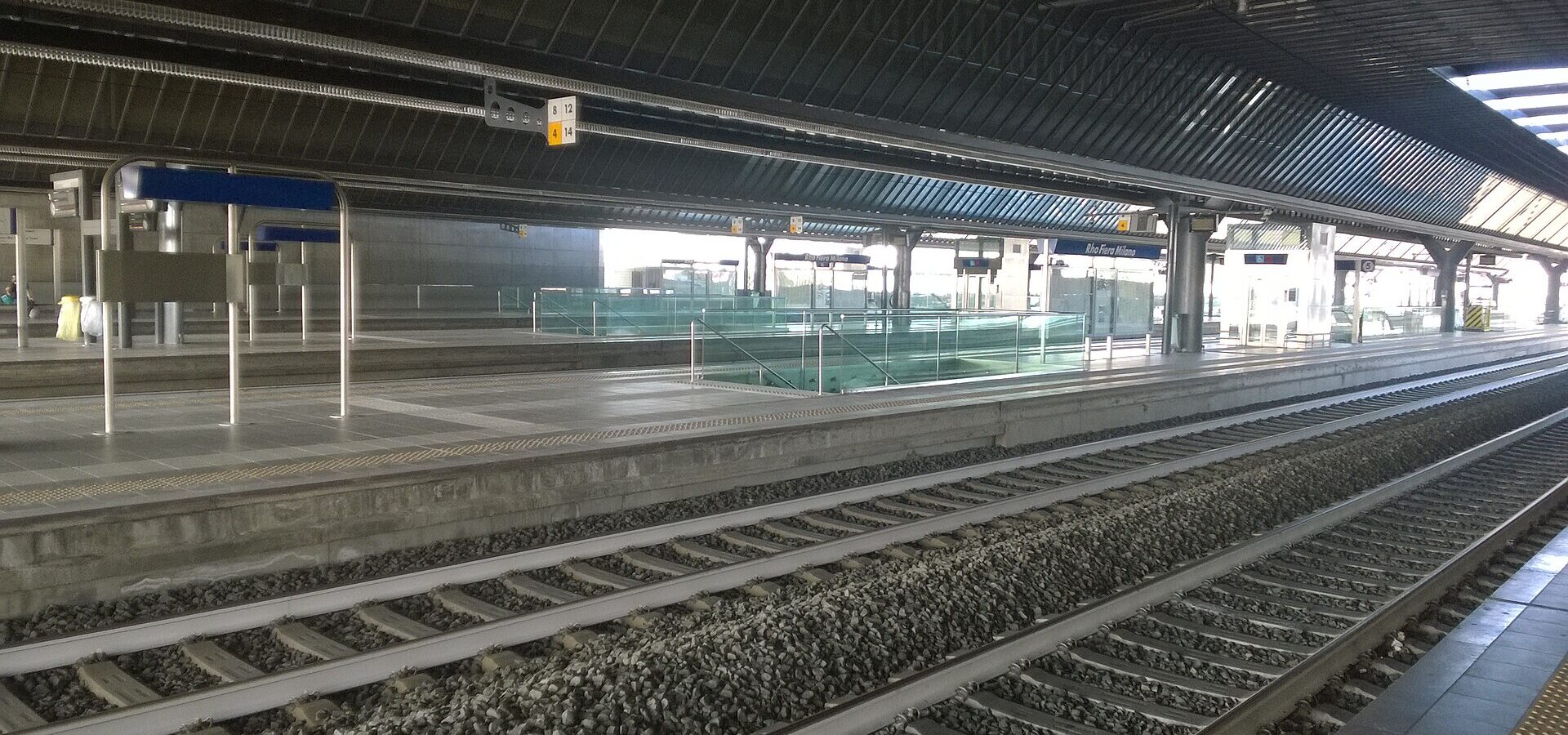
Rho Fiera Milano mainline station sits immediately beside the fairground, on the Milan–Turin line, and is served by regional trains and by some long-distance services. This is the fastest option if you are coming from another Italian city, and the natural route if you are arriving on a high-speed train and going straight to a fair. It is also useful from Malpensa: rather than going into Milano Centrale and back out again, check whether a connection via the regional network works for your timing.
Both the metro station and the railway station deliver you to the same place, at the eastern end of the site. Our train travel guide covers the regional and high-speed networks.
By car
The site is designed for it, unusually for anything in the Milan area. It sits by the A4 and the A8/A9 motorway junctions and has several thousand visitor spaces — outdoor car parks P1 and P5, and multi-storey car parks PM1 and PM2, the latter next to the West Gate. Parking is chargeable and worth booking online for a major fair, when the approach roads back up badly in the morning peak.
The site is outside Area C, so the congestion charge does not apply. Our guide to renting a car in Milan covers the ZTL rules that do apply in the city itself.
From the airports
- Malpensa: the closest of the three and the easiest. The Malpensa Express to Milano Centrale takes 51 minutes at €15, then the M5 and M1 across; alternatively check for a regional connection that avoids the city centre entirely.
- Linate: M4 to San Babila, then M1 westbound all the way to Rho Fieramilano. A long ride on one ticket, roughly an hour in total.
- Bergamo: coach to Milano Centrale, 50–60 minutes, then the metro. Allow well over an hour and a half.
Our airport transfers guide compares all three properly, and the Malpensa Express guide covers the train in detail.
The layout, and which gate to use
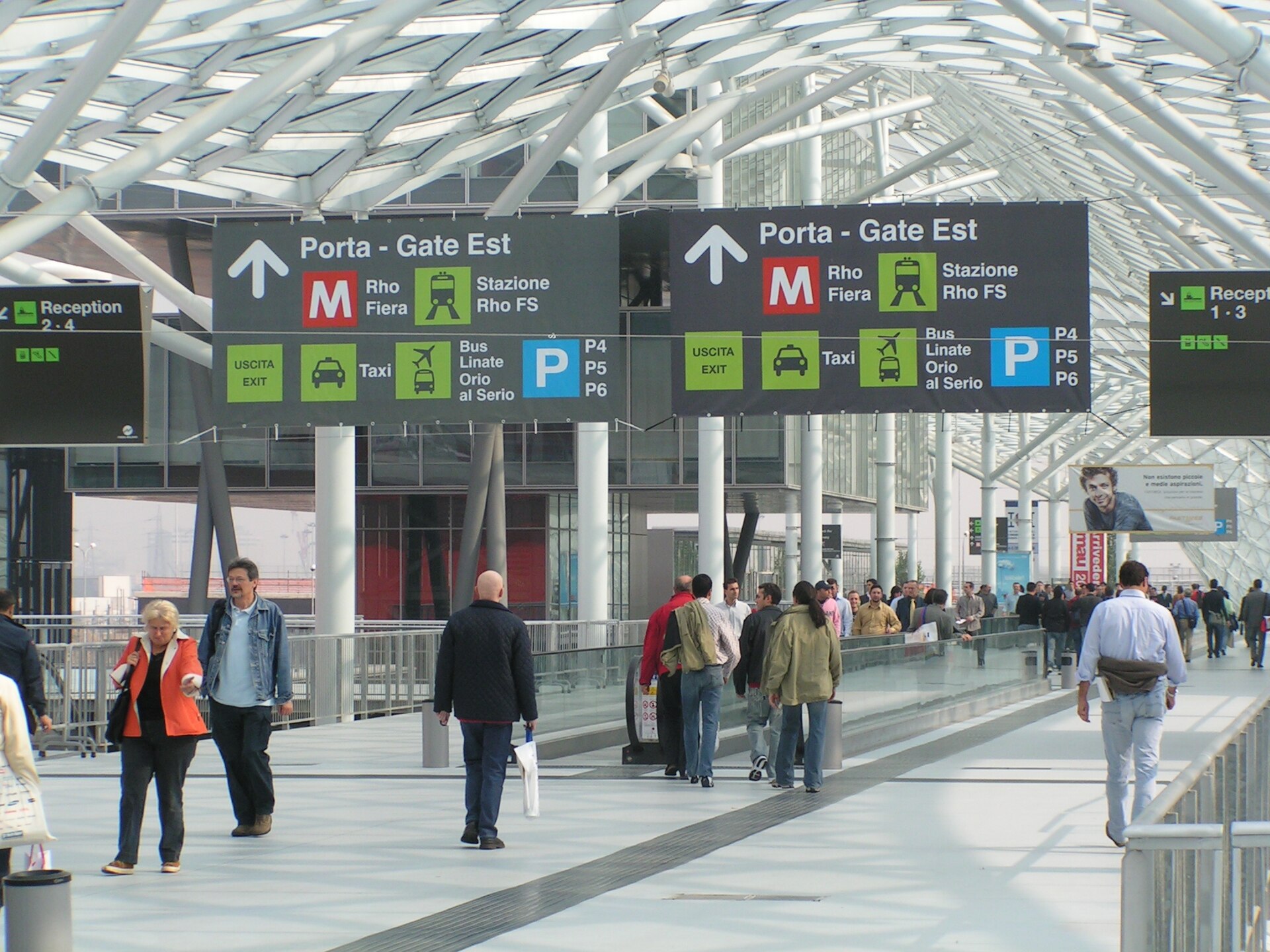
The site is arranged as two long parallel rows of pavilions either side of a central walkway — the Corso Italia — that runs more than a kilometre under the Fuksas canopy. The pavilions are numbered, odd on one side and even on the other, and moving walkways run along the spine to cut the distance.
Three public entrances:
- East Gate — adjacent to the M1 metro station and the railway station. This is where the great majority of visitors arrive, and it is the right gate for the pavilions at the eastern end of the site.
- South Gate — the principal entrance to the district, used for many fairs’ main registration and often the gate named on tickets.
- West Gate — at the far end, beside the multi-storey car parks. The right gate if you are driving, and the right gate if your pavilion is at the western end, which saves you the full length of the walk.
The practical rule: find your pavilion number first, then choose your gate. If your stand is in pavilion 22 and you head for the wrong gate, you have added a long walk to your day in each direction. Every fair publishes a site plan; look at it the night before.
Inside: practicalities
Food and drink
There are cafes, bars and restaurants distributed along the spine and inside the pavilions, and the standard is decent by exhibition-centre norms — this is Italy, and even a fairground coffee is drinkable. Prices are what you would expect from a captive audience.
The thing to plan around is timing. Catering can be busy around lunchtime during a major fair. Eat a little before or after the rush and the wait at the counter is shorter. If you are on a budget, there is nothing stopping you bringing a panino in from the city.
Cloakrooms and left luggage
Cloakrooms operate at the main gates during fairs, and using one is strongly advised. You will be carrying a coat, and by mid-afternoon you will also be carrying several kilos of catalogues that exhibitors have pressed on you. Larger left-luggage arrangements vary by event — if you are coming straight from a train with a suitcase, check the specific fair’s visitor information rather than assuming.
Wi-fi, cash and connectivity
Wi-fi is provided across the site, with the usual exhibition-centre reliability, which is to say it works until everyone tries it at once. Cards are accepted everywhere. Our SIM card and wifi guide covers staying connected in Italy if you are visiting from outside the EU.
Accessibility
Rho is a modern, purpose-built site with accessibility services: Fiera Milano’s Mobility Center rents manual wheelchairs and electric mobility scooters, the Rho Fiera metro station has lifts, and the route from the railway station is accessible. The distances are the main obstacle rather than the design. Our Milan accessibility guide covers the city.
What to wear
Whatever your industry expects, on the most comfortable shoes you own. A full day at Rho means a great deal of walking on hard floors, so layers you can take off and put in a cloakroom are worth more than a smart coat you have to carry.
A realistic day at Rho
The shape of a good day here is fairly consistent regardless of which fair you are attending.
- 08:00–08:30, leave the city. The M1 can be crowded at peak times on the big days; ATM treats roughly 07:00–09:30 as the morning peak on the M1. Leaving earlier costs you nothing and buys you a seat.
- 09:00–09:30, arrive and get through the gate. Registration queues are at their shortest in the first half hour, and badge collection for a large fair can itself take twenty minutes at the peak.
- 09:30–12:00, the pavilions that matter. This is your best window: the halls are quiet, the stands are staffed and unhurried, and you are still fresh enough to look properly.
- 11:45, eat. Early, deliberately, before the crush.
- 12:45–16:00, the second half. Energy drops sharply after about four hours in a hall, so put the pavilions you care least about here, and use the moving walkways rather than being proud about it.
- 16:00–16:30, leave. The exit and the metro both fill up as the fair closes, and leaving ahead of that rush saves you a wait on the platform.
That is a six-and-a-half hour day, which sounds short and is not — you will have walked a half marathon’s worth of hard floor and looked at several hundred stands. Anyone telling you they did nine hours at Rho and enjoyed it is describing the ninth hour generously.
If you are working the fair
Two additional pieces of advice from people who do this professionally. First, book meetings in geographical order rather than in order of importance — two appointments at opposite ends of the site with half an hour between them is not a schedule, it is a sprint. Second, agree a specific stand number as a meeting point rather than a gate or a cafe, because there are several of each and mobile reception inside a steel hall containing 20,000 people is not to be relied upon.
If you are exhibiting
Build-up and breakdown access, contractor passes, freight routing and stand catering all run through the organiser rather than through Fiera Milano directly, and the rules differ from fair to fair. The one constant is that the site is strict about build and breakdown windows, and that the traffic around the goods gates during those windows is far worse than anything a visitor experiences. Allow for it.
The fair calendar
Rho runs major international fairs through most of the year, and each of them fills the city’s hotels. The best known include the Salone del Mobile in April, EICMA for motorcycles in November, HOST for hospitality, MICAM and MIPEL for footwear and leather goods, HOMI for homeware, TUTTOFOOD for food and BIT for tourism. Several run on alternating years and the calendar shifts, so check fieramilano.it for your dates rather than working from a list.
This matters even if you have no interest in trade fairs at all. If a hotel rate in Milan looks inexplicably high for an ordinary Tuesday in October, the explanation is almost always something happening at Rho.
Where to stay
Stay in Milan. The city is thirty minutes away on a single metro line, and it has the restaurants, the bars and everything else you would want after a day in an exhibition hall. The hotels immediately around the fairground in Rho and Pero exist for exhibitors who need to be on stand at seven in the morning, and they price accordingly during fairs while offering nothing in the evenings.
If you do want to be close, the sensible compromise is somewhere on the M1 between the centre and Rho — the western neighbourhoods around Lotto, Amendola or Pagano put you fifteen minutes from the fairground and fifteen minutes from the Duomo. Our where to stay in Milan guide covers the neighbourhoods, and for the extreme case of Design Week our guide to where to stay during Milan Design Week explains what happens to prices.
If you are here to work rather than to look around, our Milan business travel guide covers the practical side — expenses, meetings, timings and getting a working day done in this city.
Frequently asked questions
How do I get to Fiera Milano Rho from central Milan?
Take the M1 red line to Rho Fieramilano, checking that your train is on the Rho branch rather than the Bisceglie one. The mainline station Rho Fiera Milano sits next door and is the faster option from outside the city.
How long does it take from Milano Centrale?
By metro, take the M2 from Centrale and change to the M1 at Cadorna for Rho Fieramilano; the ATM journey planner gives the time for your travel day. There are also direct mainline trains from Centrale to Rho Fiera, which can be quicker if the timing works.
Which entrance should I use?
East Gate if you arrive by metro or train and your pavilion is at the eastern end; West Gate if you are driving or your pavilion is at the western end; South Gate if that is what your ticket or registration specifies. Check the site plan for your pavilion number before you travel.
Is there parking at Fiera Milano Rho?
Yes — several thousand visitor spaces across outdoor car parks P1 and P5 and multi-storey car parks PM1 and PM2, the latter beside the West Gate. Chargeable, and worth booking ahead for a major fair.
Can I visit Fiera Milano Rho without a trade fair ticket?
Not really. The site is an exhibition complex, not a public building, and access is by ticket or accreditation for whatever event is running. There is nothing to see there on a day when nothing is on.
How big is it, really?
Twenty halls in eight pavilion buildings along a walkway of more than a kilometre, with 345,000 square metres of indoor space. A full day can mean a lot of walking, and the first-time visitor is usually surprised by how much.
Is it worth staying near the fairground?
Only if you are exhibiting or have an early start on stand. Visitors are much better off in the city, thirty minutes away, where the food and the evenings are.
Final thoughts
Fiera Milano Rho is a well-designed, well-connected, genuinely enormous exhibition site, and almost every problem people have with it comes down to underestimating the distances. One metro line gets you there in half an hour on an ordinary ticket; a site plan consulted the night before saves you half an hour of walking; and comfortable shoes save you the rest. Sort those three things out, stay in Milan rather than in Rho, and the logistics stop being a subject you have to think about at all.