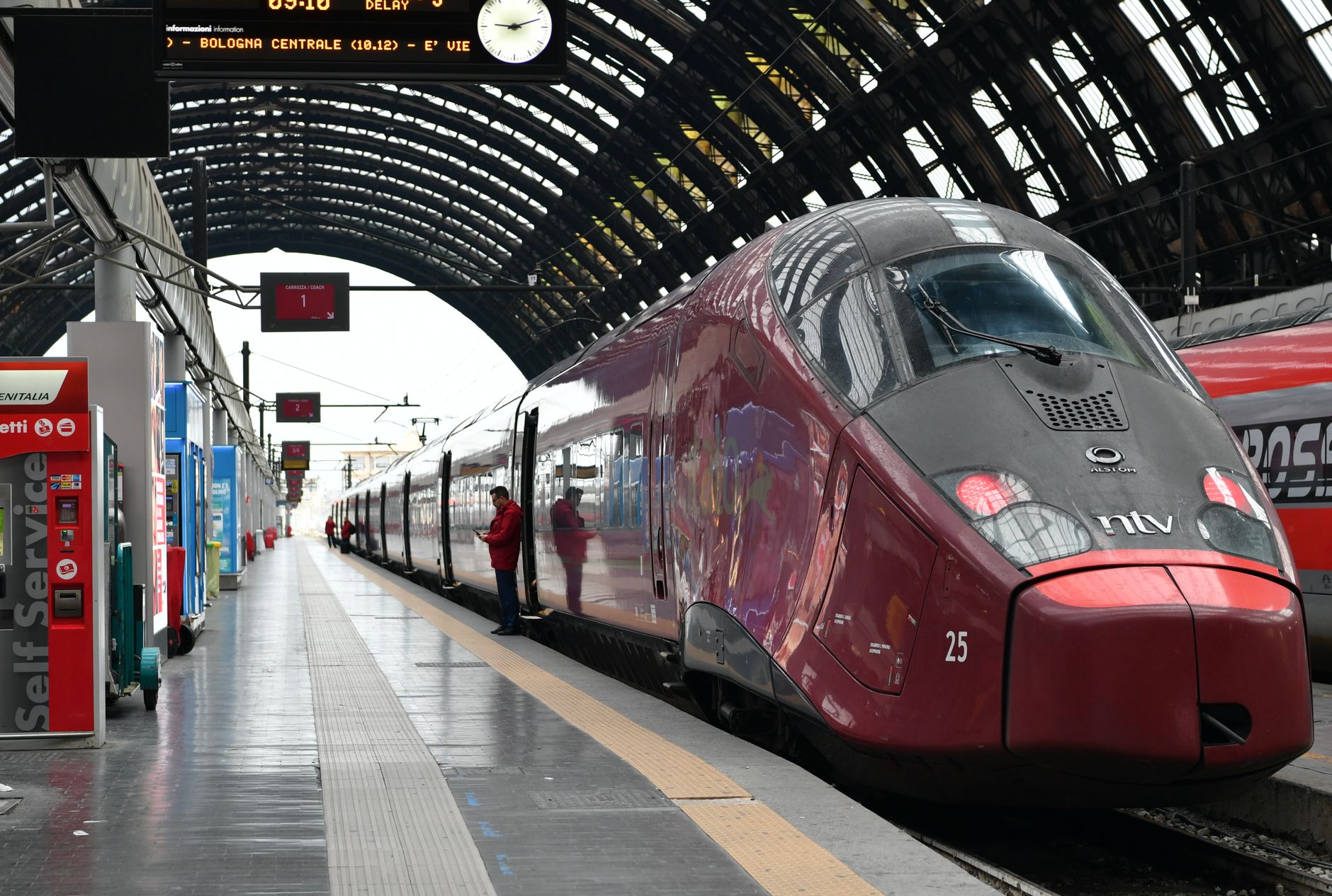
The Malpensa Express is the rare airport train that is genuinely the best option for almost everybody — and yet the single most common mistake at Malpensa is people queuing for the coach because it costs five euros less. Those five euros buy you an extra twenty minutes on a motorway, a seat you cannot get up from, and a drop-off outside Centrale rather than inside it. The train wins. It nearly always wins.
What it is: a dedicated Trenord service running between both Malpensa terminals and central Milan, four departures an hour, from roughly 05:30 in the morning until about 00:20 at night.
An adult single costs €15 and a return €25; children aged 4 to 13 pay €7.50 single and under-3s travel free, and a family ticket covering two adults and two children is around €36. The fare is identical whether you travel to Milano Cadorna or Milano Centrale — but Cadorna is 37 minutes and Centrale is 51, so unless you have an onward mainline train to catch, take Cadorna. Buy before you board: there are no tickets sold on the train and the penalty for boarding without one is not worth testing. Validate a paper ticket at the platform machine; a phone ticket bought in the Trenord app needs no validation. That is the Malpensa Express in full.
Fares: what you actually pay in 2027
- Adult single: around €15, either direction, to either Milan terminus.
- Adult return: around €25 — a saving of €5, valid for up to 30 days, but sold only online or through the Trenord app. You cannot buy the discounted return from a station machine.
- Child 4–13: around €7.50 single, €12.50 return.
- Under 3: free.
- Family ticket: around €36 for two adults and two children — comfortably the best value on the list if it fits your group.
Fares do move, so treat these as the shape of the pricing rather than a promise, and check before you travel. The important structural points do not move: the return is only worth buying if you are certain of the return leg and you buy it digitally, and a family of four should never be buying four singles.
Is it cheaper to book in advance?
Not in the way airline fares are. There is no dynamic pricing on this line and no early-bird discount — a ticket bought three weeks out costs exactly what a ticket bought on the platform costs. What buying ahead does get you is access to the fare types the machines do not sell, namely the discounted return and the family ticket, and the ability to walk past a queue of thirty people at Terminal 1 at 08:15. Both are worth the two minutes it takes to download the app before you fly.
Does the ticket cover the metro at the other end?
No — and this catches people out. Your Malpensa Express ticket takes you as far as Cadorna, Centrale or whichever intermediate station you get off at, and stops there. The onward metro or tram journey is a separate Milan urban ticket at €2.20, valid 90 minutes. Contactless tap-in works at the metro gates, so you do not need to buy anything in advance. Our Milan metro guide covers how the urban fares work and which passes are worth it.
Cadorna or Centrale? The decision most people get wrong
Two Milan termini, one fare, fourteen minutes between them. The default assumption is that Centrale must be better because it is the famous one. For most visitors it is not.
Take Cadorna if…
- You are staying anywhere in the historic centre, Brera, the Duomo area, Sant’Ambrogio or the Castello quarter.
- You want the shortest journey — 37 minutes against 51.
- You dislike dragging luggage through crowds. Cadorna is small, bright, above ground and the platforms feed almost straight onto the metro.
- You are heading to the Navigli or Porta Genova, which are a short M2 ride away.

Take Centrale if…
- You have an onward high-speed train to Rome, Florence, Venice, Turin or Bologna. Then Centrale is not just better, it is essential — see our Milan train travel guide.
- Your hotel is in the Centrale district. Plenty are; the area has the city’s biggest concentration of business hotels and the hotels near Milano Centrale are priced accordingly.
- You are travelling on to Lake Como by train, since the Varenna and Como Nord services run from Centrale and Cadorna respectively — the split is explained in our Milan to Lake Como transport guide.
One caveat on Centrale. It is a magnificent building and a slightly wearing one to arrive in with bags: enormous, busy, and with the Malpensa Express platforms at the far end of the shed from the taxi rank. If you have a choice, and no onward train, Cadorna is the calmer arrival.
Where to buy your ticket, and where not to
There is no ticket sales on board. This matters more than it sounds, because the Malpensa platforms at Terminal 1 are down two escalator flights from arrivals and it is entirely possible to walk onto a train without passing a machine.
- Trenord app — the best option. Buy in seconds, no validation needed, and it is the only place the discounted return and family fares appear.
- Station machines — at both terminals and all Milan termini. English interface, cards accepted. Fine, but they queue at peak.
- Ticket office and newsagents — slower, but staffed, which helps if something has gone wrong.
- Third-party resellers — avoid unless the price is genuinely identical. Several sites sell the same €15 ticket with a booking fee attached and nothing added.
Validation: the rule that trips up visitors
A paper ticket bought from a machine must be validated before you board, in the small green or yellow machine on the platform. It stamps the time and starts the ticket’s validity. An unvalidated paper ticket is treated as no ticket at all, and Trenord inspectors on the airport line check thoroughly and do not care that you are a tourist. A ticket bought in the app is already active and needs nothing.
The route, the stops and the rolling stock
The Malpensa Express serves both Terminal 1 and Terminal 2, so you never need the Skylink shuttle just to reach a train. Terminal 2 is the first stop, Terminal 1 the second — which means passengers boarding at T1 sometimes find the good luggage space already taken.
Services to Centrale call at Milano Bovisa and, further out, Saronno and Busto Arsizio; some also serve Milano Porta Garibaldi. Services to Cadorna take the Ferrovie Nord route through Bovisa and Saronno. The intermediate stops are worth knowing if your accommodation is out that way — Bovisa in particular is a legitimate alternative for anyone staying in Isola or the north of the city, and the fare is the same.
Check the departure board rather than assuming: both destinations use the same platforms at the airport and the trains alternate. Getting on the wrong one is not a disaster, but it is fourteen minutes and a different side of the city.
The trains themselves are modern, air-conditioned, single-class, with proper luggage racks at the vestibule ends and overhead shelves that will take a cabin bag but not a large suitcase. There is no assigned seating, no catering and no first class. On the 07:00–09:00 and 17:00–20:00 runs you may well stand for part of the journey, which with two large cases is the one genuinely unpleasant scenario on this line.
First trains, last trains, and the gap in the middle of the night
The first departure from Terminal 2 is around 05:30, and the last leaves around 00:20. Between roughly 00:30 and 05:00 the line does not run.
That gap is the Malpensa Express’s only real failure, and it catches a specific group: passengers on delayed evening long-haul arrivals. If you land at 23:40 and the bags take forty minutes, you will watch the last train leave. Coaches partially cover the overnight hours; the €114 flat-rate taxi covers all of them.
If your flight lands after midnight, read our guide to arriving in Milan late at night before you book anything.
Going the other way, an early-morning departure needs the same arithmetic backwards. A 06:40 flight from Terminal 1 means being at the airport by about 05:00, which the first train cannot deliver. That is the one scenario in which an airport hotel genuinely pays for itself.
Strikes, delays and what to do when the line stops
Italy has scheduled national transport strikes several times a year, and Trenord is regularly part of them. They are announced in advance rather than sprung on you, which is the saving grace — but they are announced on Italian-language notice pages that most visitors never see, and a strike day can thin the Malpensa Express to a skeleton service or suspend it outright.
Two habits protect you. First, check the Trenord app’s service notices the evening before you travel to the airport; a red banner is unmistakable even if you read no Italian. Second, on any strike day, give yourself the coach or taxi budget as a fallback rather than hoping. Guaranteed minimum services usually cover the early morning and early evening bands, but “usually” is not a word to plan an international flight around.
Ordinary delays are rare on this line and rarely severe — it is a short, dedicated route with little to go wrong. The more common annoyance is a train that terminates short or swaps its Milan terminus at the last minute. If the platform board changes, believe the board rather than your ticket, because the ticket is valid for either destination.
Luggage, children and awkward loads
The rolling stock was built for commuters with a nod towards airport passengers, and the nod is smaller than it should be. Each carriage has luggage racks at the vestibule ends, and they fill from Terminal 2 outwards.
- Two large cases, two people: fine outside peak. In the morning rush, board at the very front or rear of the train — those carriages are consistently emptier.
- Travelling with small children: under-3s are free and there is step-free access at both terminals and both Milan termini. Cadorna is much the easier arrival with a pushchair.
- Skis and bulky sports kit: possible but genuinely awkward on a busy service. If you are heading to the Alps with hardware, price a transfer.
- Bikes: Trenord’s bike rules vary by service and season, so check in the app rather than turning up hopeful.
One small piece of local knowledge worth having: at Terminal 1 the station is two escalator flights below the arrivals hall, and the lifts are signposted but not obvious. If you are carrying anything heavy, find the lift before you commit to the escalator with a case in each hand.
When the coach beats the train
I have been unequivocal so far, so here are the honest exceptions. The airport coach at around €10 is the better choice when:
- Your hotel is a short walk from Piazza Luigi di Savoia, the coach bay on the east flank of Centrale. Then the coach drops you almost at the door.
- You are travelling at an hour the train does not cover. Coaches run later into the night and start earlier.
- You are counting every euro. Over a return trip, €10 is real money on a tight budget — see our budget Milan guide.
- You have three or more large cases. Hold luggage on a coach beats wrestling them onto a rush-hour train.
For four adults arriving together, the €114 fixed-rate taxi is only a few euros more than four train singles, door to door, with no luggage problem at all. The full comparison across all three airports and every mode is in our Milan airport transfers guide, and the terminal detail is in our Malpensa airport guide.
Frequently asked questions
How much is the Malpensa Express?
Around €15 for an adult single and €25 for a return, with children aged 4 to 13 at roughly half price and under-3s free. A family ticket for two adults and two children is about €36. The fare is the same to Cadorna and Centrale.
How long does the Malpensa Express take?
Thirty-seven minutes to Milano Cadorna, fifty-one to Milano Centrale, from either terminal.
Can I buy a ticket on the train?
No. Tickets are not sold on board and travelling without one carries a fine. Buy from the Trenord app, a station machine or the ticket office before you board.
Do I need to validate my ticket?
Only paper tickets. Stamp them in the platform machine before boarding. App tickets are active on purchase and need nothing.
Does the Malpensa Express run at night?
Not between about 00:30 and 05:00. Outside that window it runs four times an hour.
Is there luggage space on board?
Yes — racks at the vestibule ends of each carriage and overhead shelves for cabin bags. Space is finite and Terminal 2 boards first, so at Terminal 1 in a busy hour you may be standing with your case.
Is the Malpensa Express worth it compared to a taxi?
For one or two people, easily — €15 or €30 against a fixed €114, and the train is usually faster than the road at peak. For four adults sharing, the gap narrows to a few euros and the taxi wins on comfort. Above four people, or with a mountain of luggage, book a private transfer instead.
Can I use the Malpensa Express between the two terminals?
You can, and it is quick, but there is no need to buy a ticket for it: the free Skylink shuttle and the free inter-terminal train both connect Terminal 1 and Terminal 2 around the clock.
Which station is best for the Duomo?
Cadorna. It is on the M1, which reaches Duomo in two stops, and the journey from the airport is fourteen minutes shorter than to Centrale.
Final thoughts
Buy the ticket in the app before you clear customs, walk down to the platform, get on the Cadorna train, and you are in the middle of Milan thirty-seven minutes later for fifteen euros. There is no cleverer way to do this, no local secret you are missing, and no reason to stand in the coach queue unless one of the four exceptions above applies to you.
The only planning that genuinely matters is the overnight gap. Know when the last train leaves relative to your landing time, and decide in advance what you will do if you miss it — because the arrivals hall at 00:45 is a poor place to start working it out. Once you are in the city, our Milan travel tips take over.