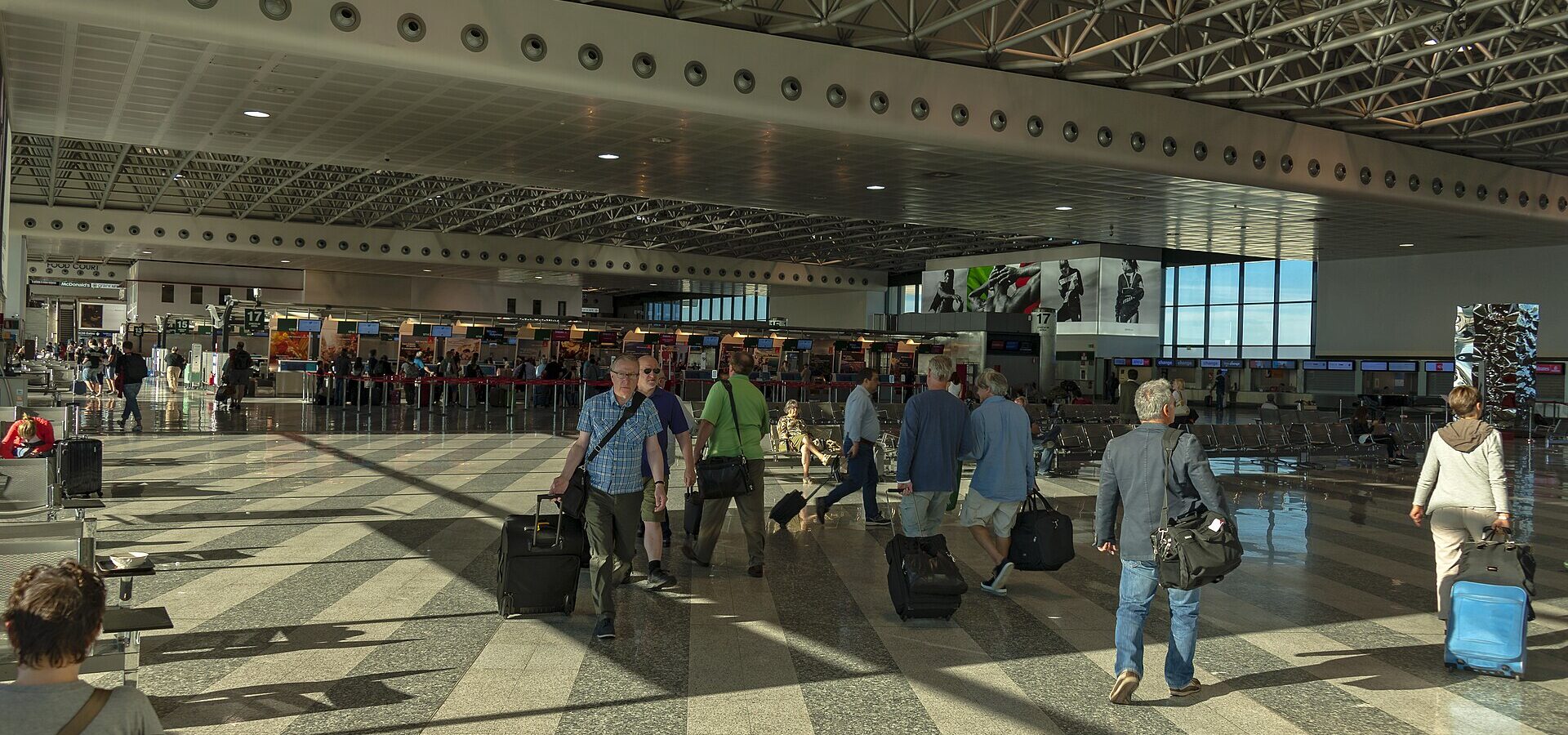
Malpensa is not in Milan. It sits 48 km northwest of the Duomo, in the province of Varese, close enough to Lake Maggiore that on a clear approach you can see the Alps out of the left-hand windows. Nobody tells you this before you book, and it is the single fact that shapes everything about arriving here — the transfer time, the cost, and whether that 06:40 departure is realistically catchable from a hotel in the centre.
It is also, by a distance, the most functional of Milan’s three airports. Roughly 31 million passengers passed through in 2025, up 8.6% on the year before, and the place absorbs them better than its reputation suggests.
Malpensa has two terminals: Terminal 2 is easyJet and nothing else; Terminal 1 is every other airline, split into satellites A, B and C. A free Skylink shuttle links them 24 hours a day in under ten minutes. The fastest way into the city is the Malpensa Express train at around €15, 51 minutes to Milano Centrale or 37 to Cadorna, four departures an hour. Allow two and a half hours before a Schengen flight and three before a long-haul one, and if you are a non-EU passport holder arriving for the first time since April 2026, add half an hour for biometric border registration. That is the whole airport in five sentences, and the rest of this Malpensa airport guide is the detail behind them.
Terminal 1 or Terminal 2? Check before you leave home
This is the one mistake that costs people flights, so deal with it first. Malpensa’s two terminals are 3 km apart and are not a short walk in any sense — they are separate buildings on opposite sides of the runways.
- Terminal 2 is easyJet’s, and effectively easyJet’s alone. It is a low, plain building with a single check-in hall, a compact security area and a food offer that runs out of ideas quickly.
- Terminal 1 is everyone else: ITA Airways, Emirates, Lufthansa, Wizz Air, Neos, the long-haul carriers, the lot. It is arranged as a long central hall feeding three satellites — A for Schengen, B for non-Schengen, C for the heaviest long-haul departures.
The Skylink shuttle runs between the two round the clock, free, every seven to twenty minutes during the day and roughly every half hour between 22:45 and 05:15. The ride is under ten minutes. There is also a free inter-terminal train. Neither is a reason to relax: if you land at T1 with a connection out of T2, budget 45 minutes door to door including the walk at both ends, because the walk at T1 is long.
The airport’s full official name, since 2024, is Milano Malpensa Airport Silvio Berlusconi. Nobody in Milan calls it that. Signs, tickets and departure boards all still say Malpensa, and so does everyone you will ask for directions.
Arriving at Malpensa: the first thirty minutes
Passport control and the EES
Since 10 April 2026, the EU Entry/Exit System has been fully operational at Italian airports. If you hold a non-EU passport, your first crossing since that date means biometric registration — fingerprints and a facial scan — instead of an ink stamp. It takes a few minutes at a kiosk, and at busy times the queue for those kiosks is the queue.
The honest advice: your first post-April-2026 entry into Italy will be slower than you expect. Subsequent ones are genuinely quick, because the system already has you. The EU’s own “Travel to Europe” app lets you pre-register your passport and face within 72 hours of the border, which shaves real time off the kiosk stage. ETIAS — the separate pre-travel authorisation — is expected in the last quarter of 2026 but is not required yet. That timeline has slipped more than once, so check the official EU page rather than trusting any date you read in a blog, including this one.
Baggage and the arrivals hall
Terminal 1 baggage reclaim is on the ground floor and is usually efficient; twenty minutes from gate to belt is typical for a European arrival, longer for wide-bodies landing in the 06:00–09:00 morning bank when everything comes in at once. Trolleys are free.
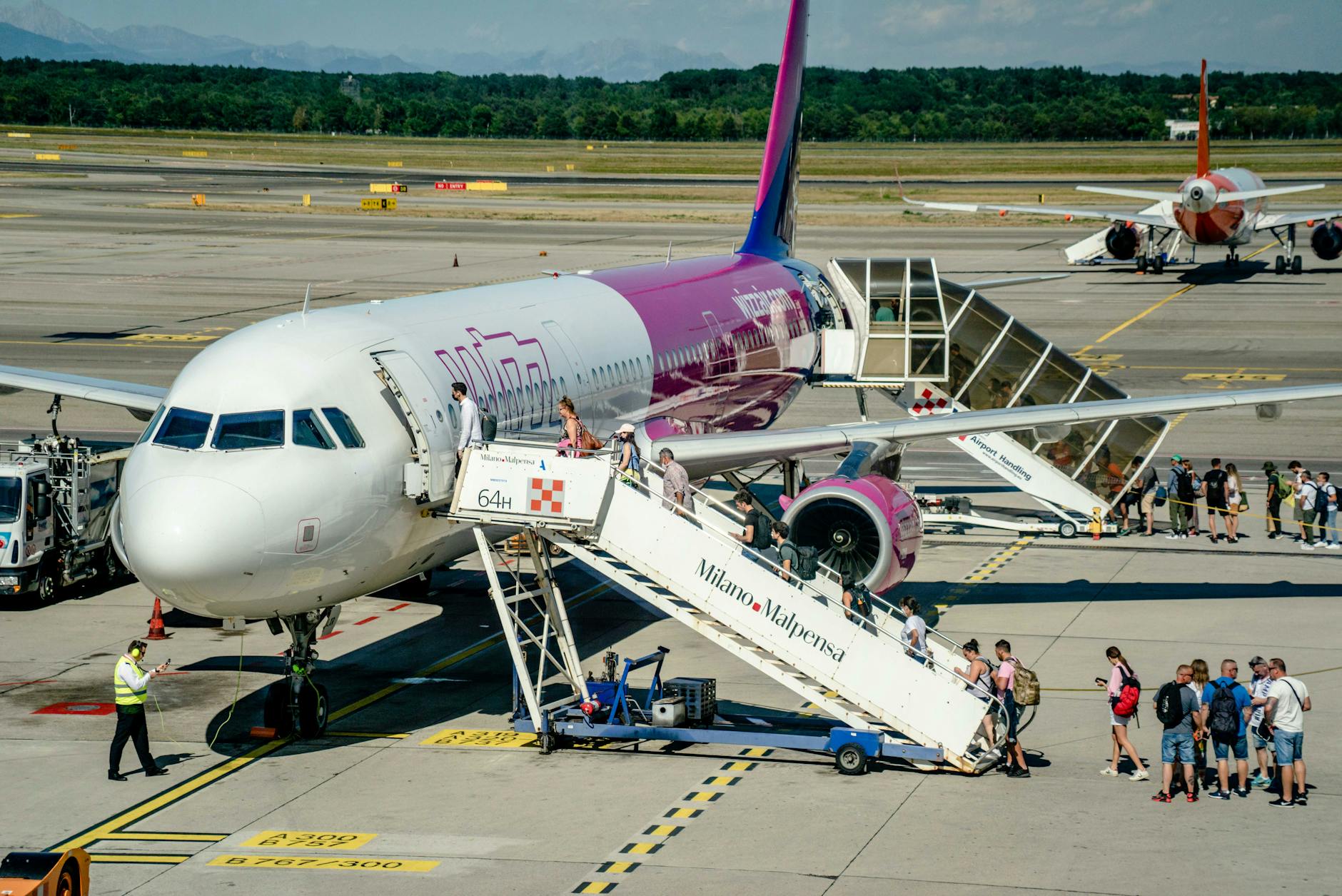
Past customs you emerge into a wide arrivals hall with car hire desks, a Forexchange bureau, cafes and those escalators. The one thing to keep your wits about: people who approach you in the arrivals hall offering a taxi are not taxis. Real Milan taxis are white, queue outside at a marked rank, and charge a fixed €114 flat rate to the city centre. We go into the tactics in detail in our guide to taxis and ride-sharing in Milan, but the rule at Malpensa is simple: if someone speaks to you first, walk on.
Getting from Malpensa into Milan
Four realistic options, and the right answer depends almost entirely on how many of you there are and what time it is.
- Malpensa Express train — around €15, four an hour, 51 minutes to Milano Centrale or 37 minutes to Milano Cadorna. Serves both terminals. First departure from Terminal 2 around 05:30, last around 00:20. No tickets sold on board, so buy before you step on.
- Coach — around €10, 50 to 70 minutes to Centrale depending on the ring road. Slower and cheaper, and it wins if your hotel is near Stazione Centrale or you are travelling at an hour the train does not cover.
- Official taxi — €114 flat rate to the centre, fixed by the city, regardless of traffic. For four people with luggage, split four ways, that stops looking outrageous.
- Pre-booked private transfer — usually a little under the taxi rate, with the advantage of a named driver waiting if you are arriving with children or at 01:00.
My default is the train to Cadorna rather than Centrale, and hardly anyone does this. Cadorna is 14 minutes closer, sits on both the M1 and M2 metro lines, and is a far more pleasant station to drag a suitcase through. Centrale only wins if you are connecting onward by mainline rail, which is covered in our Milan train travel guide. Either way you will want the Milan metro guide for the last leg.
Tickets, timetables and the Cadorna-versus-Centrale question in full are in our Malpensa Express train guide.
For a side-by-side comparison across all three Milan airports — including when Linate or Bergamo works out cheaper — see our Milan airport transfers comparison, and the parent Milan airports guide.
The overnight gap is the one thing worth planning for here — our guide to arriving in Milan late at night covers what runs after the last train and what it costs.
A lot of arrivals here never intend to see Milan at all, and the airport is on the right side of the city for the lakes — every route from Malpensa to Lake Como is compared in its own guide.
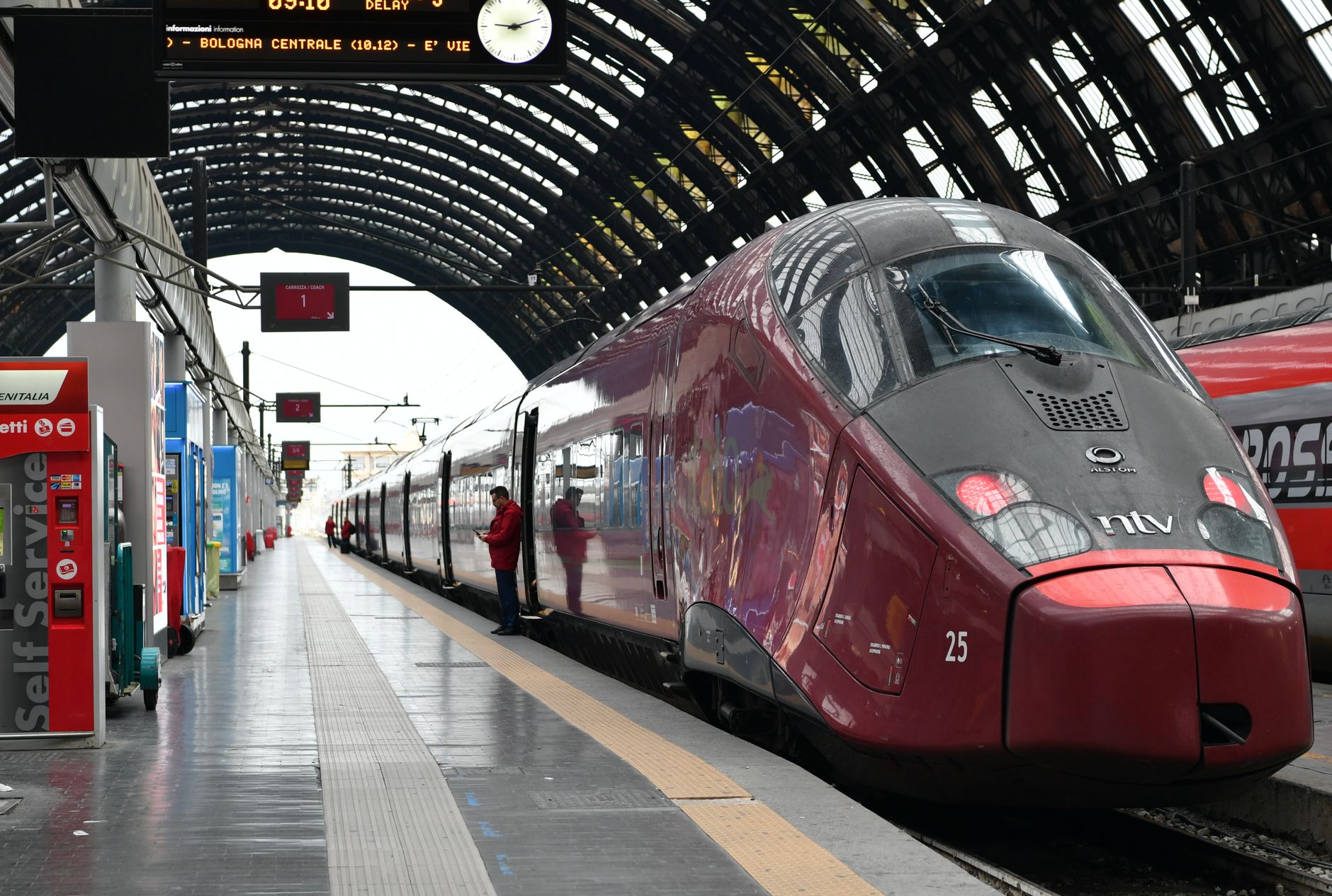
Departing from Malpensa: how early is early enough
Malpensa’s security is better than it used to be and the queues are rarely catastrophic, but the terminal is large and the walk out to the C satellite is genuinely long.
- Schengen, hand luggage only: two hours is comfortable.
- Schengen with a bag to drop: two and a half.
- Long-haul from Terminal 1 satellite C: three hours, and use them. The walk alone can eat fifteen minutes.
- Terminal 2, easyJet: two hours. The building is small; the constraint is the single security channel at peak.
Peak departure banks are roughly 06:00–09:00 and 17:00–20:00. If your flight sits inside one of those windows, take the upper end of every number above. Outside them, Malpensa at 14:00 on a Tuesday is one of the calmest big airports in Europe.
If your flight leaves before about 08:00, sleeping out here stops being an indulgence and starts being sensible — we compare the hotels near Malpensa airport and what their shuttles actually cost.
Tax-free shopping and VAT refunds
If you have been shopping in Milan and are claiming VAT back, do the refund before you check your bags, because customs may want to see the goods. The desks are landside in Terminal 1 and the queue at 07:00 is unforgiving. Our tax-free shopping in Milan guide explains what qualifies and what the paperwork actually needs to say.
Lounges at Malpensa: which ones are worth paying for
Terminal 1’s main option is Sala Montale, in the non-Schengen B gates area, open roughly 06:00 to 22:00. Walk-up access runs about €39, and Priority Pass is accepted subject to capacity — that last clause matters, because at 07:30 on a weekday it is regularly full and the door staff are not negotiating. There is also a premium lounge in the old Casa Alitalia space at around €68.
Is it worth it? Honestly, usually not. At €39 for a couple of hours you are buying a quieter chair, decent coffee and a lukewarm buffet. If you are alone before a long-haul flight, or with children who need somewhere to stop being children in public, yes. For a two-hour Schengen wait, no — the landside cafes in the central hall are perfectly good and about a third of the price. Terminal 2 has nothing worth the detour at all.
Practical services: luggage, SIM cards, food, wifi
Left luggage is available in Terminal 1 on the arrivals level. Quoted prices vary widely between sources and the per-bag tariff changes, so check the rate at the desk before you commit — and if you are storing bags for a full day, the private storage networks in central Milan are usually cheaper than the airport is.
SIM cards. You can buy one at Malpensa, from the Forexchange bureaux and phone shops in Terminal 1 and a Vodafone outlet in Terminal 2. You should not. Airport tariffs are inflated well beyond what the same operators charge in a city-centre store, and an eSIM bought before you fly costs a fraction of either. Our Milan SIM card and wifi guide has the current comparison. Free airport wifi covers both terminals and is fine for maps and messaging.
Food. Landside Terminal 1 is decent — proper espresso, a few sit-down options, a supermarket for assembling a picnic before a budget flight. Airside is more variable, and the satellites thin out badly at the far ends. Eat before you clear security if you have the choice.
Going straight to the lakes. Plenty of people fly into Malpensa with no intention of setting foot in Milan at all, and the airport is well placed for it: wrong side of the city for Milan, right side for the lakes. Routes to Como, Varenna and Bellagio are covered in our Milan to Lake Como transport guide.
Hiring a car at Malpensa — and why most people should not
The car hire desks sit in the Terminal 1 arrivals hall with the pick-up garage a short covered walk away, and Malpensa is the only one of Milan’s airports where hiring a car is straightforwardly sensible. It is on the motorway network, it is outside the city, and the roads north to the lakes and west to Piedmont are easy.
The trap is the city itself. Central Milan is ringed by Area C, a congestion charge of €7.50 a day that applies Monday to Friday from 07:30 to 19:30, plus Area B, a much larger low-emission zone covering almost the whole municipality. Both are camera-enforced, both catch hire cars, and the fines — which arrive at your home address months later with an administration fee bolted on by the rental company — run from roughly €80 to €335. Add parking at €3 an hour or more in the centre, and a car you keep for a four-night city break can quietly cost more than it saves.
So: hire at Malpensa if you are driving away from Milan — the lakes, the Franciacorta vineyards, the Alps, Piedmont. Do not hire a car to sit outside a hotel in Brera. Our guide to renting a car in Milan covers the paperwork, the insurance upsell to refuse, and exactly where the zone boundaries fall.
Connecting through Malpensa
Malpensa is a functional connecting airport but not a slick one. Terminal 1 to Terminal 1 within Schengen is easy and 60 minutes is enough. Anything crossing the Schengen border, or anything involving Terminal 2, needs more — and note that a T1–T2 connection almost always means clearing landside, collecting bags and checking in again from scratch, because separate-ticket itineraries are the norm on the easyJet side. Treat two separate bookings as two separate journeys and leave three hours between them.
Where Malpensa falls short
Three honest complaints. The first is the distance — no amount of good rail service changes the fact that you are an hour from the city, and on a two-night trip that hour each way is a real cost. The second is the Terminal 1 layout, designed when passenger numbers were half what they are now and showing it at the pinch points, particularly the walk out to satellite C and the funnel into passport control on arrival. The third is that Terminal 2 is a joyless building, and easyJet passengers get the worst of Malpensa in every category: fewer services, longer waits, a colder wait.
None of that makes it a bad airport. Linate is nicer and closer; it is also small, curfewed and served by far fewer routes. If your flight goes to Malpensa, it goes to Malpensa, and the transfer problem here is genuinely solved — which is more than can be said for Bergamo.
Frequently asked questions
How far is Malpensa from Milan city centre?
About 48 km northwest. The Malpensa Express covers it in 37 minutes to Cadorna or 51 to Centrale; a taxi takes 45 to 60 minutes depending on the ring road, at a fixed €114.
Can I walk between Terminal 1 and Terminal 2?
No. They are 3 km apart across the airfield. Use the free Skylink shuttle, which runs 24 hours and takes under ten minutes, or the free inter-terminal train.
How early should I get to Malpensa?
Two hours for a Schengen flight with hand luggage, two and a half with a bag to drop, three for long-haul out of Terminal 1 satellite C. Add half an hour if you are flying in the 06:00–09:00 or 17:00–20:00 peak.
Is there a night train or bus from Malpensa?
The Malpensa Express runs until roughly 00:20 and restarts around 05:30. Coaches cover part of the overnight gap but not all of it, and between about 01:00 and 04:00 your realistic options narrow to a taxi or a hotel near the airport.
We cover the after-midnight scenarios in detail in our guide to arriving in Milan late at night.
Should I stay near the airport before an early flight?
If your flight leaves before about 08:00 and you are relying on the first train, yes — the maths gets tight, and a shuttle hotel removes the risk entirely. Otherwise stay in the city; you are paying for a bed either way and Milan is the better place to spend the evening. Our where to stay in Milan guide covers the neighbourhoods.
Specific properties, and which ones actually run free shuttles, are in our guide to hotels near Malpensa airport.
Do I need euros in cash at the airport?
Not really. Cards work everywhere, including on the Malpensa Express and in official taxis. The airport exchange rates are poor; if you want cash, take it from an ATM in the city.
Final thoughts
Malpensa is an airport that rewards a small amount of preparation and punishes none at all. Know which terminal you are in, buy your train ticket before you reach the platform, take Cadorna rather than Centrale unless you have a reason not to, and give yourself an extra half hour if you are crossing the EU border for the first time this year. Do those four things and the hour between the runway and the Duomo is genuinely painless — which, for one of the busiest airports in southern Europe, is not a low bar.
Then start the trip properly. Our Milan travel tips and things to do in Milan guides pick up where the arrivals hall ends.