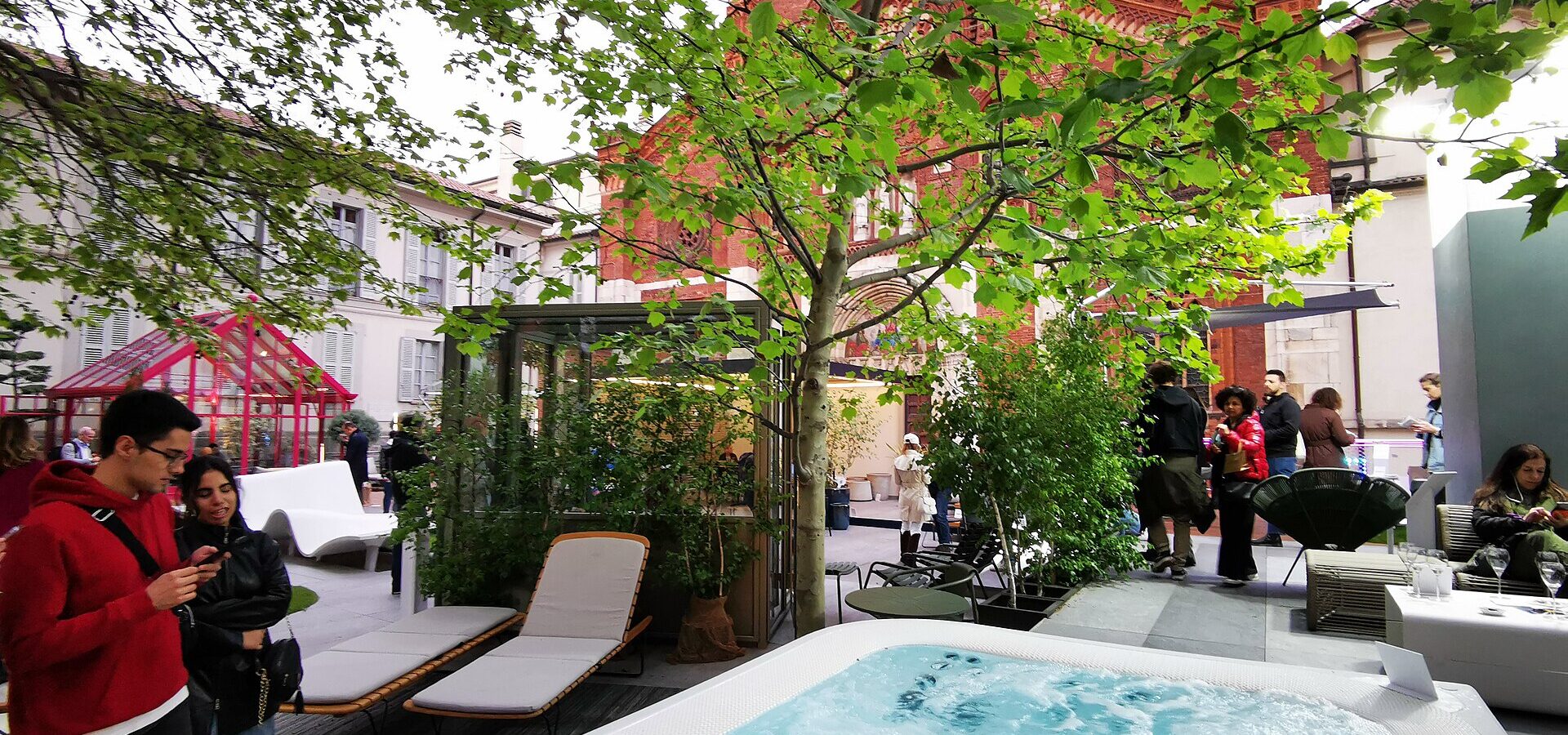
The most important week in the global design calendar is not one event. It is a trade fair on the north-western edge of the city, reached by the M1, and a sprawling, largely free festival in the streets that runs under the Fuorisalone name. Understanding that Milan Design Week is two separate things wearing one name is the whole trick to enjoying it.
Milan Design Week 2027 runs from Monday 12 to Sunday 18 April 2027. It has two halves. The Salone del Mobile is the official trade fair at Fiera Milano Rho — the 65th edition, ticketed, running 13–18 April, open to the general public on Saturday 17 and Sunday 18 April and reserved for trade visitors before that, with suppliers and students admitted from Friday 16 April; check the organiser’s ticket page for current prices. The Fuorisalone is everything else: several thousand exhibitions, installations, showroom openings and parties spread across Brera, Tortona, Isola, 5Vie, Alcova and a dozen other districts, almost all of it free and open to anyone who turns up. If you are not in the furniture business, the Fuorisalone is the reason to come and the Salone is optional. Book accommodation as early as you can — this is one of the heaviest-demand weeks of the year for Milan’s hotels — and plan to walk a very long way.
This guide covers both halves: what each one is, the 2027 dates and how the week is structured, the districts and what each is good at, how to plan a day that does not collapse, where to stay when the whole city is full, and an honest account of which parts are worth your time.
What Milan Design Week actually is
In April, Milan fills up for six days: the Salone del Mobile alone reported 316,342 visitors in 2026, and that is before anyone counts the Fuorisalone. Furniture and lighting brands launch their year’s collections. Car manufacturers, fashion houses, tech companies and food brands build installations that have nothing to do with furniture and everything to do with being in Milan that week. Every showroom in the city opens its doors, most of them with a bar. It is the peak week of the year for the city’s metro and a major one for hotels.
The event has two organisational realities that do not map onto each other.
The Salone del Mobile
The Salone Internazionale del Mobile is the official trade fair, founded in 1961, held at the Fiera Milano exhibition complex in Rho on the north-western edge of the metropolitan area. It is a proper industry fair: thousands of exhibitors in enormous pavilions, mostly selling to buyers, distributors, architects and specifiers rather than to the public. It is ticketed, it has opening hours, it has a floor plan, and it is where the actual business of the furniture industry gets done.
The ticketed half of the week has its own rules about who may attend on which day — our Salone del Mobile guide covers tickets, the pavilions and how to survive a full day at Rho.
The Fuorisalone
The Fuorisalone — literally “outside the Salone” — is everything happening in the city itself. It grew up in the 1980s as brands began mounting their own presentations in Milanese showrooms rather than in fair booths, and it has since dwarfed the thing it grew out of in visitor numbers and in cultural weight. There is no single organiser. Districts self-organise, brands book courtyards and palazzi and disused factories, magazines and institutions curate their own programmes, and the whole thing is coordinated loosely through the Fuorisalone.it platform and a handful of district associations.
The practical consequence: the Fuorisalone is free, unticketed and open to anyone walking past. You do not book. You turn up, join whatever queue exists, and go in.
How the Fuorisalone came to eat the Salone
It is worth understanding the sequence, because it explains the shape of the week. The Salone came first, in 1961, as a straightforward Italian furniture industry fair with a national remit. The Fuorisalone is the programme of showroom, district and installation events that grew up around it in the city.
That was the Fuorisalone in embryo: a handful of showroom openings that were more interesting than the booths at the fair. By the 1990s the disused industrial buildings of Zona Tortona had been colonised, in the 2000s Brera formalised itself as a district, and in the 2010s the model spread to Isola, 5Vie, Ventura and the rest. Somewhere in that period the centre of gravity shifted. The trade fair still sets the dates and still does the business, but the thing people travel to see is now the city.
The consequence for a visitor is a slightly strange one: the free, unorganised half of Milan Design Week is the half with the cultural weight, and the expensive, organised half is the one you can skip.
Milan Design Week 2027: dates and structure
The 65th Salone del Mobile.Milano runs 13–18 April 2027 at Rho Fiera Milano, and the Fuorisalone runs across the city from Monday 12 to Sunday 18 April.
- Tuesday 13 to Friday 16 April: the Salone is trade-focused. The city is at its most intense — this is when the brands present, when the press previews happen and when the parties are.
- Saturday 17 and Sunday 18 April: the Salone opens to the general public. The Fuorisalone is at its most crowded, and the city fills with Milanese families and day-trippers as well as the trade.
- Opening hours at Rho: 09:30–18:30 for trade visitors, the general public and students; press from 08:30.
One important cycle to know: the Salone alternates two of its biggest satellite exhibitions on a two-year rhythm. Euroluce, the international lighting biennial, runs in odd years and therefore returns in 2027. In even years its place is taken by EuroCucina (kitchens) with the International Bathroom Exhibition. If you have a professional interest in lighting, 2027 is the year to come. SaloneSatellite, the showcase for designers under 35, runs every year for the full duration and is open to the public throughout — it is consistently the most interesting room at Rho and I would put it above most of the main pavilions.
Should you go to the Salone at all?
An honest answer, because most guides dodge this.
If you work in the industry: obviously, yes. That is what it is for.
If you are a serious design enthusiast: yes, one day, on a public day, and go straight to Euroluce and SaloneSatellite. The scale is genuinely impressive — twenty-plus pavilions, and walking the whole thing is a physical undertaking — and there is work at Rho you will not see in the city.
If you are a curious visitor who likes nice things: probably not. A furniture trade fair is a furniture trade fair. It is a very large shed full of sofas, brilliantly lit and beautifully staged, and after three hours the sofas begin to blur. You will get more out of one afternoon in a Brera courtyard than a full day at Rho, and it will cost you nothing. The Fuorisalone is the part of Design Week that people remember.
Tickets, the pavilion layout, which days to pick and how to survive a full day in the halls are all covered in our Salone del Mobile guide.
Getting to the Salone at Rho
Fiera Milano sits on the north-western edge of Milan, and it is easy to reach. The M1 red line runs directly to Rho Fiera Milano, which is inside the Mi1–Mi3 zone, so the standard €2.20 single covers it; tap in with a RicaricaMi ticket or a contactless card. There is also a mainline railway station, Rho Fiera, immediately adjacent, served by regional and some long-distance trains, which is the fastest option if you are coming from outside the city or straight from Malpensa.
Two practical warnings. The M1 during Design Week is busy, especially around the fair’s opening and closing — travel outside those times if you can. And the fairground is enormous, with multiple entrances; check which gate serves your pavilions before you set off, because walking the perimeter can add half an hour.
The site itself — entrances, getting between pavilions, food, parking and the hotels around it — is covered in our Fiera Milano Rho guide.
The Fuorisalone districts
This is the heart of the week. Each district has a character, and knowing which is which saves you an enormous amount of walking.
The free half of the week is organised by district, and the districts are not interchangeable — our Fuorisalone districts guide covers what each one does best and how to route a day between them.
Brera Design District
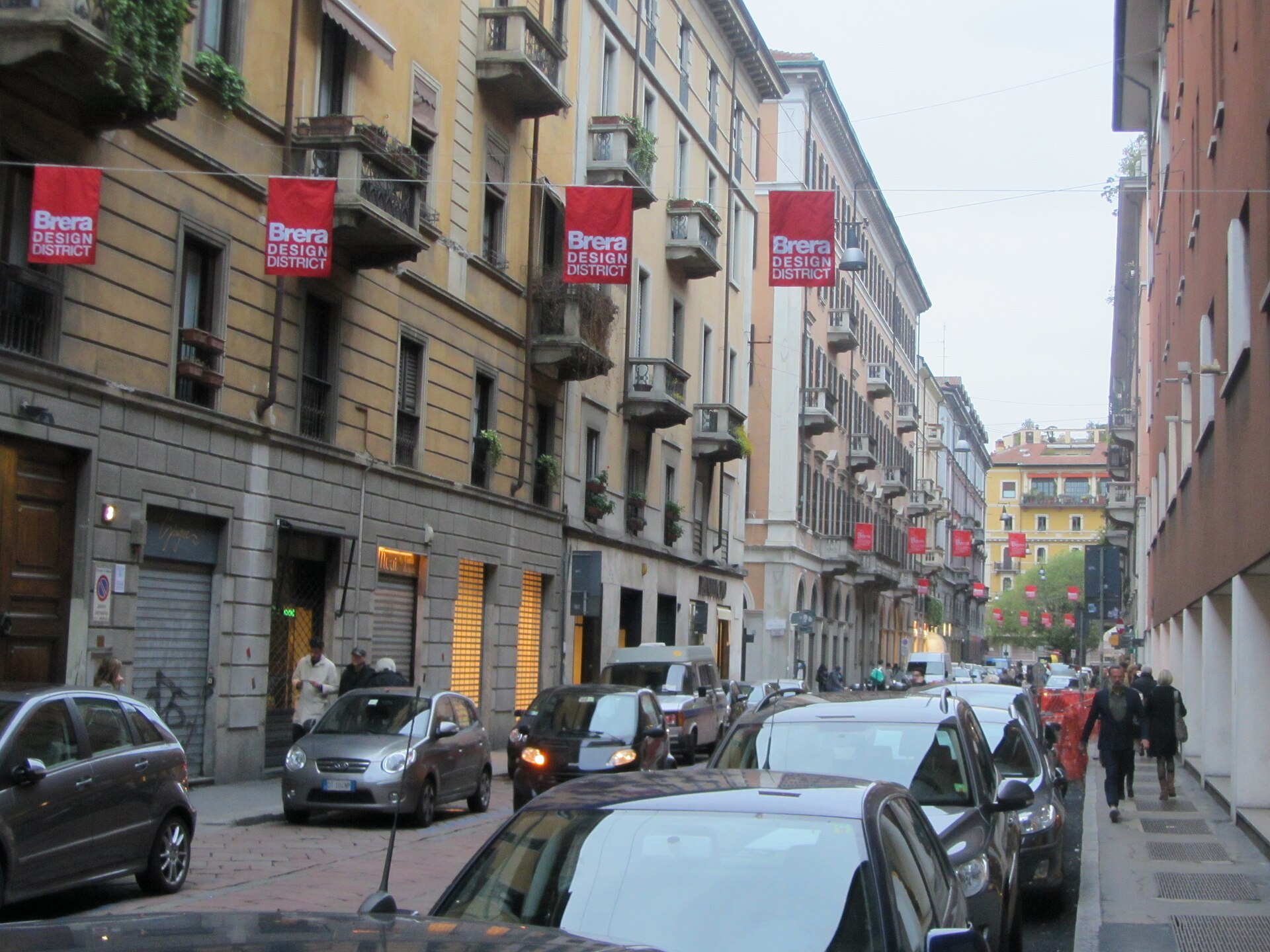
One of the main central districts, with 217 permanent showrooms listed for its 2026 programme. Brera is a network of narrow cobbled streets north of the Duomo, full of galleries, showrooms and palazzi with courtyards, and during Design Week installations turn up in showrooms, historic courtyards, palazzi and exhibition spaces. The big furniture houses have permanent showrooms here, so Brera is where you see the year’s serious collections in the settings they were designed for.
It is also, by a wide margin, the most crowded. The streets fill up as the day goes on and the headline installations draw queues. Go early — before 11:00 is genuinely pleasant — and treat the evening here as a social occasion rather than a viewing one. Our Brera guide covers the district the rest of the year.
Zona Tortona
West of the centre, near Porta Genova, in the converted industrial buildings around Via Tortona and Via Savona. Historically the district that made the Fuorisalone what it is, and still the place for large-scale brand installations — car manufacturers, technology companies, fashion houses building temporary environments in old factories. The work is bigger and more theatrical here than in Brera and considerably less to do with furniture.
Tortona’s reputation has slipped somewhat in recent years as brands have moved to newer districts, and some regulars now find it corporate. I still think it is worth half a day: the scale of what gets built in those warehouses is not replicated anywhere else, and Superstudio and the surrounding venues remain serious draws.
Isola
North of Porta Garibaldi, in the shadow of the Bosco Verticale towers. Isola Design District is the young, independent, self-organised end of the Fuorisalone — independent designers, collectives, sustainability-focused work, and a lot of it in shops, bars and small studios rather than grand palazzi. It is the district where you are most likely to talk to the person who made the thing you are looking at.
Also the most pleasant to walk. Isola is a real neighbourhood with an ordinary life going on around the exhibitions, the bars are good and the crowds are manageable. Our Isola guide covers it in full, and the Bosco Verticale is on the doorstep.
5Vie
A historic part of the city centre, between the Duomo, Sant’Ambrogio and the ruins of the Roman imperial palace. 5Vie is the district for craft, materials, collectible design and one-off pieces, shown in antique shops, artisan workshops and deconsecrated buildings. It is the most curated and the least commercial of the major districts, and if you find the brand installations exhausting this is the antidote.
It is also close enough to the centre to fold into a normal sightseeing day, which none of the others really are.
Alcova
The wildcard, and for many people the best thing in the week. Alcova is a curated exhibition of independent and experimental design that takes over an abandoned or unusual site — over the years a former panettone factory, a disused military hospital, a cluster of decaying villas. The setting is half the point, and the setting changes every year.
Two things follow from that. First, Alcova is often outside the city proper, which means a train or a shuttle and half a day rather than an hour. Second, you must check the location for the current year — there is no permanent address, and every guide that states one confidently is repeating something out of date. It is announced in the weeks before the fair.
The others worth knowing
- Università Statale — the courtyards of the historic university building in the centre host INTERNI’s Design Week installations, free to enter in 2026 and centrally placed. Always worth an hour.
- Durini and the design district — Via Durini and the surrounding streets are Milan’s permanent furniture showroom quarter, so the density of brands here is high all year and higher in April.
- Triennale Milano in Parco Sempione is the city’s design museum and a Design Week hub, with its own exhibition programme. Unlike everything else here it is worth visiting in any month.
- Porta Venezia, Porta Romana and NoLo have all developed their own district programmes in recent years, generally smaller, more local and considerably less crowded.
Each district in detail — what to see, how to route a day between them and which installations reliably queue — is in our Fuorisalone districts guide.
How to plan the week
The single biggest mistake visitors make is trying to cross the city too many times. Milan is not huge, but Tortona, Brera and Isola are far enough apart that every crossing costs time, the metro is busy, and the streets are full. Plan by district, one or at most two a day, and walk within them.
If you have one day
Brera in the morning, from 10:00, before the crowds. Lunch. Università Statale in the early afternoon, which is fifteen minutes’ walk away. 5Vie in the late afternoon. Aperitivo in the Brera or Sant’Ambrogio area. You will have seen the central half of the Fuorisalone and walked perhaps 8 km, and you will not have been on a train.
If you have three days
- Day one: Brera and Università Statale, as above.
- Day two: Tortona in the morning, Isola in the afternoon — they are at opposite ends of the M2 and M5, which makes the transfer straightforward.
- Day three: either the Salone at Rho (if it is a public day) or Alcova plus 5Vie. Not both.
If you are here for the trade
Rho on Tuesday and Wednesday when the halls are workable, the city in the evenings, and the Fuorisalone properly on Thursday and Friday once the meetings are done. Keep Saturday clear or leave — the public days at Rho are far busier and the city is worse.
Practical rules that make a difference
- Start at 09:30, not 11:00. The first two hours of each day are the only uncrowded ones.
- Wear proper shoes. Design Week is a walking event; expect a lot of walking, and much of it is on cobbles.
- Register in advance for anything you actually care about. A growing number of Fuorisalone events use free timed registration, and the ones that do fill up.
- Accept that you will miss things. There are well over a thousand events. Nobody sees a meaningful fraction. Choosing four districts and doing them properly beats a list of thirty locations.
- Use the official Fuorisalone platform for the current year’s programme and district maps rather than a printed guide, since venues change late.
Getting around during Design Week
The metro is the backbone and it is under real strain. Trains can be crowded at peak times, and the stations you will use most are Porta Genova for Tortona, Lanza and Montenapoleone for Brera, and Garibaldi for Isola. Trams and buses get stuck in traffic that is worse than usual because of installation deliveries and road closures.
One answer is bikes and scooters: the city is flat, and cycling can be convenient between venues once you have checked the actual route. Our guide to cycling in Milan covers the schemes and the rules.
Taxis are close to useless in the middle of the day — demand is enormous, the ranks are empty and app waits run long. Our taxis and ride-hailing guide explains what actually works, and during Design Week the honest answer is mostly “walk”.
Where to stay, and what it will cost
This is the part to sort out first, before you book anything else. Milan Design Week is one of the highest-demand weeks of the year for accommodation in the city, and hotel rates commonly run at two to three times their ordinary level, with minimum-stay requirements attached. Rooms that would be €150 in March are €400 in the middle of April.
Three strategies work:
- Book six to nine months ahead. Genuinely. Regulars book their April rooms the previous spring. This is the only approach that gets you a good hotel at a reasonable rate.
- Stay outside the ring. The districts near the M1, M2 and M5 termini, or towards Rho, cost far less and are twenty minutes from the centre.
- Consider the commuter towns. Monza is nine minutes from Milano Centrale by train. Como, Bergamo, Pavia and Novara are all under an hour and all have hotel stock that does not price on the Milanese furniture calendar.
The neighbourhood-by-neighbourhood breakdown, the booking timeline and the commuter options are in our guide to where to stay during Milan Design Week.
Apartments are worth considering for groups — see our guide to apartments in Milan — though they price up in April as aggressively as the hotels do.
Eating, drinking and the parties
Every restaurant in central Milan is fully booked from Tuesday to Saturday. That is not an exaggeration, and it catches out people who assume they can walk into somewhere at 20:30. Book dinner before you arrive, for every night, or accept that you will be eating late and improvising.
The compensations are considerable. Showrooms across the city put on drinks in the late afternoon and evening, and a great many of them are open to anyone who walks in — this is the week when Milan’s normally private design world holds the door open. The aperitivo culture that the city runs on all year operates at full intensity, and our aperitivo guide explains how it works. For proper meals, book, and see our best restaurants in Milan.
The invitation-only parties are real and they are not, for the most part, accessible to visitors. Do not spend the week trying to get into them; you will have a better time in the courtyards and the bars.
Design Week with children, and accessibility
The Fuorisalone is more child-friendly than it sounds — large installations, things to walk through, plenty of colour, and no tickets to buy — but the crowds are heavy and the days are long. Isola and 5Vie work better with children than Brera or Tortona. Triennale in Parco Sempione is the reliable option, with a park attached.
On accessibility: Rho Fiera is a modern, level, fully accessible site. The Fuorisalone is a different matter, since it takes place in historic buildings, courtyards with steps and converted industrial spaces of varying quality, and the crowds themselves are a barrier. Check individual venues, and our Milan accessibility guide covers the wider city.
What else is on in Milan that week
Everything, and much of it is better than usual. The museums and galleries schedule their major openings to coincide, the Triennale and the Fondazione Prada both programme deliberately for the week, and the commercial galleries open new shows. Mid-April is also a genuinely good time to be in Milan on the weather — see our Milan in spring guide — with long light evenings and the parks in leaf.
The corollary is that the ordinary tourist attractions are busier too. If seeing the Last Supper or the Duomo rooftop is on your list, book those slots before you book anything Design Week related, because they will be gone.
What to bring
- Comfortable shoes you have already broken in. This is the whole list, really. Everything else is optional.
- A power bank. You will navigate, photograph and check programmes on your phone all day, and there is nowhere to charge.
- A tote rather than a rucksack. Some venues will not let large bags in, and you will be handed a great deal of printed material whether you want it or not.
- A light waterproof. April in Lombardy is genuinely changeable — warm afternoons and cold, wet evenings in the same day. Our Milan packing list covers the season properly.
- A refillable bottle. Milan’s drinking fountains are everywhere and the water is good.
- Business cards, if you have them. Design Week runs on people introducing themselves in courtyards, and the exchange is still physical more often than not.
Design in Milan the rest of the year
If April does not suit — and for many visitors it should not — almost everything that makes Milan a design city is there in June or November, without the crowds or the surcharge.
- Triennale Milano in Parco Sempione is a permanent design museum with a serious exhibition programme and one of the better museum cafes in the city.
- The Via Durini showroom district is there beyond April, with each showroom keeping its own hours. Walking into Cassina, B&B Italia or Molteni on an ordinary Tuesday, with nobody else in the room, is a considerably better way to look at furniture than doing it in a crowd.
- The permanent collections — the Museo del Novecento, the design holdings at the Castello Sforzesco and the architecture of Porta Nuova and CityLife — tell the same story more slowly.
- The city itself. Milan’s twentieth-century architecture, from the Torre Velasca to the Bosco Verticale, is the reason the design industry settled here. Our attractions guide and museums guide cover the permanent version.
Our best time to visit Milan guide sets out what each month is actually like, including the ones where a hotel room costs a third of the April price.
Is Milan Design Week worth it?
For anyone with a professional or serious amateur interest in design, architecture or making things: unequivocally, yes, and it is one of the genuinely unmissable events in Europe. For a general visitor choosing when to come to Milan: it is the most interesting week of the year and the worst value. You will pay triple for a hotel, you will queue for everything, and you will not get near a restaurant table. If your interest in design is casual, come in May instead and see the city properly.
The middle case — someone who likes design, is coming anyway, and can absorb the cost — should come for the Fuorisalone, skip Rho entirely, pick three districts, and treat the whole thing as a free open-air exhibition that happens to be the best of its kind anywhere. That is what most of the people having the best time out there are doing.
If you are weighing up whether to travel during the fair at all, Milan in April sets Design Week against the rest of the month and is blunt about what it costs.
Frequently asked questions
When is Milan Design Week 2027?
Monday 12 to Sunday 18 April 2027 across the city, with the Fuorisalone starting on the Monday. The Salone del Mobile’s 65th edition runs 13–18 April at Rho Fiera Milano.
Do I need a ticket for Milan Design Week?
Not for most of the Fuorisalone, which is largely free, though some events ask for registration, so check each event’s page. You need a ticket for the Salone del Mobile at Rho, which is a separate ticketed trade fair, and only on the days it is open to you — the general public days in 2027 are Saturday 17 and Sunday 18 April.
How much does a Salone del Mobile ticket cost?
Recent editions have run roughly €38–53 depending on the day and how far ahead you buy, with early-bird online rates cheaper than buying at the gate. The 2027 rates are published by the organiser closer to the event — buy from salonemilano.it rather than a reseller, and check the current price rather than relying on a figure quoted anywhere else, including here.
Can the general public go to the Salone del Mobile?
Yes, on the designated public days — Saturday 17 and Sunday 18 April in 2027. SaloneSatellite, the under-35 designers’ showcase, is open to the public for the whole run.
What is the difference between Salone del Mobile and Fuorisalone?
The Salone is the official ticketed trade fair at Rho, run by a single organiser. The Fuorisalone is the unticketed festival of exhibitions and installations across the city, with no single organiser, that grew up around it. Together they are called Milan Design Week.
How many days do I need?
Three is the sweet spot: enough to do four or five districts properly with a day at Rho if you want one. Two works if you stay central. Anything beyond four days and you will start repeating yourself, however long the programme is.
Is Milan Design Week busier than Fashion Week?
Considerably. Fashion Week is a closed industry event that most of the city barely notices; Design Week takes over entire neighbourhoods and fills every hotel. Our guide to Milan during Fashion Week explains the contrast.
Can I visit Design Week without any interest in furniture?
Yes, and plenty of people do. Much of the Fuorisalone is closer to public art than to product launch — large-scale installations, light works, sound pieces, food and drink projects — and you can walk through a great deal of it treating it as a city-wide exhibition. That is a perfectly legitimate way to do the week.
What should I book first?
Accommodation, six to nine months ahead. Then dinner reservations. Then, if you want it, a Salone ticket. Everything else can be decided when you arrive.
Final thoughts
Milan Design Week is the rare event that is simultaneously an enormous commercial trade fair and a genuinely open, free, city-wide festival, and the reason it works is that the two halves need each other without being the same thing. Take the Fuorisalone as the main event, treat the Salone as an optional professional supplement, book your bed absurdly early, choose three districts rather than ten, and start each day at half past nine. Do that and you will see Milan doing the thing it is better at than any other city on earth — and you will have paid for almost none of it.